HOME/BLOG/YOUR EXPERIENCE IS THE PROMPT: HOW I BUILT THE AI ADVANTAGE PROFILE
AI Building
Your Experience Is the Prompt: How I Built the AI Advantage Profile
The list cleanup, the strategy, the build, and three prompts to create your own version
April 12, 2026|5 min read
There's a specific kind of clarity that comes from deleting 428 subscribers in a single weekend. That decision also finally pushed me to build a new AI quiz lead magnet (I'm calling it a profile) from a different perspective. This is my 3rd quiz, and it's a custom build, on my own site, wired directly into my email system.
Not the anxious kind, where you second-guess every click. The other kind, where the questions are simple, but also lead somewhere.
In March, I wrote a piece called "What Substack Doesn't Tell You About Your Subscribers." It got 3,394 views, 235 likes, and 108 comments. It struck a nerve, which told me something, and it also made me go digging into my own list in a way I'd been putting off for longer than I'd like to admit.
While it wasn't ideal to uncover everything, it's only been uphill since then.
The List Cleanup That Changed Everything
I deleted 428 subscribers in one weekend, my open rate jumped from 31% to 39%, and I realized the front door of my business needed to change before I started driving real traffic to it.
I pulled subscriber data through a tool called Subflow AI and started running signals I couldn't see through Substack's native analytics. People who had been sitting on my list for months, some of them years, who had never opened a single email (at least not since my move to Substack a year and a half ago). Not one click. Not one engagement. Just a subscriber number that looked like growth but wasn't.
When I looked at where they came from? A massive chunk was imported from the WordPress Chick days. People who had followed that version of me and, when the newsletter migrated to Substack, just... stayed. Technically subscribed, technically part of the audience, actually completely gone. The other chunk was from Substack's recommendation engine (you can read more about that in those posts, it's not stellar).
What's the difference between a quiz and a profile?
A quiz assigns you a bucket and moves on. A profile paints a picture of where you actually are and uses it to personalize everything that comes after: the emails, the PDF, the next steps.
This is actually the third version of what started as a quiz. 🙄
"The Business Within" was the original, built when I was just discovering vibe coding. "Find Your AI Path" came next, a 9-path matrix that worked but was built for a different season of the brand. Neither version did what I actually needed, which is not just to identify where someone is, but to personalize everything that happens after.
And your current level in terms of where you actually are with AI right now.
Then it routes that information into a system that personalizes what comes next, from the first email to the PDF link waiting in your inbox. Not just "here's your result" — "here's your result, and everything from this point forward is calibrated to your specific situation."
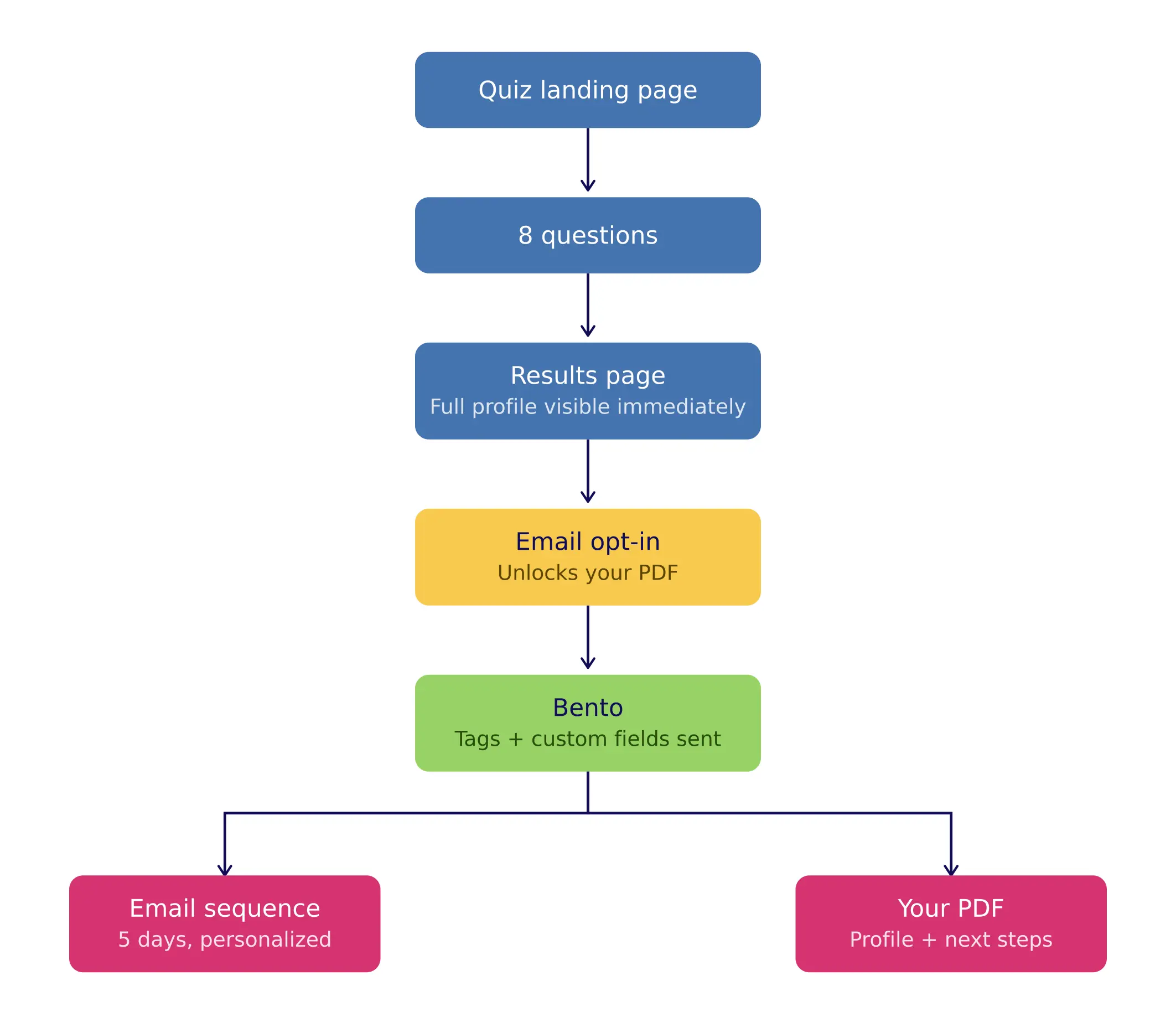
Here's how the wiring actually works.
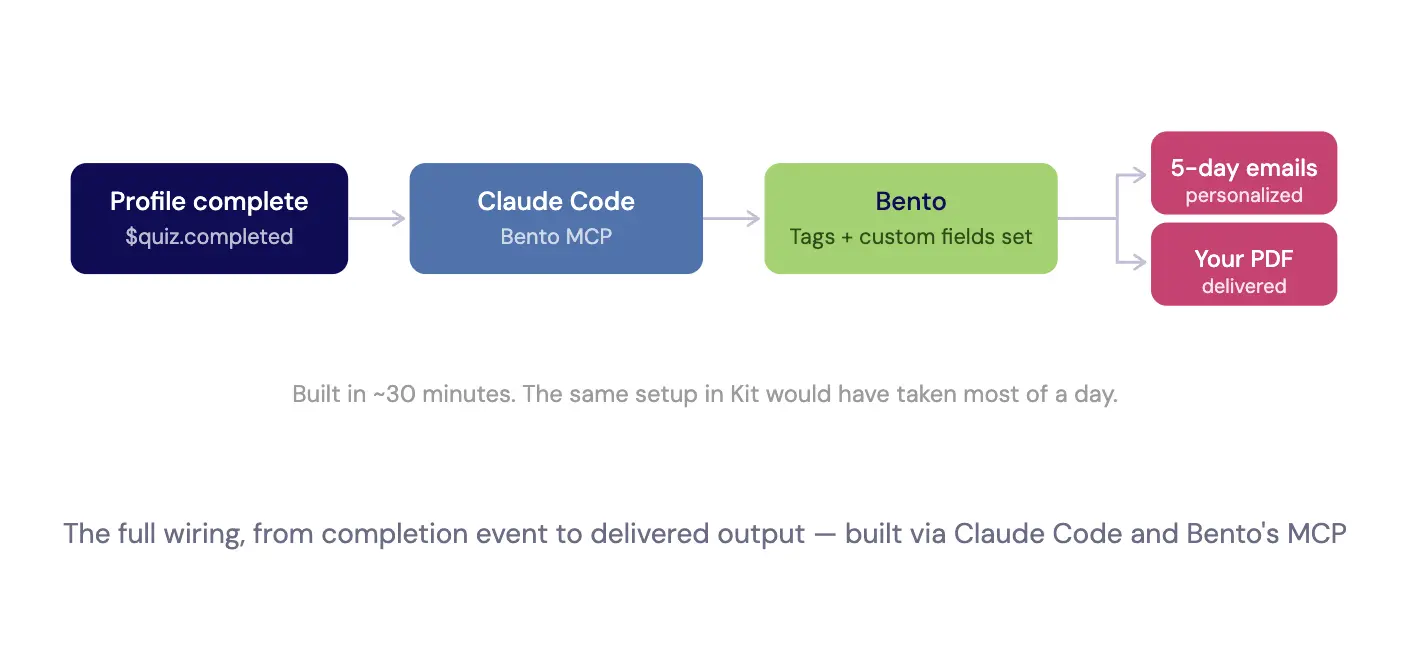
Every person who takes the profile gets a 5-day email sequence and PDF specific to their identity, focus, and level — wired automatically through Bento.
Quick note before we get into the wiring, because I get this question: Bento is an AI-first email marketing platform, and the reason I moved from Kit comes down to two things.
1) It's half the cost at every subscriber tier
2) It has an MCP server, which means Claude Code can talk directly to it via API. I didn't know Kit also has an MCP server when I switched, but I also like how Bento is event-based (vs. a form or tag).
When you opt in, your results are entered (passed automatically via the MCP) into Bento as custom fields: your AI identity, focus area, current level, and biggest obstacle.
Bento then uses those to trigger a 5-day email sequence that is genuinely written for where you are. This goes well beyond swapping in a first name. The email you receive on day one names your specific revenue opportunity based on your combination.
If your focus is Content, you're reading about building AI-powered content systems and what that looks like as an income stream, including concrete ideas like an AI Content Accelerator or offering AI content implementation to clients in your industry once you've got the process working.
If your focus is Operations, you're reading something completely different: about automating client work, building systems that don't require you to be in the room, and making that a productized service. The examples, the revenue opportunities, the specific next steps, all of it is calibrated to your actual situation.
The PDF lives behind the opt-in for one reason: I want to follow up with you.
What you see on the results page is complete and real; everything is right there. The PDF maps out your AI identity, your revenue opportunity, and your specific next steps in a format you can keep and reference. Then the email sequence picks up where the results page leaves off. The goal is that you walk away with a clear picture of where you are, what that means for your business, and what to actually do next.
Every person who takes this profile is a visit to my site, a real signal to Google. Domain authority builds through traffic to pages you actually own, not through a third-party embed. That distinction matters more the longer you're in this.
So I built it myself, and this is the part where I want to show you something rather than just describe it.
Every person who takes the profile gets a 5-day email sequence and PDF specific to their identity, focus, and level — wired automatically through Bento.
How I actually built this AI quiz lead magnet (including the version that looked like cosmic horror 😂)
The short answer: Claude Code, a clear picture of what I wanted, and 18 years of knowing how digital marketing works. No code written from scratch, no developer hired, no plugin purchased.
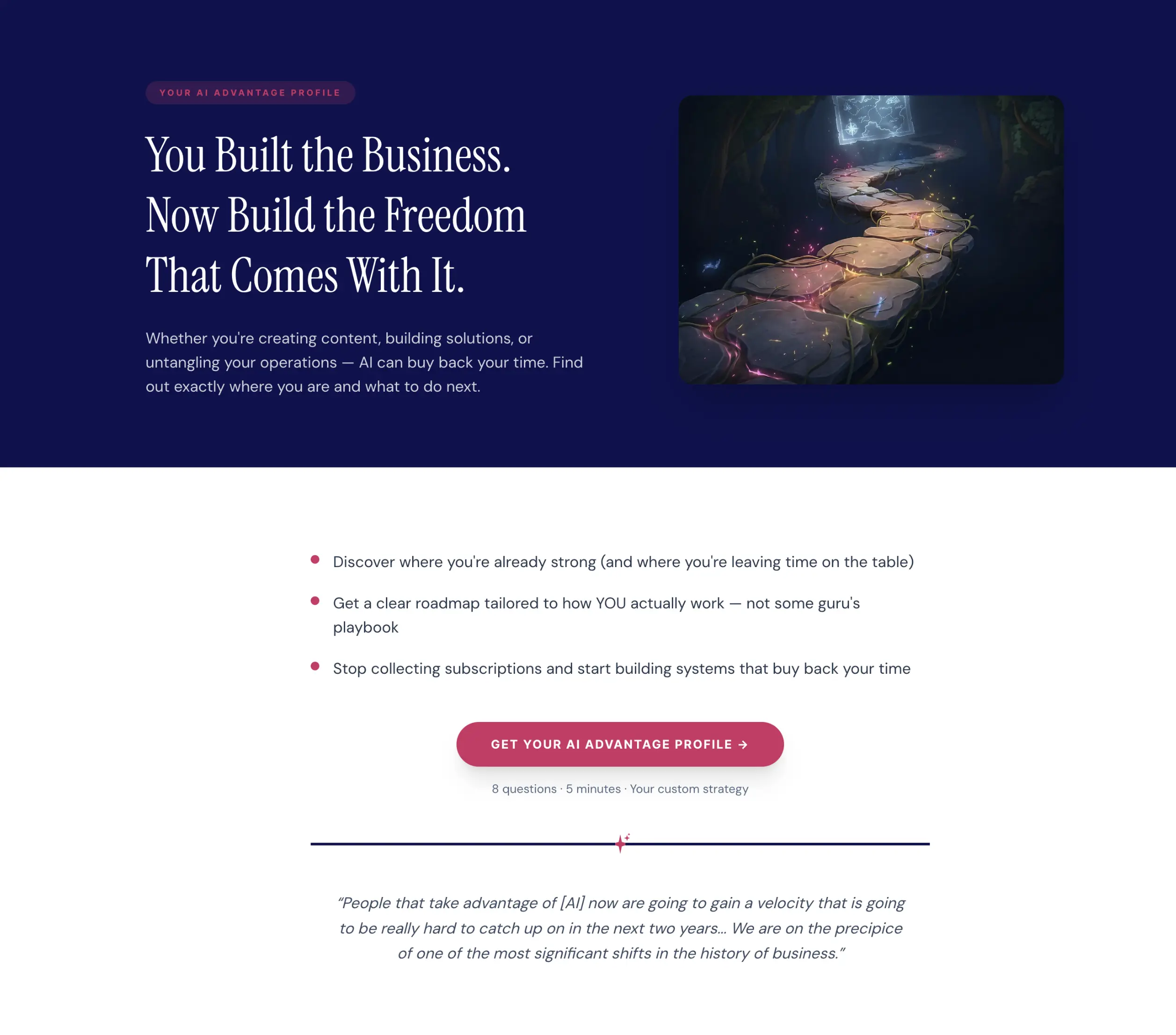
The first design worked. Bento was wired, the personalization logic was solid, and the routing was exactly what I wanted. But when I went back and looked at it after sitting with it for a few days, I just knew it was off. The biggest piece of it was the images — dark, mysterious, the kind of visual energy you'd see on a fantasy RPG site, not on a profile for women entrepreneurs who want to get clear on their AI strategy (btw, the cosmic horror was Claude's words when I said it all felt off, lol).
There's also a practical reason this lives on my website rather than on a third-party tool: I wasn't about to pay for another platform, and I wanted the traffic. Every person who takes the profile is a visitor to my site, which is a meaningful signal to search engines.
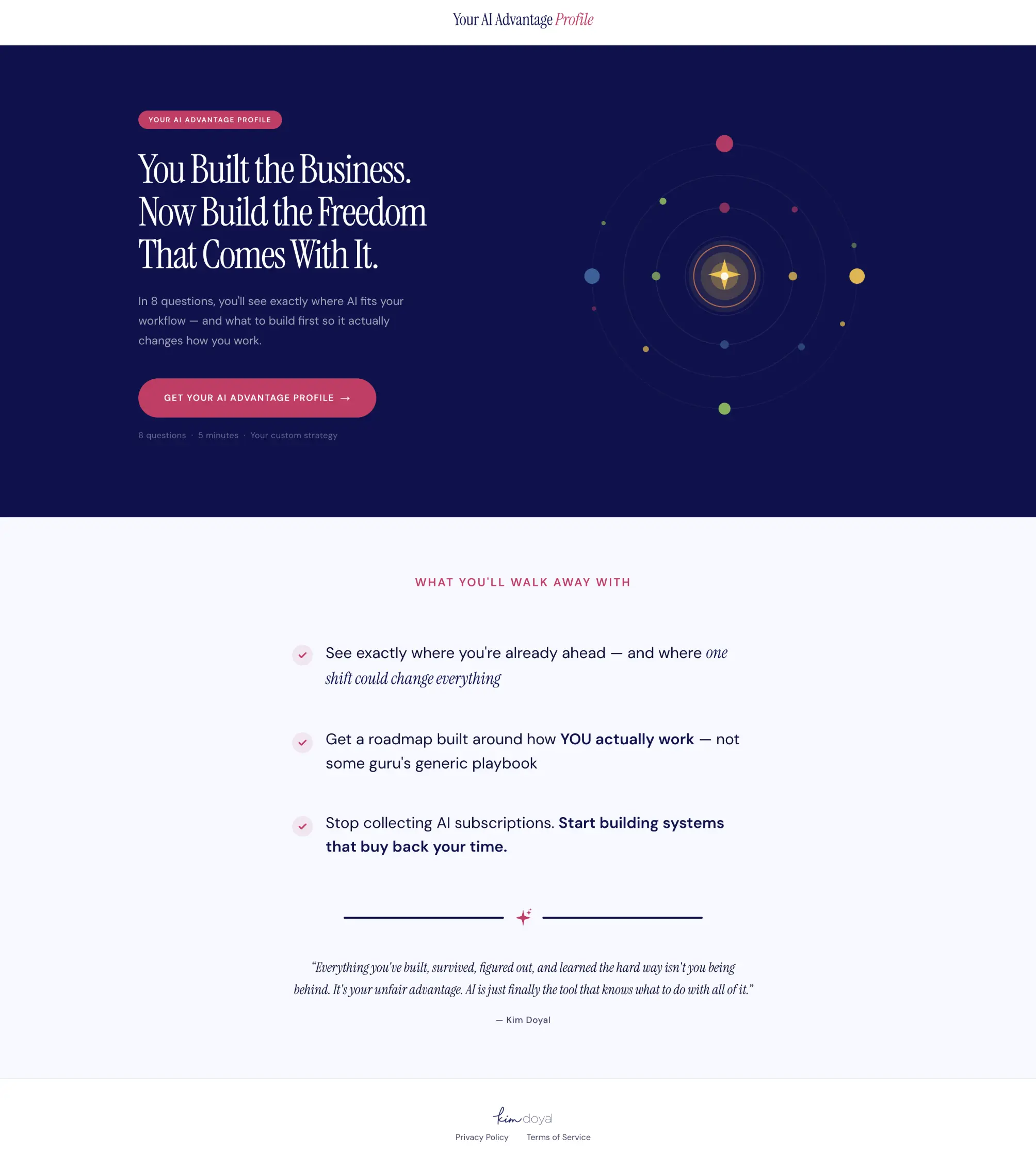
The copy was solid. The image was... a glowing stone path through what can only be described as a fantasy RPG. Functional, but not exactly "here to help you build your business with AI" energy. Back to the drawing board.
So I rebuilt it. Brand colors, warmth, and invitation energy. The landing page and the profile flow now feel like they belong to the same world as everything else on my site (and the little orbs animate around the star).
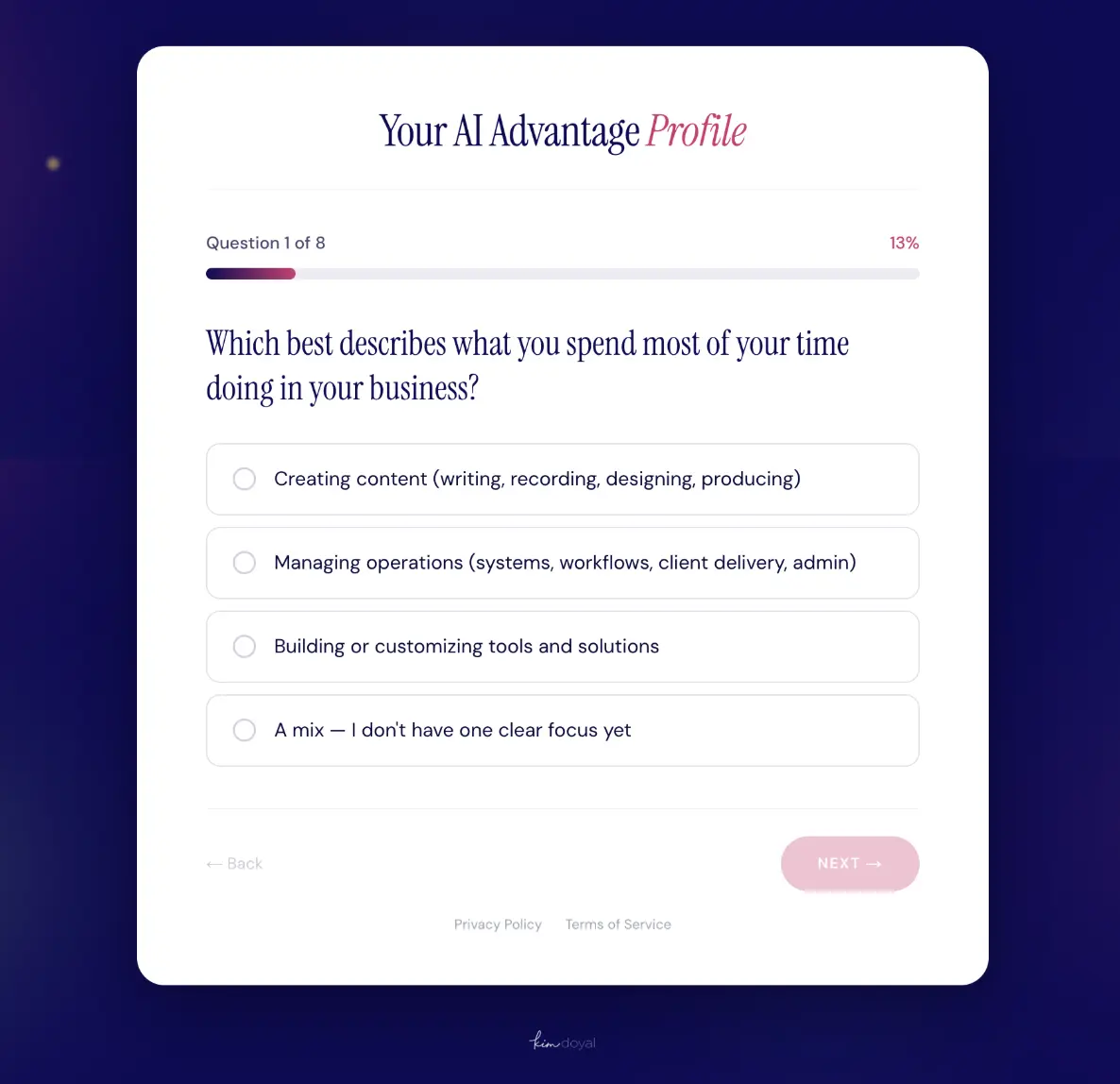
Same headline, completely different energy. Clean geometric visual, brand colors throughout, and a quote that actually says what this is for. This is the version that feels like it belongs.Clean, simple, one question at a time. No overwhelm, no walls of text — just eight questions that build a picture of exactly where you are and where AI can do the most for you.
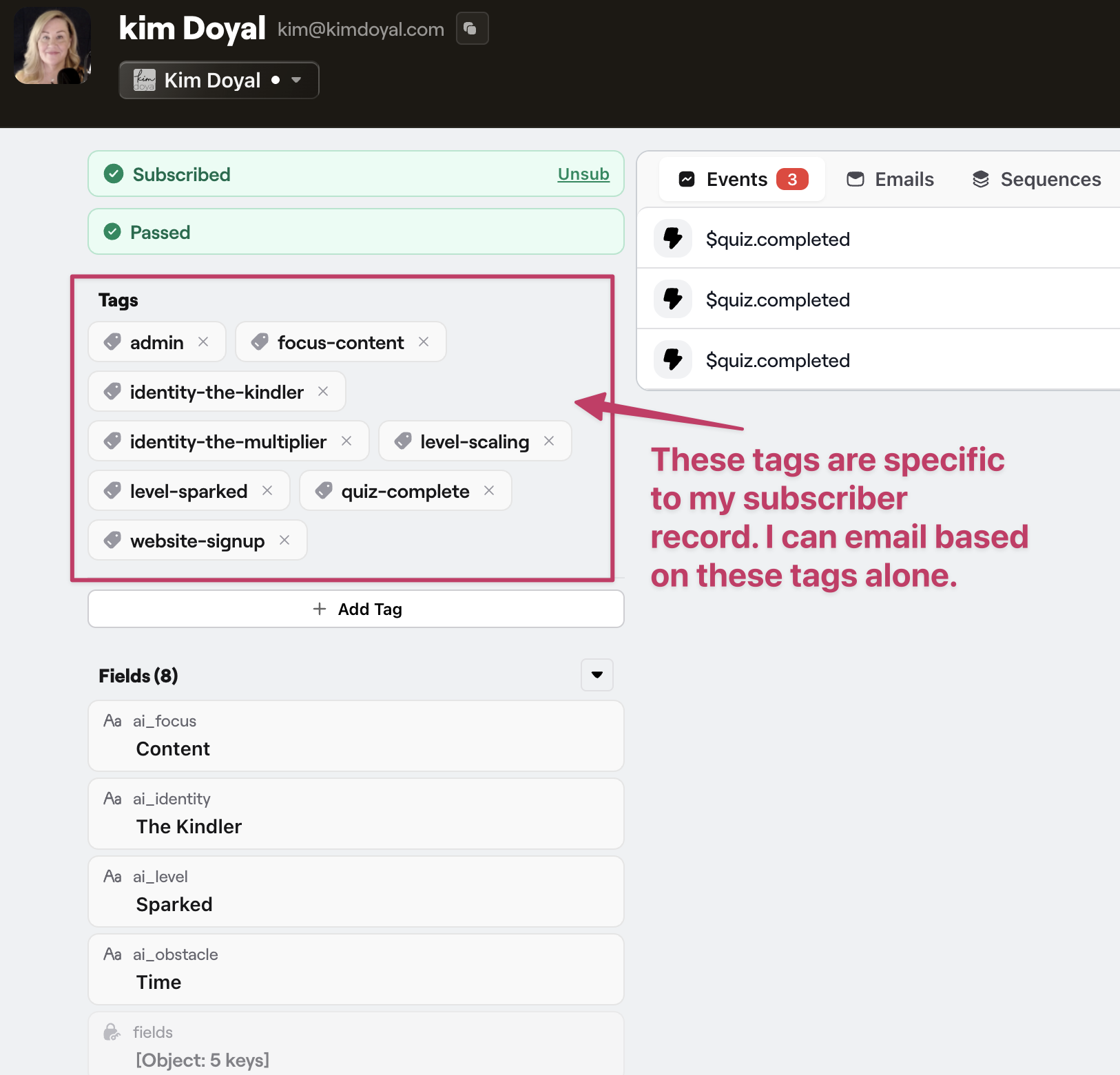
This is what Bento shows me when I look at a subscriber's profile after they take the quiz.
Every tag applied automatically the moment the profile was completed — focus, identity, level, all of it. I can now send targeted emails based on any single tag or combination without touching a thing manually.
The tags were applied automatically: focus-content, identity-the-kindler, level-sparked, quiz-complete. The custom fields: ai_focus = Content, ai_identity = The Kindler, ai_level = Sparked, ai_obstacle = Time.
Now think about what that makes possible.
I can filter my entire list to just the people whose ai_focus is Content and send them something specifically useful for where they are. I can reach only the Sparked-level subscribers who are ready for the next step but haven't taken one. I can speak directly to people whose biggest obstacle is Time, versus the people whose obstacle is Confidence or Clarity. Every segment gets something that actually applies to them, not a broadcast hoping some of it sticks.
That's not just email marketing. That's knowing exactly who you're talking to from minute one, and letting that shape everything you send them going forward.
This was built with Claude Code. Not a plugin, not a third-party tool, not a developer I hired. Claude Code and a very clear picture of what I wanted (I use VSCode & Claude Code and I primarily use the chat).
And no, I didn't write a single line of code from scratch (couldn't even if I wanted to, lol).
The email sequence alone, five emails with personalization logic mapped to every identity, focus, and level combination, took about 30 minutes to build. Here's what that looked like: I wrote the copy. I named the sequence and created the event shell in Bento. Claude Code, connected to Bento via the MCP and my API credentials, built the automation, wired in the emails, set up the triggers, and tested it. I didn't add a single email manually.
That same build done in Kit, with content snippets and custom fields configured by hand, would have taken most of a day. That time difference is real, and it compounds across every build you do (if you have Kit, look into the MCP, because I felt like I'd won the time lottery when Claude Code did all of this with the Bento MCP!).
What I brought to this build was 18 years of experience with digital marketing.
Knowing what information you actually need to personalize an email sequence. Knowing what a good user experience feels like at each step of a funnel. Knowing when something looks wrong, even when you can't immediately articulate why (i.e., cosmic horror 😂). That knowledge isn't something AI replaces. It's what tells the AI what to build.
That's vibe coding. Not a shortcut, not a way to fake expertise you don't have. It's the application of deep domain knowledge through AI tools. And here's what I keep coming back to: it works because of what you already know, not in spite of it.
For example, your 25 years of project management experience mean you already know exactly what a well-structured workflow looks like and what breaks without proper handoffs. Your decade of client work means you know what your clients actually struggle with, not just what they say they struggle with. Your lived experience as the kind of person your audience is trying to become, that's the thing that makes your builds specific in a way generic AI output can't replicate.
You don't need to learn to code. You need to be able to describe what you want clearly enough that the AI can build it, patient enough to learn how to fix things (simply more conversations with AI), and if you've been in business for more than five years, you already have everything you need to do exactly that.
Three Prompts to Figure Out Your Version of This
I'm not going to tell you to go build a quiz this weekend. But I am going to give you the thing that made this whole system possible, because this is the work that has to happen before any tool, quiz, or lead magnet actually works: real clarity about who you're talking to, what they need, and what the right entry point looks like.
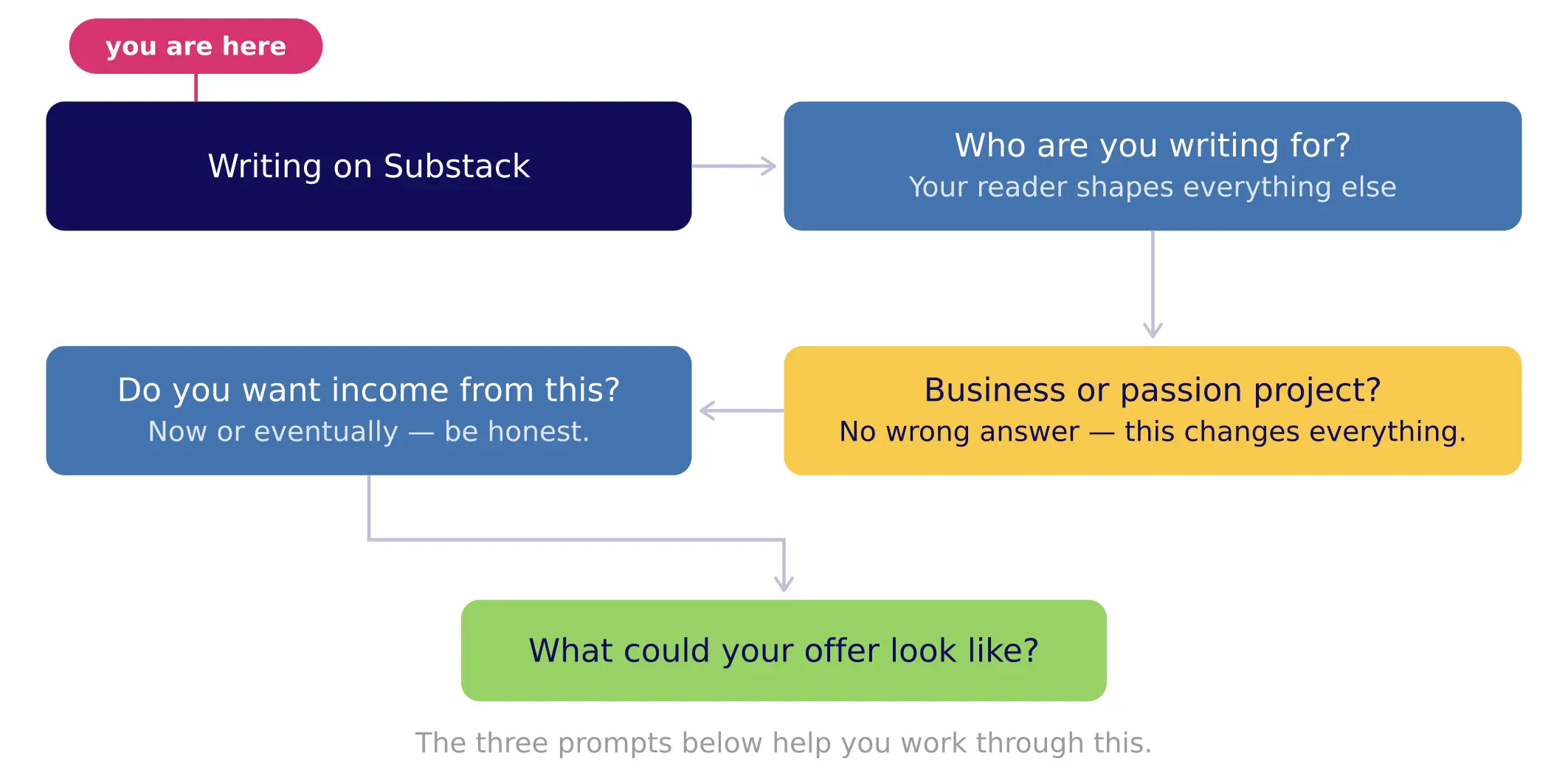
Before the prompts themselves, here's a quick map of where you might be in the bigger picture. The prompts are most useful once you've got some honest answers to these foundational questions.
Before you build anything — a quiz, a lead magnet, an offer — these are the questions that have to have honest answers first. The prompts below help you work through each one.
Wherever you are on that map, the prompts below meet you there. These three work in sequence. Each one builds on the last. Run them in order and don't skip ahead.
Prompt 1: Define your audience (the real version)
The goal is a specific person, not a demographic. Not "women 40-55 who own online businesses." The person who's reading your content right now, what they already know, what they're afraid of, what they want more than anything. This level of specificity is what separates an opt-in that filters for the right people from one that brings in everyone and no one.
I need to get crystal clear on who I'm actually talking to in my business — not a demographic, but a specific psychological portrait of my ideal reader and buyer.

Here's what I know about my business:
[Your niche, what you do, who you serve, how long you've been doing it]

Here's what I currently think I know about my audience:
[Your current understanding — be honest, even if it's vague]

Ask me 5–7 questions that will take me from "I think I know who this is" to "I could write a piece of content that makes this person say you're talking directly to me." After I answer, write me a one-paragraph audience portrait I can use as a reference anytime I'm creating something new.
Prompt 2: Your offers (pick your track)
This prompt comes in two versions.
Use whichever fits where you actually are.
Track A: You already have offers. The work here is honesty — not "here's what I wish my audience was ready to buy," but "here's where they actually are right now, and here's whether what I'm selling meets them there." This is also where you bring in the income, time, and quality-of-life goals, because the business structure should serve the life you want to build, not the other way around.
Based on my audience portrait below, I need to look at what I'm selling and whether it actually maps to where my audience is right now — not where I wish they were.

My audience portrait: [paste from Prompt 1]

Here's what I currently offer:
[List your offers, prices, and formats]

And here's what I want my business to give me:
[Be specific: income target, hours per week, what freedom actually looks like day-to-day for you]

Help me:
1. Identify which offers are most aligned with where my audience is right now
2. Spot any gaps between what they need first and what I'm leading with
3. Name the mismatch honestly if something isn't working

I'd rather know now.
Track B: You're figuring out what to offer. You know who you're writing for, and you have real experience and expertise, but you haven't landed on the right offer. This prompt helps you build from scratch based on your audience portrait and your actual goals.
I need help defining what offers to create for my business. I have expertise and an audience, but I haven't settled on the right product or service structure yet.

My audience portrait: [paste from Prompt 1]

Here's what I know about my expertise and experience:
[What you've done, what you know deeply, what you've helped people with]

Here's what I want my business to give me:
[Income target, hours per week, what freedom looks like for you — be specific]

Based on all of this, help me:
1. Identify 2–3 offer types that would genuinely serve this audience at their current stage
2. Recommend which to lead with and why
3. Suggest a simple pricing structure that matches how this audience makes buying decisions

Don't suggest what sounds impressive. Suggest what I could actually build and deliver without burning out.
Prompt 3: Design your entry point
Now you combine both. Given what you know about your audience and your offers, what's the right thing someone experiences FIRST? What immediately tells them they're in the right place and naturally filters out the people who will actually benefit from what you do?
Given my audience portrait and my offers, I need to design the right entry point — the thing someone experiences first that immediately tells them they're in the right place AND naturally filters for the people who will benefit from what I actually offer.

My audience portrait: [paste from Prompt 1]
My offers and goals: [paste from Prompt 2]

Help me design an entry point — a quiz, a profile, a lead magnet, a short tool, a challenge — that:

1. Speaks directly to my specific audience in their current situation
2. Naturally filters for the right people (not everyone who clicks, the ones who will benefit from what I actually offer)
3. Delivers real value before they've bought anything
4. Connects clearly to my first paid offer

Tell me what format makes the most sense for my specific situation and why. Then sketch the concept in 3–4 sentences.
Run these three in sequence, and you'll have more clarity than most people get from a very expensive mastermind. (I know, because I've been in those masterminds. 🙃)
Quick answers to the questions you might be thinking:
Do I need to know how to code to build something like this?
No. What you need is the ability to describe what you want clearly — who it's for, how it should work, what information it needs to capture, what happens after someone opts in. If you've been running a business for more than five years, you already have everything that takes. The AI does the building. Your experience is the prompt.
Can't I just use a quiz plugin for this?
If you're on WordPress, yes. And you have to pay for it. You could also use a 3rd party tool and it would live on someone else's infrastructure, and it wouldn't do what this does — full custom fields passed into your email platform, personalized sequences triggered automatically, everything on your own domain adding traffic signals to your site. A plugin would solve the "I need a quiz" problem. Building solves the "I need this to work exactly the way I want it to work" problem.
How long does something like this actually take to build?
This one took a few sessions, mainly because I went through two design iterations (see: the cosmic horror phase). The actual technical build — the quiz logic, the Bento integration, the email sequence, the PDF — was faster than I expected. The clarity work, getting specific about identities, levels, focus areas, and what each combination means for the email content, that's where the time goes. Which is also where the value comes from.
What if I'm not ready to build yet — is the profile still useful?
That's exactly what it's designed for. Take the profile, get your result, read the five-day email sequence that comes with it. That's a complete picture of where you are and what to do next, whether you're ready to build something or just trying to figure out where AI fits in your business right now.
There's a bigger post coming on the business model side of all this... specifically, how to build something sustainable and scalable without burning out, hiring a team, or needing outside capital. We're going to get into what that structure actually looks like, what I'm building, and why the entry-point-first approach changes the whole math. That's next. For now, the AI Advantage Profile.
The AI Advantage Profile is the answer I built to my own version of Prompt 3. If you want to see what yours looks like, click here to find your AI Advantage Profile. Takes three to five minutes, max.
You'll see your full profile on the results page immediately, and opting in unlocks a personalized PDF and a five-day email sequence tailored to your specific identity, focus, and level.
And if you want to build your own version of this as an actual AI-powered tool, something that runs these prompts intelligently, builds your entry point strategy, and gives you an output you can take straight into Cursor or Claude Code... that's exactly what I'm building as the sixth tool for SPARK Lab members (launching very, very soon!). For now, start with the prompts above.
Kim Doyal is a digital marketing strategist and AI builder with 18 years of online business experience. She is the founder of AI Spark Studios and SPARK Lab, and the creator of The Hub — a custom 33-agent AI operating system that runs her entire business. She has also built kimdoyal.com, StackRewards, and multiple AI tools and agents using vibe coding, a natural language approach to building software without a traditional development background.