HOME/BLOG/I STOPPED USING OTHER PEOPLE'S SYSTEMS. HERE'S WHAT I BUILT INSTEAD
AI Tools
I Stopped Using Other People's Systems. Here's What I Built Instead
Why I stopped duct-taping apps together and built a personal operations hub that actually matches how my brain works
February 26, 2026|10 min read
I’ve tried more project management tools than I can count.
I started with Basecamp around 2009 (don’t quote me on the year). After that, in no particular order: Trello, Asana, Teamwork, Notion, ClickUp, Airtable, Monday, and a plethora of other tools that were more minimalist... think to-do lists with a few extra features tacked on.
None of them ever stuck.
Teamwork came closest when I ran my outsourcing company and had to manage people (never again). But even that was someone else’s idea of how I should work, shoved into a UI that looked like it was designed by committee (circa 1995, I might add… this was years ago, I have no idea what Teamwork looks like now).
What I always wanted these tools to have, but were missing, was a way to customize them further. In other words, “What do you actually want to see when you open this thing?”
I’ve been showing my operations hub to a few people lately, and the reaction is pretty consistent. They get quiet for a second, lean in, and then say something like “I want that” or “How do you have this?” And it’s not because the tech is fancy. It’s because for the first time in a long time, I have one place for my business and my life, and it’s built the way my brain actually works.
Not the way a product designer in San Francisco thinks I should work (no offense to San Francisco - I’m a 5th-generation San Franciscan). And certainly not the way a YouTube productivity influencer says I should organize my day. The way my brain works. Mine (somehow I feel like a petulant child when I say ‘Mine’ 😂).
And apparently, that’s the thing that blows people away.
The Persistent Problem
Here’s the thing... we all have systems. Even not having a system is a system (wing-and-prayer approach, but if that’s how you roll, it’s a system in and of itself).
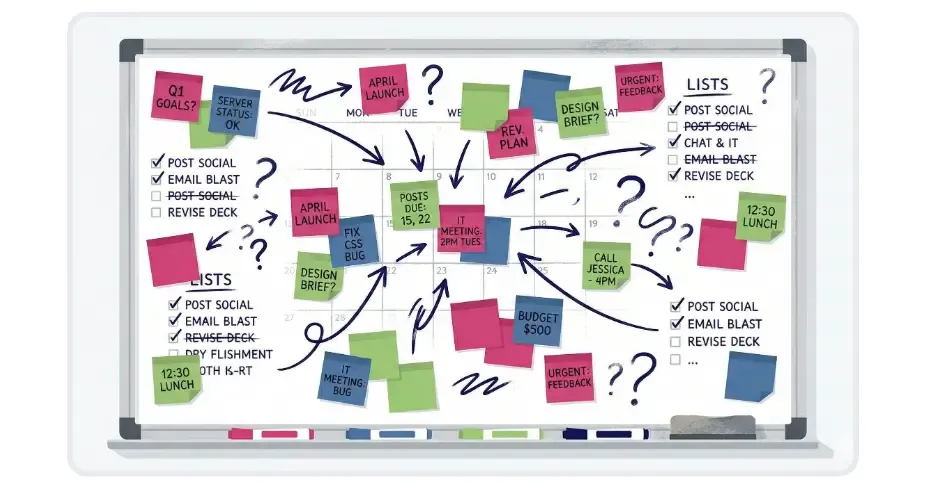
Notes in one app. Content ideas in another. Client stuff in a third. Calendar over here, reflections over there. A to-do list that doesn’t talk to my projects. A content pipeline that lives mostly in my head and partly in random drafts scattered across three different tools.
Illustration of a cluttered whiteboard covered in colorful sticky notes, overlapping checklists, conflicting arrows, and question marks representing the chaos of scattered business systems
This is what "I have a system" actually looks like for most of us. (Don't worry — it gets better.)
It wasn’t quite chaos (I’m a little too type-A for that), but it was scattered.
And scattered, for someone running a business while managing life and trying to maintain some semblance of a balance, can be exhausting. Not dramatically exhausting. Just the slow, steady drain of context-switching all day long, hunting for that thing you wrote down somewhere, and never quite feeling like you can see the whole picture.
I know I’m not the only one.
Every entrepreneur I talk to has some version of this. We’ve all duct-taped together a collection of apps, notebooks, and browser tabs and convinced ourselves it’s a “system.” (It’s not a system. It’s organized-ish chaos with good intentions.)
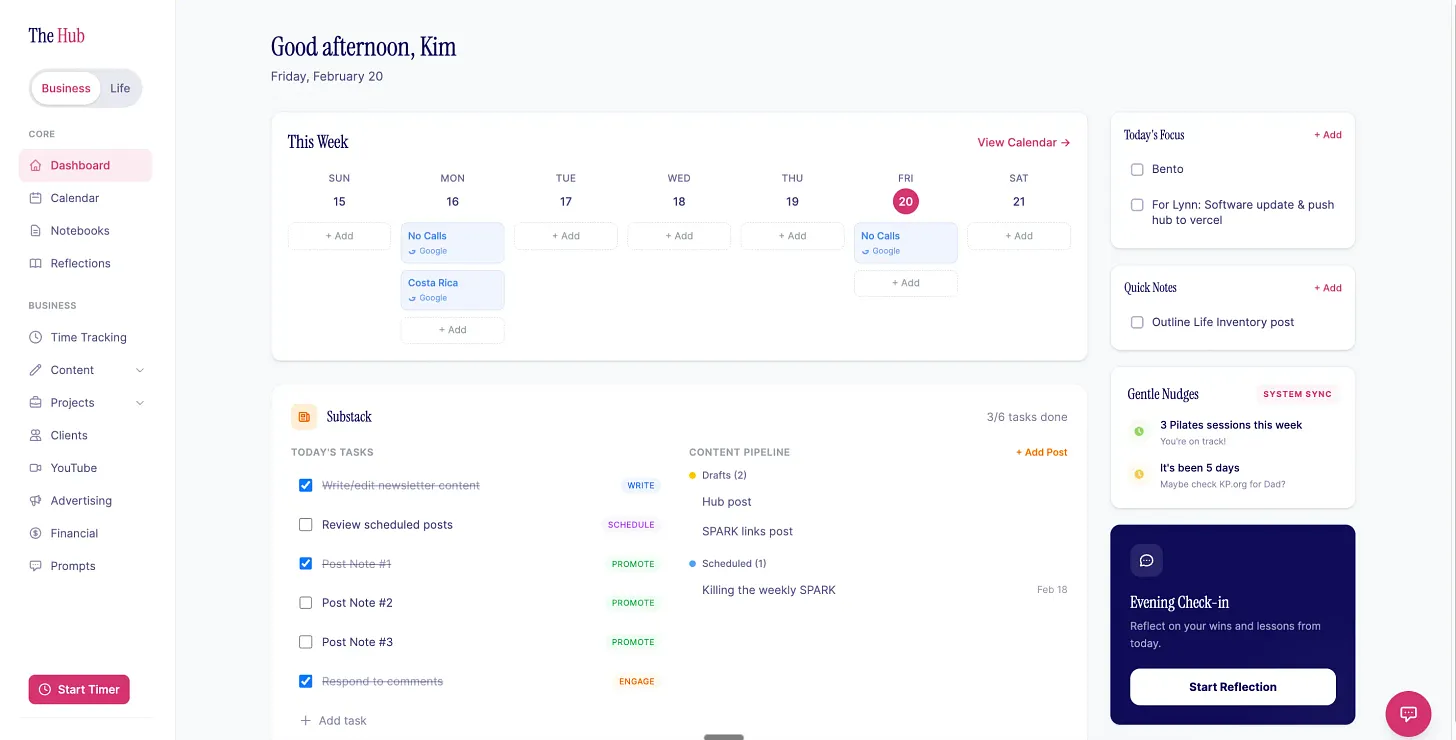
Personal operations hub dashboard showing a good morning greeting, weekly calendar view, today’s focus sidebar, gentle nudge reminders, and evening check-in card
The Hub — one place for everything. This is what I see when I start my day.
What I Actually Wanted
Because of the work I’ve done vibe-coding this year (better constraints, rules, and planning), I knew I could create something I wanted to work in (note: Building/creating by solving problems for ourselves is one of the best routes for learning!).
My main intention (i.e., problem to solve), though, was to stop losing the thread.
When I was a kid, I used to lie on my bed for hours with a stack of paper, pencils, and a big book I’d use as a desk. I’d just draw. Nobody told me to… I’d lose entire afternoons in it.
I think about that now because building ‘The Hub’ was the grown-up version of that same impulse. I didn’t need another app. I needed to go deeper into what I already knew about how I work and actually build something around it (I’m having so much fun with all of this that I lose track of time, the same way I did when drawing as a child).
But there’s another piece to this that I don’t think gets talked about enough… I’m a visual person. I wanted something that didn’t just function well but also looked like a place I'd want to show up to every morning. Every project management tool I’d ever used felt like it was designed for function alone, and the aesthetics were an afterthought (if they were a thought at all).
I wanted a dashboard that felt like mine. Clean, bright, intentional… not like I was logging into someone else’s corporate software.
So here’s what I wanted:
One dashboard that said good morning, showed me the week, and reminded me what I’m focusing on today (without 47 tabs open).
One place for content: Ideas, drafts, scheduled posts, published pieces — a pipeline I could actually see instead of hunting through folders and mental sticky notes.
My business in one lane: time tracking, projects, clients, YouTube, financial stuff, and a prompts library so I’m not digging for that one prompt I wrote three weeks ago.
And my life in another lane: health, wellness, my dad’s stuff, travel, intentions, learning, money.
Same app, different mode… because I’m not two separate people, and the idea that my business and my life need to live in completely different tools has always felt wrong to me.
And I wanted two things that most productivity tools get spectacularly wrong: gentle nudges (reminders that feel supportive, not naggy) and an evening check-in. A place to reflect on the day with simple prompts, optional tags, and zero guilt trip if I skip it.
That’s it. Not a revolution. Just one place that’s actually mine.
What It Became
The Hub is that place.
When I open it, I see a greeting (Good morning, Kim… or afternoon, or evening, depending on when I actually sit down… because, why not?), today’s date, and a weekly view. In business mode, I see my content pipeline at a glance. What’s in draft, what’s scheduled, what’s live.
In the sidebar, I’ve got Today’s Focus, quick notes, and those gentle nudges I mentioned: things like “3 Pilates sessions this week” or “Check Kaiser (medical) for Dad” — the kind of reminders that actually help, not make me feel behind.
There’s an Evening Check-in card. One click and I’m in a simple reflection flow — optional title, optional life-area tag, prompts like “What went well today?” and “What challenged me?” I can write a few sentences and save.
No performance review.
No gamification.
No streaks to maintain.
Just a place to land at the end of the day.
The rest of the app is the structure I need to run my actual life. Calendar, Notebooks, Reflections. Under Business: Time Tracking, Content (with my newsletter front and center), Projects, Clients — including client-level project pages — YouTube, Advertising, Financial, and a Prompts library. Under Life: Health, Wellness, Identity, Dad, Travel, Intentions, Learning, Money.
And honestly? It’s beautiful.
And yes, that matters.
When I open it, it doesn’t feel like a tool I’m supposed to use… it feels like a space I designed for myself. The colors, the layout, the way information is organized... it reflects how I think, not how some product team decided information should be displayed.
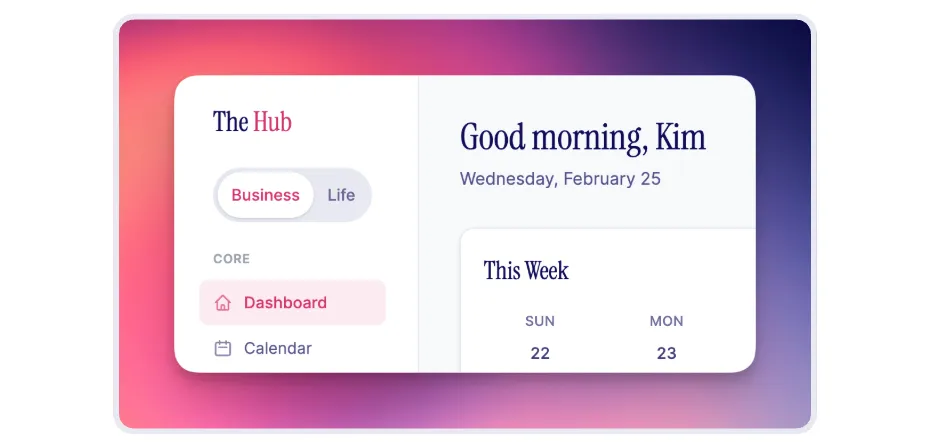
Hub navigation showing Business section with content, projects, clients, YouTube, financial, and prompts, alongside Life section with health, wellness, dad, travel, and intentions
Business brain and life brain — same app, different mode.
The Content Pipeline Changed Everything
The content piece is a big deal for me. If you publish regularly (a newsletter, a blog, a YouTube channel, social), you know the pain of content living in twelve different places. Ideas in your Notes app. Drafts in Google Docs. Published posts on your platform. Some kind of spreadsheet or Notion board, trying to track what’s where. Nothing talks to anything else, and half the time you can’t even find the draft you started last Tuesday.
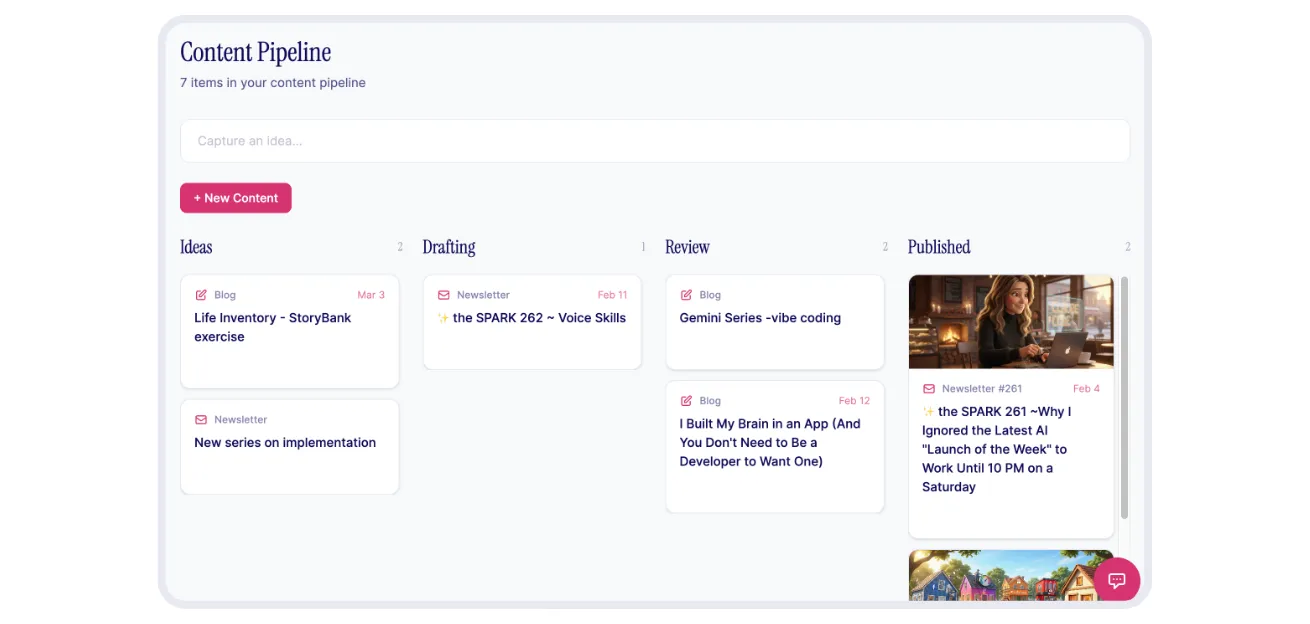
In The Hub, I can create a note, tag it, and move it through the whole pipeline. Draft to scheduled to published (or archive, because let’s be real, not every idea deserves to see the light of day). I can switch between list, kanban, and calendar views depending on what I need to see. When I’m ready, I can publish from inside The Hub.
No more “where did I put that draft?” No more “what was I going to post next?” No more opening four apps to manage one piece of content.
For someone who’s published 260+ consecutive weekly newsletters, this was the thing that made me want to cry with relief. (Okay, maybe not cry. But close.)
Content pipeline in kanban view showing posts organized by stage from idea through draft, scheduled, and published
caption...From idea to published — the content pipeline I always wanted. (And yes, I can switch between kanban, list, and calendar views.)
Why People React the Way They Do
People aren’t blown away by my calendar or to-do list. Everybody has those. They’re blown away because it’s built for one person.
My mom was a project manager. Great on the computer, great with Excel, figured stuff out. She was the original “I’ll teach myself how this works” woman in our family. I’m like my mom that way. There’s something in me that has always wanted to be in charge of how things are organized. I was in management at 18, not because someone handed it to me, but because I kept pushing for it. That same drive is what made me look at every project management tool on the market and think... this isn’t it (not to mention managing some of these productivity tools practically becomes a part-time job. Hard pass).
The Hub isn’t a generic productivity tool trying to be everything to everyone and ending up kind of mediocre at everything. It’s a command center that matches how I think, what I need to see first thing in the morning, and how I want to close out the day.
The mode toggle between Business and Life isn’t a gimmick — it’s how I actually switch contexts. The gentle nudges use language and timing that feel like me, not like some app’s default notification tone. I’ve made it this far in life without an app yelling at me to ‘get shit done’… lol. The evening check-in doesn’t lecture me or track my “productivity score.”
It just gives me a place to show up.
That’s the piece that’s hard to buy off the shelf. You can get a great calendar app. You can get a solid notes app. You can get a project management tool that does 80% of what you need. But you can’t usually get “my brain, in an app” — a single place that reflects how you think, what you need, and the specific combination of business and life that makes up your actual day.
Unless you build it. Or someone builds it with you. 😉
Also… this is a constant work in progress (at least until it’s running like a well-oiled machine). I’ve also integrated Claude via an API, so I can chat with it, it can summarize things, and I get an email recap of the week on Saturday mornings. I’m working on more automations as I dig deeper.
End of day, no guilt. Just a few prompts and a place to land.
What This Means for You
If you’re reading this and thinking “I want one,” you’re not crazy. And you don’t have to be a developer.
Here’s what I’ve learned building this (and rebuilding my entire website and building multiple tools) over the past year: you don’t need to know how it’s built. You need to know what you want. You need to be able to describe how your brain works, what you need to see in the morning, what drains you about your current setup, and what “one place” would actually feel like for you.
That’s the skill. Not coding. Not technical architecture. Clarity about how you work and what you need.
Side note: My year-long journey into building has taught me so, so much. As close as AI is getting to “just tell it what you want” … I’ve learned about constraints, consistency, components, agents… you name it. Anything possible to understand how to set a project up for success before I start building. It makes a HUGE difference. *Keep learning and stay curious!
And if you’re thinking “but I’m not technical” — neither was my mom when she opened Excel for the first time and figured it out anyway. This is the same energy, just with better tools. You can describe what you want in plain English now and watch it get built.
I’m giddy every single time I build something.
Maybe your version is a beautifully organized Notion setup (which, by the way, just released custom agents). Maybe it’s a custom build like mine. Maybe it’s somewhere in between… working with AI and a clear plan to create something that actually fits. The tools now exist to make this real, and they’re becoming more accessible every month.
The takeaway isn’t “go build an app.”
The takeaway is this: scattered systems cost you more than you think. Not just in time (though they absolutely cost you time): in energy, in mental load, in that low-grade stress of never feeling like you can see the whole picture. Clarity… your one home base for what matters… is worth designing for.
Here’s What I’m Thinking
I’m considering building these with people. Not a course about productivity systems — there are enough of those in the world. But actually sitting down with someone, mapping out how their brain works, what their business and life need to have in one place, and then building it together.
Because the process of figuring out what goes in your Hub? That’s half the value. You end up with more clarity about your business, your priorities, and how you actually want to spend your time than any planning workshop could give you.
If that sounds interesting, or if you read this and something clicked, I want to hear from you. What would your one place look like? What would be on your dashboard? What would you want to see in the morning, and what would you want to close the day with?
You don’t have to have the answer fully formed. But asking the question is where it starts.
I don’t have a price, a set package, or a specific plan for this (yet). But if you’re interested, just reply, DM me, or let me know. We can figure it out (and we’d do this together if you want to learn, or I can just build it).
The Hub lives at a domain I bought just for this.
It’s my personal ops center, and I’m still adding to it, because building for how your brain works is never really “done.”
Find the first thing worth building.
A few questions. Your Build Path, plus a 30-day plan. No fluff.
Kim Doyal is a digital marketing strategist and AI builder with 18 years of online business experience. She is the founder of AI Spark Studios and SPARK Lab, and the creator of The Hub — a custom 33-agent AI operating system that runs her entire business. She has also built kimdoyal.com, StackRewards, and multiple AI tools and agents using vibe coding, a natural language approach to building software without a traditional development background.