HOME/BLOG/THE PRODUCT FRAMEWORK THAT CHANGED HOW I THINK ABOUT MY NEWSLETTER
Content Strategy
The Product Framework That Changed How I Think About My Newsletter
How Karo Zieminski's "Publication as Product" methodology made me realize I'd been publishing without a promise... and what I did about it
May 18, 2026|5 min read
In 2008, when I was "The WordPress Chick," I did my first live webinar teaching people how to set up Google Analytics and Webmaster Tools for WordPress (it's Search Console now). Then I shipped them a physical DVD, produced by a company called Kunaki, for $24.95 (apparently Kunaki is still around! It was only $1.50, and they printed, packed, shrink-wrapped, and shipped it!).
I had never done a webinar before, never produced a physical product, never shipped anything to anyone. As much as I love speaking and teaching, I was uncomfortable, and my voice shook a little. But here's the thing... I knew how to set up Google Analytics. I knew what Webmaster Tools did and why it mattered. The knowledge was already there. The rest was just ripping the band-aid off and figuring out the mechanics.
I've been thinking about that $24.95 DVD a lot this week. Because I just had the exact same experience, 18 years later, with my newsletter.
Karo Zieminski, who writes Product with Attitude, just published a piece called "Publication as Product," in which she breaks down how she treats her newsletter as a product in development. Not content, not a "publication strategy," but an actual product with a person, a promise, feedback loops, a roadmap, and a retention curve.
And I'm reading this thinking... I don't have a promise.
I've been writing on Substack for over a year (on my own site much longer). I've published plenty of posts, people subscribe, and my retention is solid. But if someone asked me, "What do you get when you read Kim Doyal?" I didn't have a clean answer. I could tell you what I write about. I could tell you who I write for. But the promise, the thing a reader would say to defend their subscription if a friend asked? I'd never put that into words.
Just like that first webinar, I had the knowledge but not the framework. Karo's article gave me the framework.
So I did what I always do... I sat down, went through Karo's framework, and got to work.
The full framework, adapted from Karo Zieminski's Publication as Product methodology.
What Does It Mean to Treat Your Newsletter Like a Product?
It means designing it as a repeatable, value-driven experience someone chooses to return to. Here's Karo's core definition, and it's the one that got me:
Karo defines a product as "a repeatable experience of value someone chooses to return to." Not something you build and sell, she says. An experience of value. When I read that, the reframe hit me immediately. My newsletter stops being "what should I write about this week?" and starts being "is this post delivering on the promise my readers showed up for?"
Karo breaks it down into components: ✔️ A promise (what readers believe they'll get if they keep showing up) ✔️ A person (mindset over demographics) ✔️ Value types ✔️ Feedback signals ✔️ A roadmap (bets, not a content calendar) ✔️ Retention ✔️ Conversion.
I want to walk you through what happened when I ran my own newsletter through each one. Because the process itself turned out to be the most useful thing I've built in weeks. (And I build a lot of things. 😉)
How Do You Find Your Newsletter's Promise?
Your promise is what readers believe they'll get if they keep showing up, and it lives above any specific topic or format. Karo asks a question that sounds simple and isn't: What sentence would your reader use to defend their subscription if a friend asked why they read you?
My first instinct was something like "she shows you that you can do this too." Which is true. But it's describing me, not what the reader gets.
So I kept pushing on it. The question my reader is carrying around isn't "what tools should I use?" It's deeper than that. It's "Can someone like me actually do this? Am I technical enough?"
And my answer, every single time I publish, is: you don't have to be. The hard part isn't the technology. The hard part is knowing your business, knowing your people, understanding the problem you're solving. And you've already done that part. You've been doing it for years.
That's the promise.
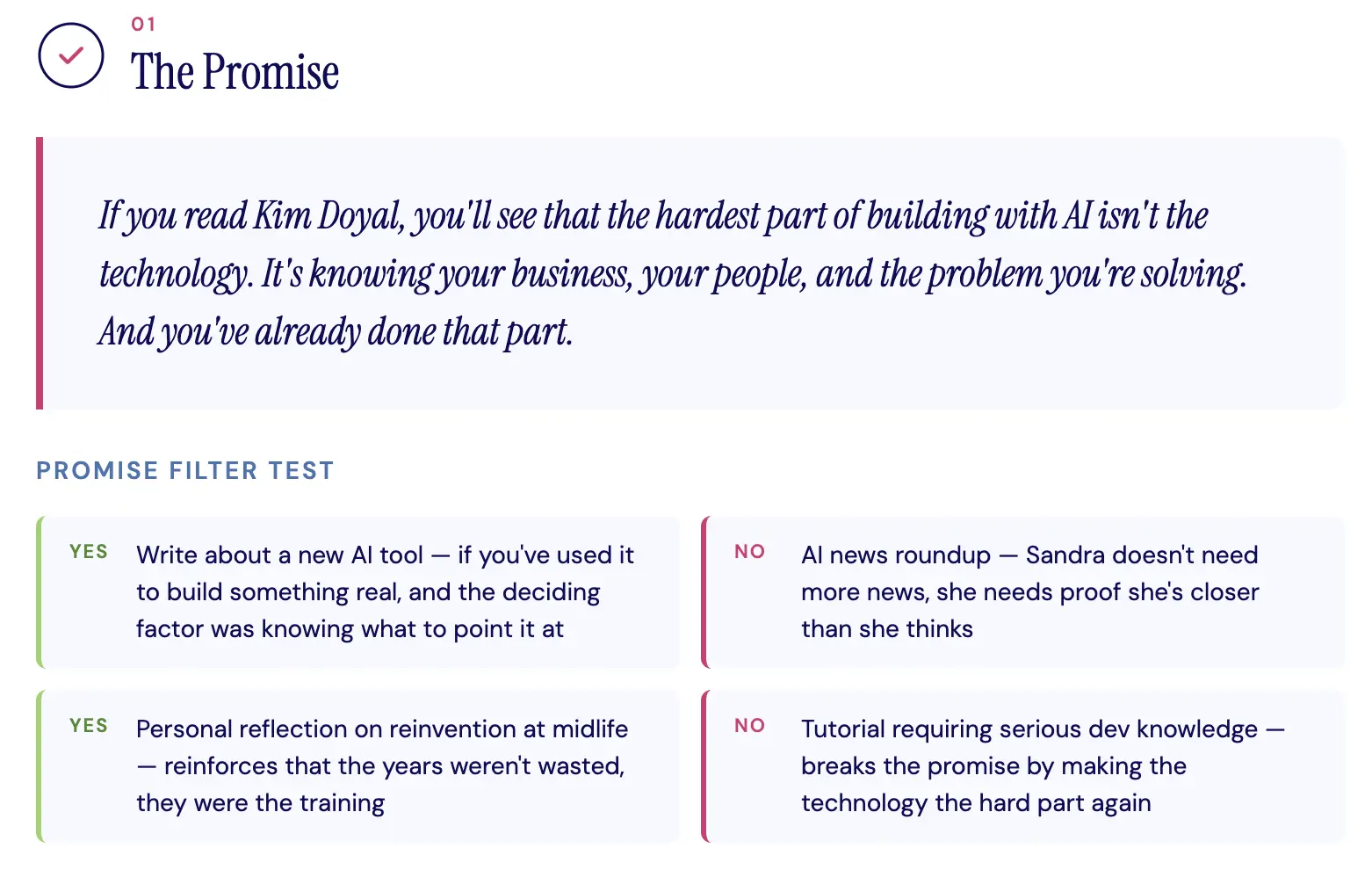
If you read Kim Doyal, you'll see that the hardest part of building with AI isn't the technology. It's knowing your business, your people, and the problem you're solving. And you've already done that part.
Here's what I love about this: it's not about a topic, a format, or a posting schedule. The promise lives above all of that. And it works as a filter.
Should I write about a new AI tool? Only if I've actually used it to build something, and the deciding factor was knowing what to point it at.
Should I write a personal reflection about reinvention at midlife? Yes, because that's a "you've already done the hard part" post.
Should I write an AI news roundup? No. My reader doesn't need more news. She needs proof that she's closer than she thinks.
The promise filter in action. If a post idea doesn't pass, it doesn't get written.
Who Are You Actually Writing For?
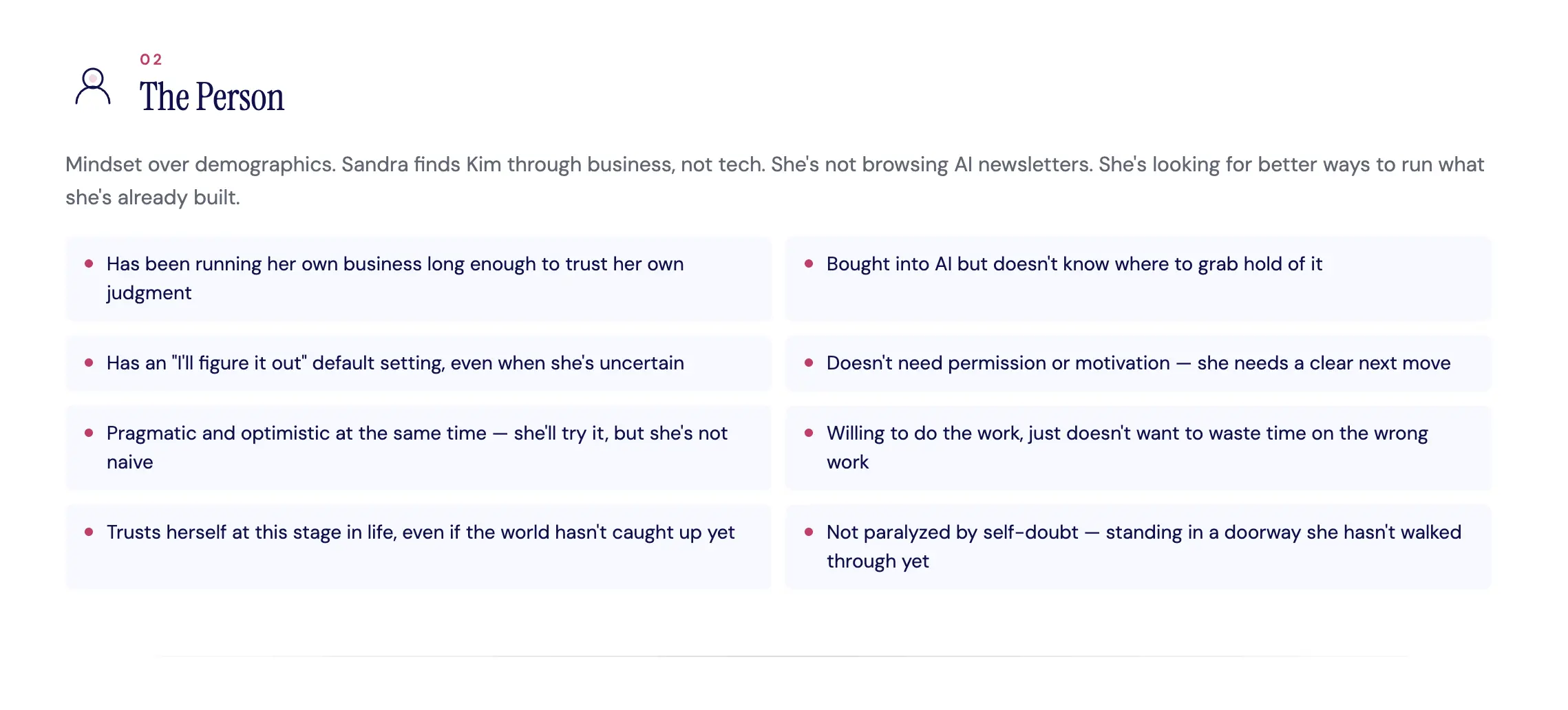
Not a demographic profile or a job title. A mindset. Karo talks about thinking in terms of "my person" rather than an ICP, because ICPs flatten a human being into a job title and a market segment. She says mindset over demographics (another way to look at this is psychographics). I'm here for that.
My person finds me through business, not tech. She's not browsing AI newsletters. She's looking for better ways to run what she's already built. She's bought into AI but doesn't know where to grab hold of it. She has an "I'll figure it out" default setting, even when she's uncertain. She's pragmatic and optimistic at the same time. She'll try it, she wants an AI strategy, but she's not naive about it.
Here's what's NOT in that description: fear, hesitation, and imposter syndrome. My reader isn't paralyzed. She's standing in a doorway she hasn't walked through yet because nobody showed her the room isn't that big.
A perfect example... someone commented on my post about the Claude Visualizer, restacked it, and said, "I didn't know about this. Is anybody using it?" She wasn't in AI or tech. She was a business owner who saw something practical, and her instinct wasn't "that's too hard for me." It was "tell me more."
That's my person.
Mindset over demographics. This is who I'm writing for.
What Do Your Newsletter Metrics Actually Tell You?
Not all posts do the same job, and evaluating them by the same metric will mislead you. This is where it got interesting. Karo talks about reading feedback signals carefully, separating what's loud from what's useful. So I looked at my subscriber-per-post data with fresh eyes.
Every single one of my top-performing posts (by new subscribers) follows the same pattern: "I did something real, here's what I found, and you can see the whole thing." The post about what Substack doesn't tell you about your subscribers, the 33-agent AI operating system, building my own platform with AI... all build-in-public posts with tangible outputs.
The reflection posts? Beautiful engagement and high open rates, but they don't convert at the same rate.
And here's the thing... that's not a problem. Those two types of posts are doing different jobs.
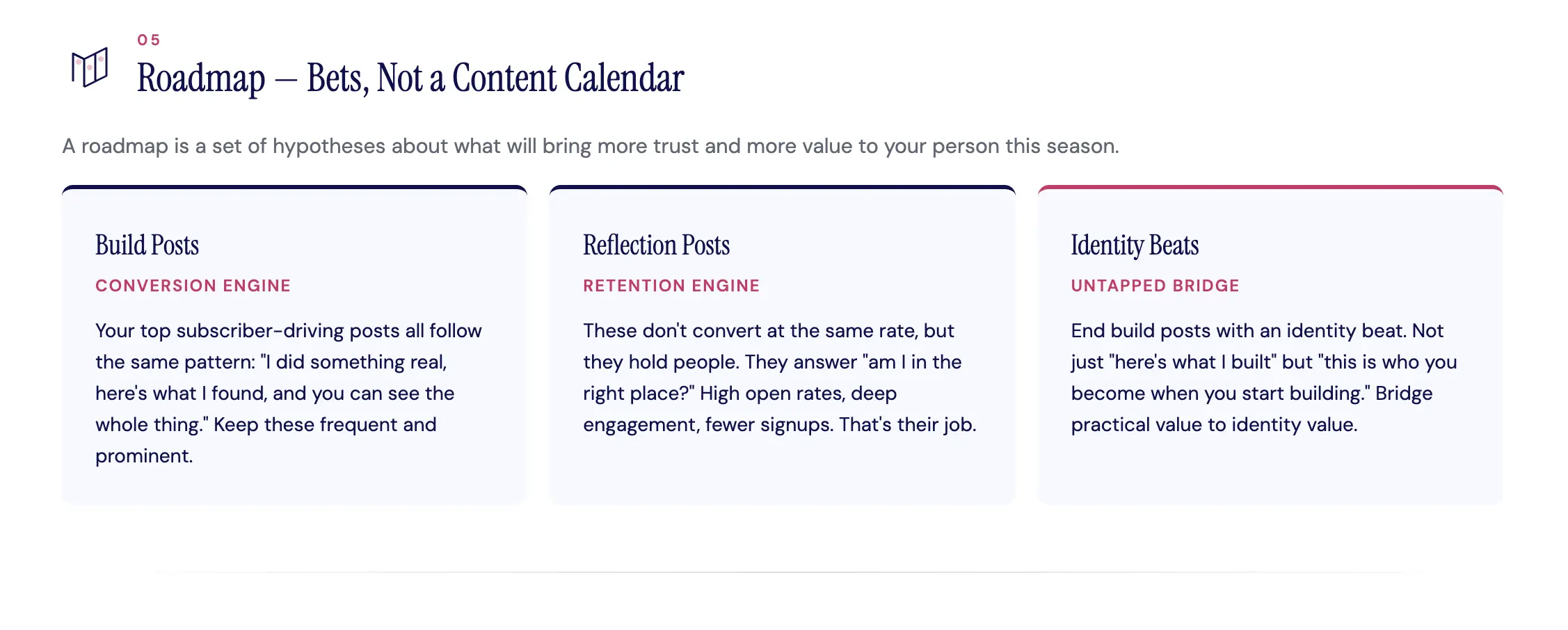
Build posts are the conversion engine. They bring new people in. Someone finds the post, sees a real output, and subscribes because they want more of that.
Reflection posts are the retention engine. They keep people around. They answer the question "Am I in the right place?" They don't need to convert. They need to make the reader feel like she's on the right path.
Once I saw that distinction, I stopped evaluating every post by the same metric. A retention post with three comments and two new subscribers isn't underperforming. It's doing exactly what it's supposed to do.
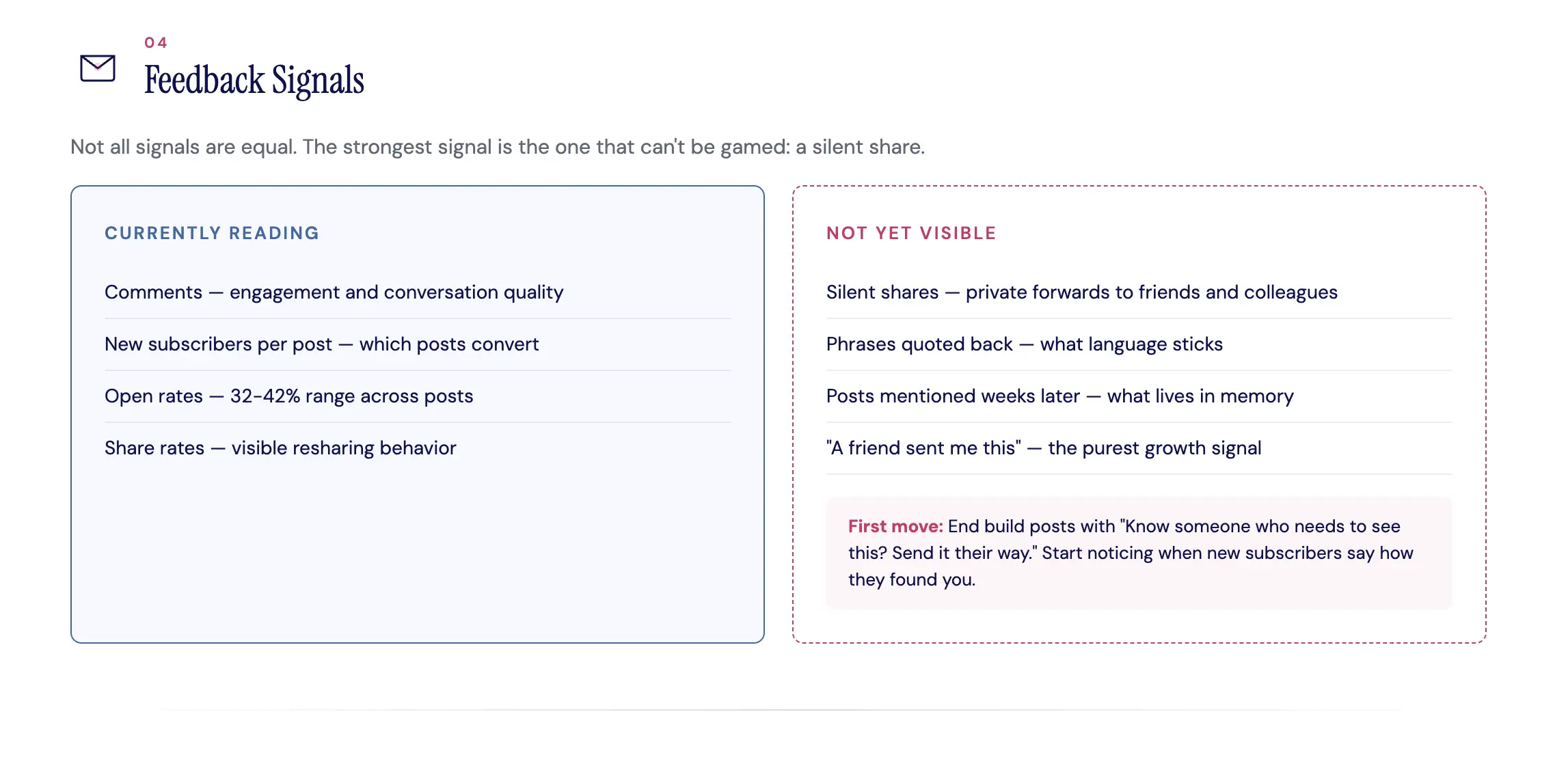
The signals I'm tracking versus the ones I've been missing entirely.
Karo calls this the roadmap, and she's clear that a roadmap is a set of bets about value, not a posting schedule. Based on what the data showed me, I'm making three bets this season: keep building-in-public posts frequent and prominent because they're the conversion engine, keep writing reflection posts because they're the retention engine, and start adding identity beats to bridge the two. Those are hypotheses, not commitments. If the data tells me something different in three months, the bets change.
A roadmap is a set of bets about value, not a content calendar.
What Value Types Is Your Newsletter Missing?
There are six types of value a newsletter can deliver, and if you're only hitting one or two consistently, you've got untapped potential.
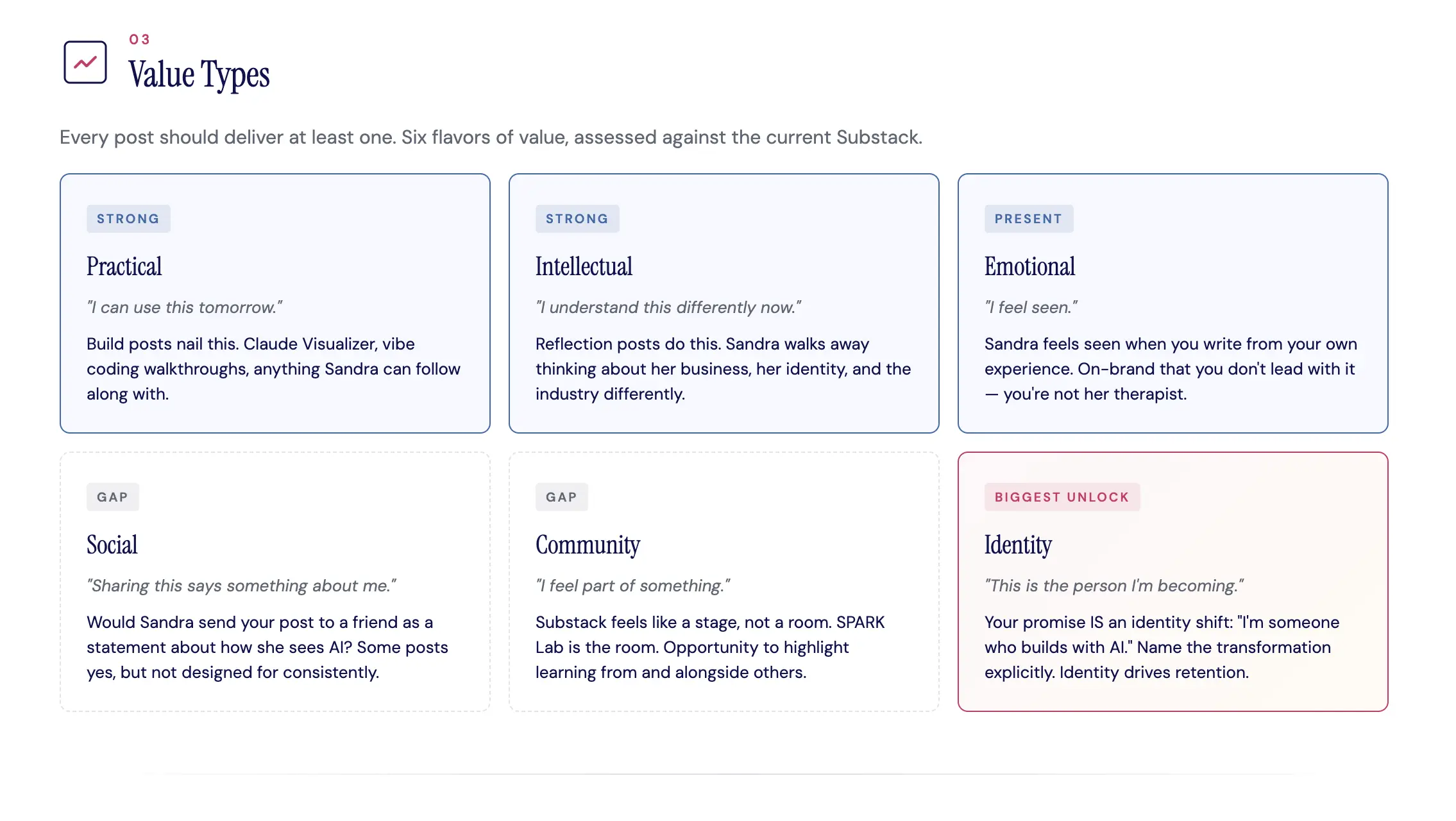
Karo identifies them as: practical ("I can use this tomorrow"), intellectual ("I understand this differently now"), emotional ("I feel seen"), social ("sharing this says something about me"), community ("I feel part of something"), and identity ("this is the person I'm becoming").
My Substack is strong on practical and intellectual, and present on emotional. But identity? That's my biggest gap, and it's wild because my entire promise IS an identity shift.
Every post I write implicitly says, "You're becoming someone who builds with AI." But I wasn't naming it or making it explicit, and the reader might internalize the shift on her own... or she might not.
The unlock is adding what I'm calling an "identity beat" to posts, and it's not a motivational pep talk or a "you've got this, girl" moment. It's more like a mirror at the end that connects what was built to who the reader is becoming. A bridge from "here's what I did" to "this is available to you too, and here's why."
And community?
This post you're reading right now is that value type. I'm linking to Karo's work, crediting the framework, and showing that good ideas come from a real ecosystem of builders learning from each other.
That's community.
Six flavors of value. I'm strong on two, missing the one that matters most.
Can You Turn a Newsletter Strategy Framework Into a Reusable Tool?
Yes, and it only took an afternoon.
Because I can't just learn something without building something from it (you know me by now... and it's how I learn best), I turned the entire framework into a pre-publish skill. It's a scorecard that evaluates every post before it goes live across five dimensions: promise alignment, person fit, value type delivery, identity beat, and silent share potential, each scored on a 1–5 scale.
It also classifies each post as a conversion post, a retention post, or a bridge post (which does both). And it runs before my AEO/SEO optimization skill, because strategy comes before search.
Is this overkill? Maybe.
But treating my newsletter like a product means building systems to evaluate it as such. Karo's framework was a completely new perspective for me, and I love it. And the skill took an afternoon to build. That's the whole point, right? The framework was the easy part.
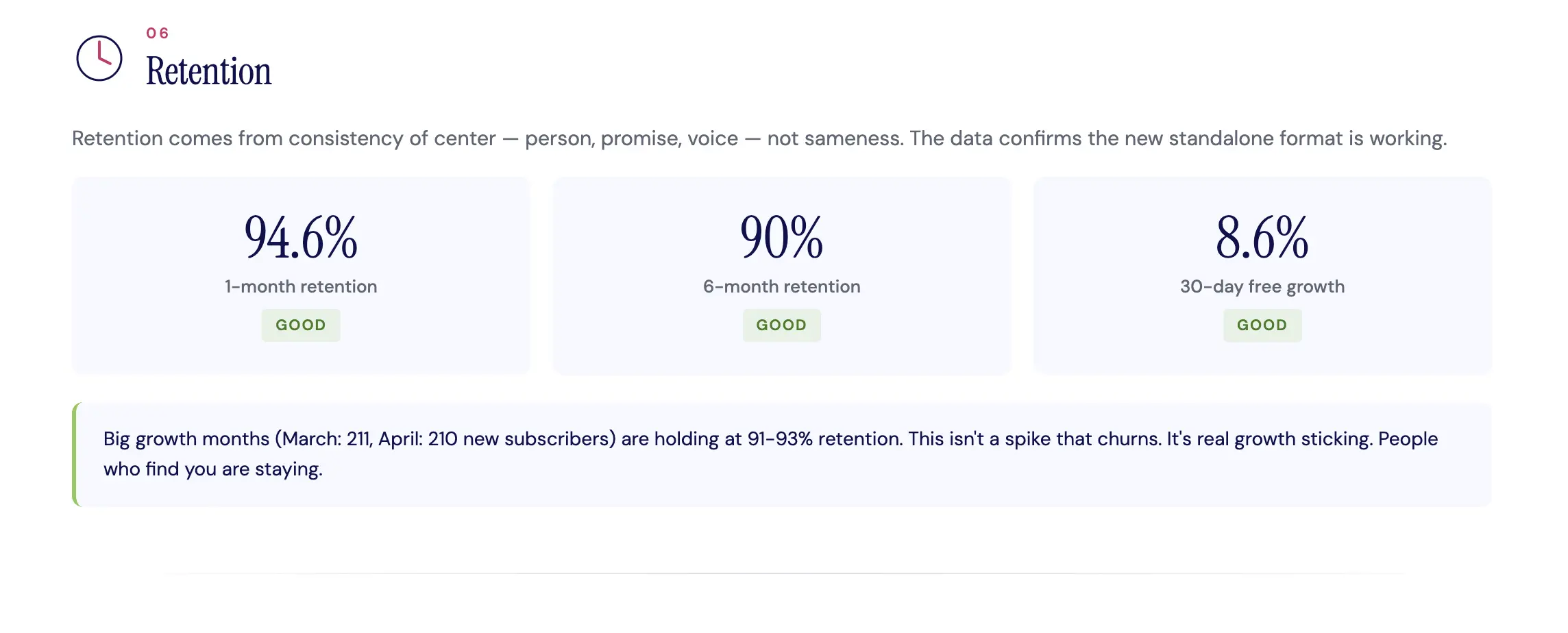
The data that told me the standalone format switch is working.
What's the Hardest Part of Running Your Newsletter Like a Product?
It's not learning the framework.
It's admitting you've been publishing without one. I've been writing for over a year, building an audience, and the strategic foundation was... vibes. Good vibes, apparently (90% six-month retention, so something was working), but vibes nonetheless.
But that's the thing about having 18 years of creating behind you. When the right framework shows up, it clicks fast, not because the framework is easy, but because you already have the context to know what fits and what doesn't. You already know your reader, your voice, and what you're building and why. The framework just gives you the language for what you were already doing intuitively.
Sound familiar?
That $24.95 DVD worked because I already knew Google Analytics inside and out. This framework worked because I already knew my reader, my voice, and my business. In both cases, the knowledge was the hard part, and I'd already done it. The mechanics... that's the part that moves fast when you stop overthinking it.
That's the promise of this newsletter, actually.
You've already done the hard part. You just might not have the language for it yet.
Do I need to define my newsletter promise before I start writing?
No. Most of us figure it out by writing first and naming it later. The promise is usually already in your content, you just haven't put it into words yet. Write, pay attention to what resonates, and the promise will reveal itself.
What's the difference between a conversion post and a retention post?
A conversion post brings new subscribers in, usually through a tangible output or build-in-public walkthrough. A retention post keeps existing readers engaged through identity, reflection, or emotional resonance. Both are valuable, and they should be evaluated by different metrics.
How do I know if my newsletter is delivering enough value?
Check it against six value types: practical, intellectual, emotional, social, community, and identity. If your post doesn't hit at least one, it's not doing product work. If it consistently hits the same one or two, you've found your strength but you may have untapped potential in the others.
What's an identity beat?
It's the moment in a post where you bridge from what was built or discussed to who the reader is becoming. Not a motivational line, more like a mirror that helps the reader see herself differently in relation to the topic.
She goes deeper into feedback loops, retention design, and conversion mechanics. It's one of the best pieces on newsletter strategy I've read this year. And if you know someone who's been writing a newsletter without a clear promise (which, let's be honest, is most of us)... send this their way.
Kim Doyal is a digital marketing strategist and AI builder with 18 years of online business experience. She is the founder of AI Spark Studios and SPARK Lab, and the creator of The Hub — a custom 33-agent AI operating system that runs her entire business. She has also built kimdoyal.com, StackRewards, and multiple AI tools and agents using vibe coding, a natural language approach to building software without a traditional development background.