TABLE OF CONTENTS
What does the "creator space" even mean anymore?Why doesn't the old playbook work anymore?Because people can smell the grift now.Do you have a business or a content habit?What's the difference between a builder and an architect?What's AI actually disrupting?Is online education part of a real business model, or is it the problem?Trust.Does reach actually equal revenue?What are you building for YOU?Common questionsThe Creator Economy Has A Business Model Problem
AI Won't Fix A Business That's Never Been Built
April 14, 2026|5 min read

I spent a good chunk of a day researching a $5,000 AI agency accelerator program. One of those programs where you have to get on a sales call to get the price (been there, done that, hard pass), so naturally, I went to Claude to see what it could find.
Overall, it's a solid program.
Strong reviews, real coaching, solid community. Unlimited 1-on-1 calls with dev, sales, branding, and outreach coaches. A six-month mentorship. The kind of thing that, a couple of years ago, I probably would have signed up for without blinking.
But I didn't (and not saying I won't, but as of now, it's a no).
Here's why.
Because when I actually sat down and asked myself what I'd learn there that I can't figure out myself... the answer was uncomfortably short. I already have the business and marketing experience... 18 years of it in fact. I'm building with Claude Code - apps, agents, MCPs, and anything else I can learn that's relevant to what I'm doing. The specific skills I wanted (deeper automation workflows, service packaging frameworks - specifically, productized services), I can probably learn through free YouTube content, smart friends (seriously, Substack has an incredible AI community), and, honestly, just building things.
So instead of spending $5K on someone else's framework, I spent a Monday morning building my own.
Hours with Claude, mapping my product ladder, projecting revenue, and identifying actual gaps in my business. Not content gaps, or "I need to post more" gaps.
Architecture gaps.
The structural stuff that determines whether you have a real business or a really impressive hobby.
And that session surfaced something I think a lot of us need to talk about. The creator economy has a business model problem. And AI is making it simultaneously worse and better.
What does the "creator space" even mean anymore?
AI is moving so fast that everyone's chasing the latest tool, the latest prompt/context framework, the latest "50 ways to use Claude." And look, those listicles work if your business model is YouTube ad revenue or if your content's goal is to position you as an expert. In other words, your content isn't talking specifically to your ideal customer. Maybe you have a full-time job in your industry, and your content anchors in your expertise. Or maybe you're running a media company (and that IS a legitimate business model), in which case reach is the game. Optimize for reach. Create the roundups and drive the views.
But for the rest of us?
The ones who have actual businesses, who sell services or products or tools or coaching or consulting... when did we start confusing content creation with business building?
Here's the question nobody's asking themselves: are you a media company, or are you a business that uses AI to grow and scale? Because those require completely different strategies, daily activities, and measures of success.
What if instead of 50 surface-level tips, you took three of those tools and drilled down into real use cases tied to actual revenue? That's a different kind of content. That's content with a business model behind it.
And I'm not knocking anyone's approach, by the way. Roundups serve a purpose. But it depends on who you're talking to and whether that content actually serves them. Some people have agencies or consultancies, and Substack is just a teeny tiny piece of what they do. Others are building their entire livelihood here. The strategy can't be the same for both.
Why doesn't the old playbook work anymore?
Because people can smell the grift now.
The internet marketing playbook that worked for a decade is collapsing (cue Lizzo, "it's about damn time.") Build an audience, sell a course about building an audience, rinse, repeat. We've watched "old school" internet marketers completely pivot their business models because the old way stopped working.
That is 100% clear.
People are savvier now. They've been burned. They've bought the $997 course that was four videos and a PDF. They've joined the "mastermind" that was actually just a Slack channel with 200 people and zero attention. They (we) know what hollow looks like.
I saw it from the inside last year. I enrolled in a program (for myself, personal development, not business). And what I found was... illuminating. This person shared that they wanted to sell their business (not immediately, but in the next handful of years). But there was no business to sell.
No customer database and a few products. Their entire IP for the program I was in was one book, which was then broken into the training modules (lazy much?) and 4 documents. The whole operation ran on duct tape and spreadsheets. It was so badly set up that it actually pushed me into vibe coding, because of how "MacGyver'd" everything was put together (and none of the legacy course platforms were ever structured for the student experience...they were set up for the business owner).
The lesson is: what do you actually own? She had IP and a prayer. A certification she created (without formal qualifications, which... tons of people do, and I'm not judging that specifically). But does a creator-made certification carry the same weight it once did?
Take Claude, for example. Anthropic has its own AI Learning Academy. If you wanted a certification (hardly necessary), would you rather get it from Anthropic or a creator?
I'm not saying we can't learn from creators. I'm incredibly grateful to the people I've connected with and follow on Substack. It's a massive brain trust... but they're not creating certifications that aren't worth the paper they'd be printed on.
My point in all of that is, again, that the old playbooks don't work anymore (especially if you've been in this space for a while).
Do you have a business or a content habit?
If you're spending 80% of your time creating content and 20% building revenue systems, you don't have a business... you have a content habit.
AI makes this worse because it's so easy to produce MORE content, faster. But more content without a business model is just more noise.
The question isn't "what AI tools should I learn?"
The question is: what am I building, who pays for it, and how does it scale without me trading more hours?
I'm coming at this from a very specific place. I've been on the content marketing hamster wheel for 18 years. Eighteen years of publishing, posting, emailing, optimizing, repurposing. And I love creating content (genuinely, deeply love it). But this moment in AI... this is the true disruption. Not because AI creates content faster. Because AI lets you build things that generate revenue independent of content.
Content supports the business. The business doesn't depend on content. That's the shift.
What's the difference between a builder and an architect?
A builder knows how to make things. An architect designs systems. AI gives you the power to build anything, but building without architecture is just... a pile of impressive things that don't connect.
When I sat down for that Monday morning session, what emerged wasn't a content plan. It was a business architecture.
I realized that everything I've been building (my research agents, my content pipeline, my AI tools, my member platform) is all the same intellectual property, packaged differently at different price points.
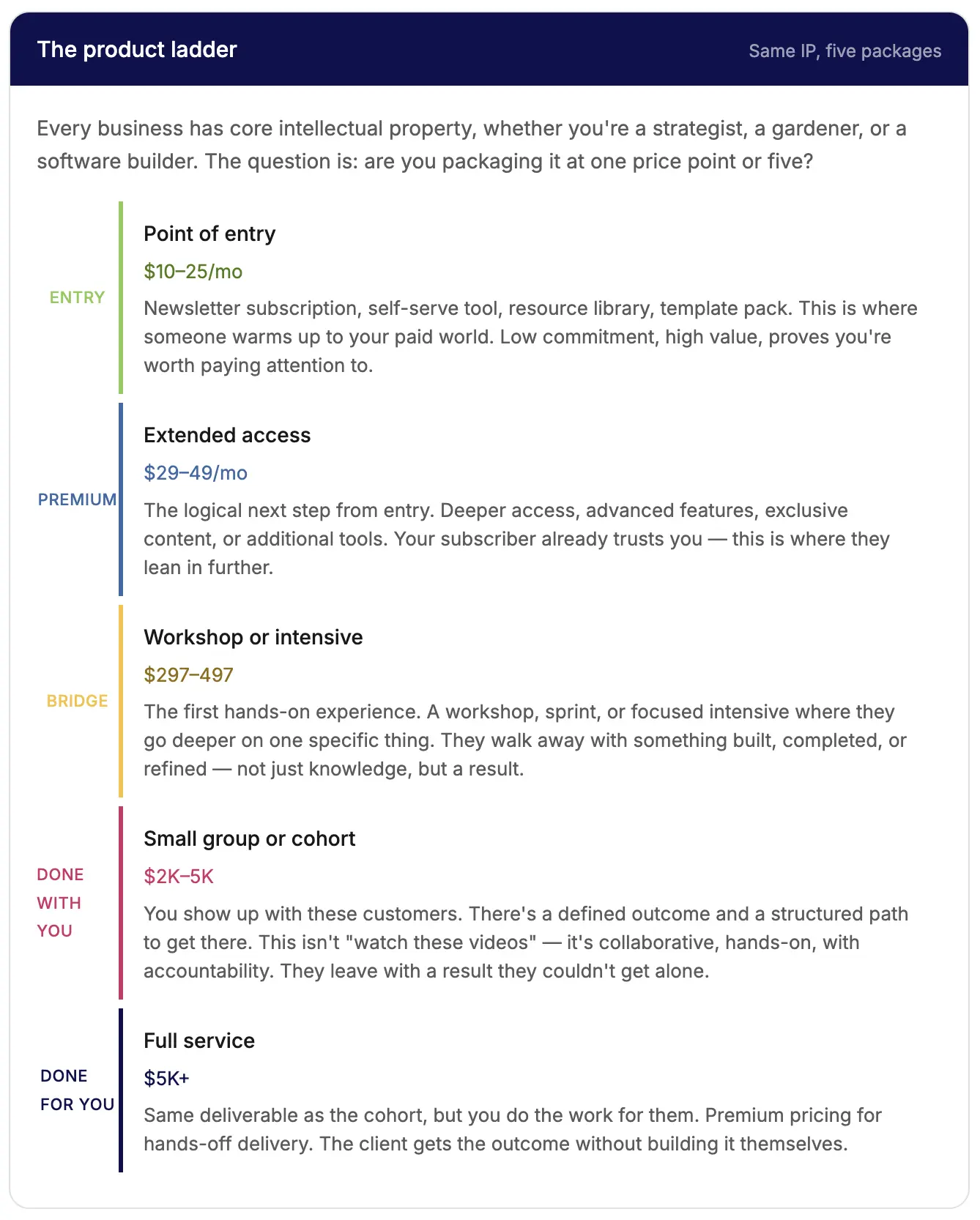
Five rungs, all with the same core IP. DIY at the bottom, done-for-you at the top. Your ideal client can start at the lowest tier and work their way up to "just build it for me" without ever leaving your ecosystem. All at a pace that works for them. They know you have more to offer when they're ready.
That's not a content strategy, that's a business model.
And the gap between where I am and where I want to be? It's not "learn more AI tools." It's three things: automate what's currently manual, document what's in my head into a single source of truth, and formalize the methodology I use instinctively so I can teach it, replicate it, or implement it.
What's AI actually disrupting?
Not content creation. Assets.
I want to do client work. I want to build my own apps. I want to grow Her Credit Map (a completely separate project in a completely different niche) because I want to own assets, not just audiences.
This matters to me because otherwise it starts feeling like the AI version of... let's just call it what it is. The creator grift. I'm not saying all creators are grifters, but the pattern is real. And some of them have built cult-like followings doing it.
The piece I want to call out (not as a defense, but as a distinction): I've been doing the content work for 18 years. I know what the hamster wheel feels like. I've run it. And this is the first time I've seen a path to building things that scale without requiring more of my time, more of my presence, more of me performing "creator" as an identity.
Is online education part of a real business model, or is it the problem?
That depends entirely on what you're teaching, who you're teaching, and whether the trust is earned or performed.
Let me be clear: online education is not dead. But it's changing, and whether your version of it survives depends on something that's always mattered but now matters more than ever.
Trust.
There's a level of trust required when someone gives you their email address. An even deeper level, when they give you money. And here's what's shifting: anyone with a little AI education and a Claude subscription can do deep research, run competitive analysis, and figure out what's working on any platform. I'm not saying everybody wants to or needs to. But the bar for "I'll pay you to teach me this" just got dramatically higher (we can't do anything about someone not actually comprehending what they're selling... 🙄 but that's true with or without AI. And there will always be people out to make a quick buck).
What happens when the people who trusted you with their money realize they could have figured this out themselves in less time than it took to learn it from you? When the curtain gets pulled back, and there's no wizard, just someone manipulating levers? (And of course, we can learn things ourselves, but how long will it take? And learning on your own doesn't suit everyone).
The Wizard of Oz is the perfect example here. The Great and Powerful Oz was just manipulating people to keep up an illusion. And we all know how Dorothy felt when she found out. She was angry and scared (about not getting home to Kansas).
That kind of trust, once broken, doesn't come back. And it doesn't break because you charged too much or delivered too little. It breaks when people realize the value gap between what you know and what they can now access on their own has narrowed to almost nothing... and you didn't adjust.

So what still holds? Deep domain expertise. A specific technical skill backed by real credentials. A methodology forged through years of actual practice (not repackaged from someone else's course). Industry knowledge that requires human judgment, human context, and human experience. The humanities side of business (philosophy, ethics, psychology, the messy human stuff that AI can discuss but can't embody) will always hit differently. The people keeping that integrated into their work are not replaceable.
But creators creating content about creating content? Teaching courses about how to create courses? That loop has been tightening for years, and AI just pulled it closed. When everyone has access to the same tools, the differentiator isn't "I know how to use this tool." The differentiator is what you build with it, who it serves, and whether it actually works.
That depends entirely on the industry, the niche, and what makes your thing genuinely unique. There's no universal answer. But there is a universal question: if your subscribers could get 80% of what you offer by spending an afternoon with Claude... what's the other 20% that makes you irreplaceable?
Does reach actually equal revenue?
No. And the sooner we stop pretending it does, the sooner we can build something real.
The content creator model trained us to optimize for reach, engagement, and followers. AI turbocharged that. But for those of us running actual businesses... reach isn't revenue. Engagement isn't equity. Followers aren't clients.
You can have 50K subscribers and no business model, or 500 subscribers and a $15K/month operation.
Which would you rather have? (You already know the answer. The question is whether your daily activities reflect it.)
And here's something people really need to sit with: avatar influencers are already making real money. AI-generated personalities with millions of followers. Now, is that happening in every market? No. It's concentrated in lifestyle, fashion, entertainment... the spaces where the "content" IS the product. If you're in the humanities, in deep education, in specialized consulting, in fields where lived experience and human judgment are the value... you're not getting replaced by an avatar anytime soon.
But the content hamster wheel? The one where you're creating to feed the algorithm, appease the platform, grow the audience, and eventually monetize somehow? That was never sustainable. AI didn't kill it. It just made the unsustainability impossible to ignore.
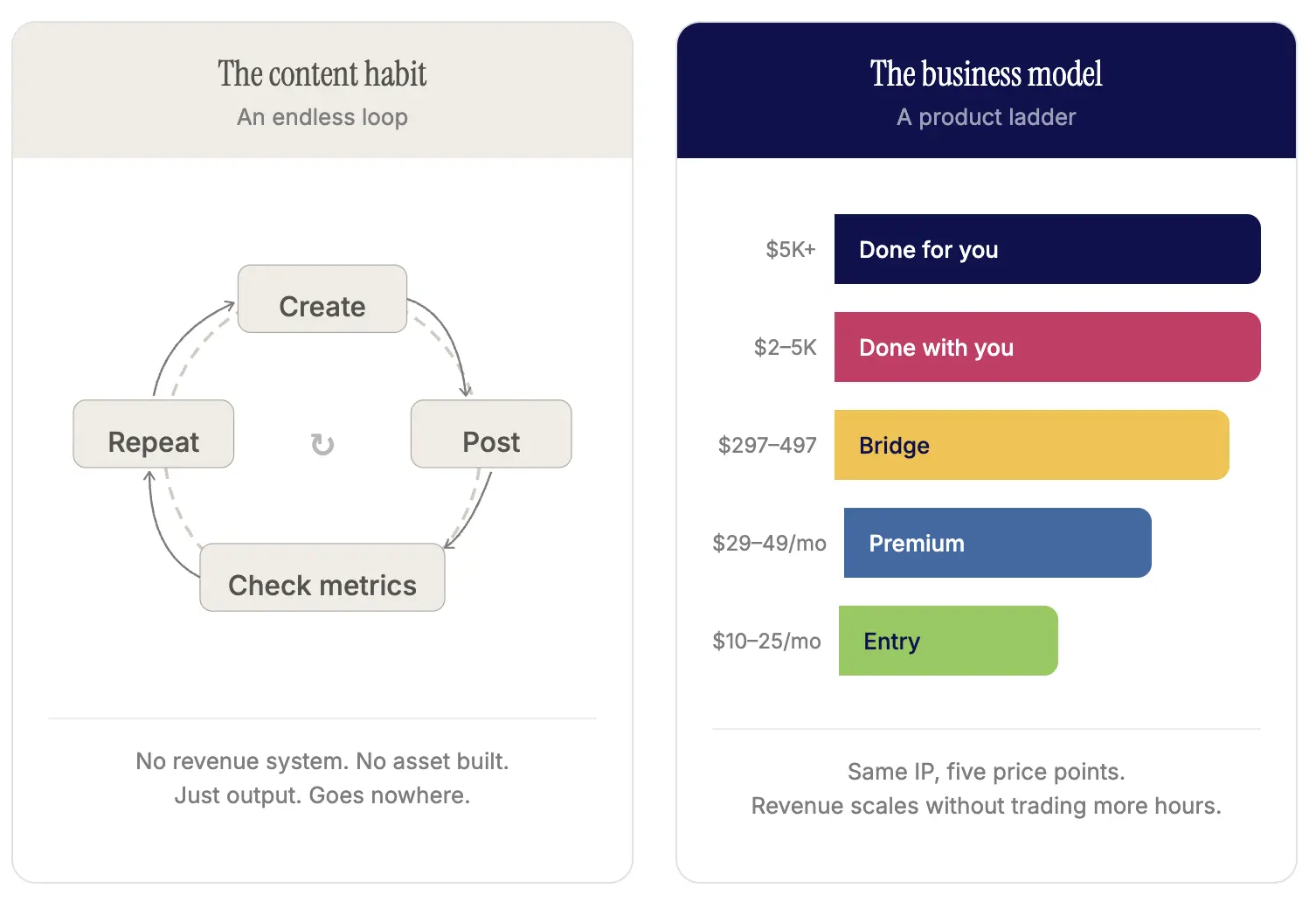
The creators who survive this aren't the ones with the biggest audiences. They're the ones with real businesses underneath the content.
What are you building for YOU?
Something that works when you're not in the room, something you own. That's the bar.
Not "what content are you creating?" What are you building?
Not everybody wants to sell a business. That's not what I'm saying. But can you answer: what do I own that exists beyond me? What's the asset? Where's the system? If you can't answer that, it's not a judgment. It's information. And you can start fixing it today.
I think the most important work any of us can do right now isn't learning the latest AI tool. It's sitting down (maybe with Claude, maybe with a notebook, maybe with a trusted friend) and getting brutally honest about the business model.
Who are you talking to? What problem do you solve for them? What does your product ladder look like? Where does the money actually come from? And does the way you spend your days support that, or are you just... creating?
There's only so much time in the day. I'm really looking at this from the lens of: what does my business look like, how does it operate, and how do I want to live my life day to day? At 55, I'm working harder than I ever have, but it's by choice. Doing work I love. Building things I own. That's not hustle culture. That's alignment.
And for the first time in 18 years... the tools match the ambition.
Common questions
What if I don't have a product ladder yet?
You don't need five rungs tomorrow. Start with one: what's the one thing you could package and sell that isn't your time? A template, a tool, a diagnostic, a workshop. Build from there. The ladder grows with you.
Does this mean content doesn't matter?
Content matters enormously. It builds trust, attracts the right people, and demonstrates your expertise. It just shouldn't be the entire business. Content supports the business model. It's not a substitute for one. (I wrote more about this in my recent post on knowing who you're talking to.)
How do I know if I'm on the hamster wheel?
Ask yourself: if you stopped posting for 30 days, would revenue continue? If the answer is no, your business depends on your content output, not on systems. That's the hamster wheel. AI can help you step off it, but only if you use it to build infrastructure, not just produce more content.
What if I'm just getting started?
Even better. You get to build the architecture first, rather than retrofitting it later. Map the product ladder before you write the first post. Decide on the creator economy business model that actually fits your life before you start optimizing for reach. Future you will thank present you.
Find out where you actually are with AI.
8 questions. Your personalized path. No fluff.
Get My AI Advantage Profile →
Kim Doyal
Kim Doyal is a digital marketing strategist and AI builder with 18 years of online business experience. She is the founder of AI Spark Studios and SPARK Lab, and the creator of The Hub — a custom 33-agent AI operating system that runs her entire business. She has also built kimdoyal.com, StackRewards, and multiple AI tools and agents using vibe coding, a natural language approach to building software without a traditional development background.
Keep Reading

Business Growth
AI Architecture Week: The Four Rooms Every AI Business Needs
I came into this week already tired. The kind of tired that's about the quantity of moving pieces, not any one thing. So instead of pushing through, I took an architecture week — five days of mapping my business instead of producing in it. Here's the four-pillar framework I landed on, and the audit prompts you can use to check your own.
April 24, 2026READ MORE
AI Building
What You Built Works... You Just Don't Want to Open It
I launched SPARK Lab minimum viable and then didn't want to log into it. It wasn't broken, it was flat, and flat is the harder problem because it doesn't tell you where to go. Here's the filter I ran on my own product, and the four prompts so you can run it on yours.
July 27, 2026READ MORE
Vibe Coding
How I Built a Custom AI App in 3 Hours (A Vibe Coding Case Study)
If you've been following my journey into "vibe coding," you know I'm always on the lookout for tools that make bringing ideas to life faster and more intuitive. While I've had success with other platforms, a new tool recently caught my eye and has completely changed the game for me.
August 28, 2025READ MORE