HOME/BLOG/THE 6 LAYERS OF A GOOD AI AGENT (AND WHAT YOU MIGHT BE SKIPPING)
AI Agents
The 6 Layers of a Good AI Agent (And What You Might Be Skipping)
What every AI agent is actually made of, explained for people who build businesses... not software
May 31, 2026|5 min read
QUICK ANSWER
Every AI agent is built on six layers: System Role (the job description), AI Model (the brain you choose), Skills (the tools it can use), Integrations (the bridges to your real systems), Knowledge Base (your data and context), and Memory (what it learns over time). Understanding these layers is what separates an agent that works reliably from one that gives you unpredictable results. You don't need all six on day one — but you need to know they exist.
I'll be honest... I didn't really understand what I'd do with AI agents until I bought one from someone else. And I definitely didn't know that every good agent is built on six distinct layers... or that understanding those layers is the difference between an agent that works and one that doesn't.
I'd been hearing "agents" everywhere for months. Agents this, agentic that, build an army of AI agents to run your business while you sleep. And I kept thinking, "Cool. But what would I actually hand off?" I have automations. I have Claude. I have a whole hub I built. But agents felt like a concept without a concrete starting point.
Then I purchased some agents from Karen Spinner at Wondering About AI. And I upgraded to get some of Dheeraj Sharma's agents at Gen AI Unplugged. And something clicked.
Dheeraj's agents in particular just blew me away. Not because the technology was magic... but because he'd built agents to do work that isn't my sweet spot. Research tasks, analysis workflows, things I can do but probably shouldn't be spending my time on. Having those agents handle that work showed me something I couldn't see from the outside: Oh, that's what you hand off. That's what an agent is for.
And I think a lot of people are stuck exactly where I was. "Yeah, an agent seems great. But where do I even start? What would I actually give it?"
There's a lot of generic advice floating around... "pick the tasks you don't like to do" or "automate your least favorite work." Which sounds helpful until you sit down and realize you don't know how to translate that into something an AI can actually run with. It's really, really hard to go from "I don't love doing this" to a working agent. The gap between those two things is bigger than anyone talks about.
So What Actually Is an Agent?
Not a chatbot. That's the short answer.
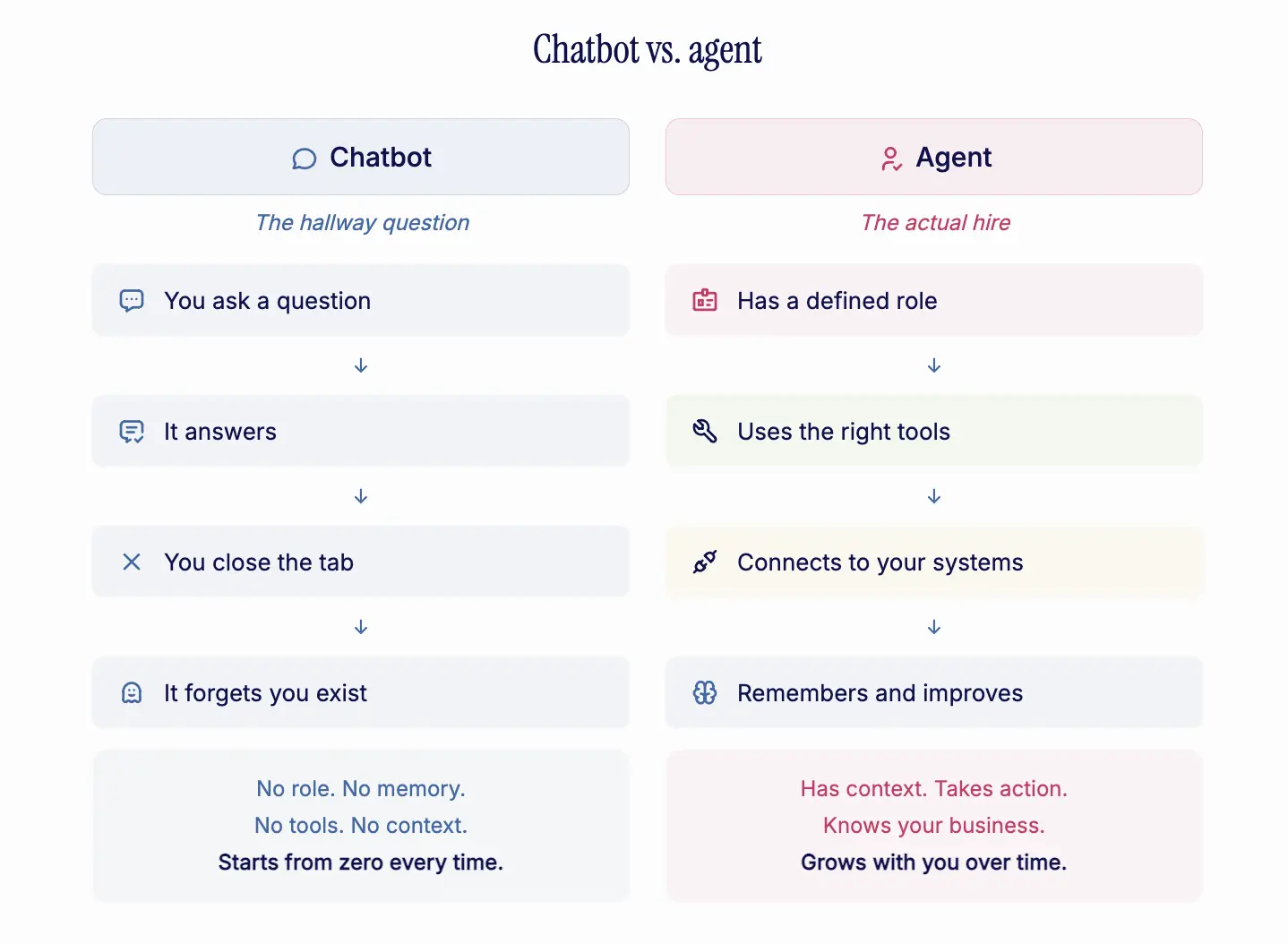
A chatbot is a conversation. You ask; it answers; you close the tab; it forgets you exist. An agent is more like a teammate... one with a specific job, tools it can use, memory of what happened last time, and the ability to take action without you standing over its shoulder directing every step.
The difference between asking a coworker a quick question in the hallway versus actually hiring someone and giving them a role on your team. The hallway question is useful. But the hire? That person shows up every day with context, with a defined responsibility, with the ability to go do things on your behalf.
That's where things are heading. And you don't need to be technical to understand it... You just need the right frame.
A chatbot is a conversation. An agent is a colleague.
The Frame That Changed How I Think About This
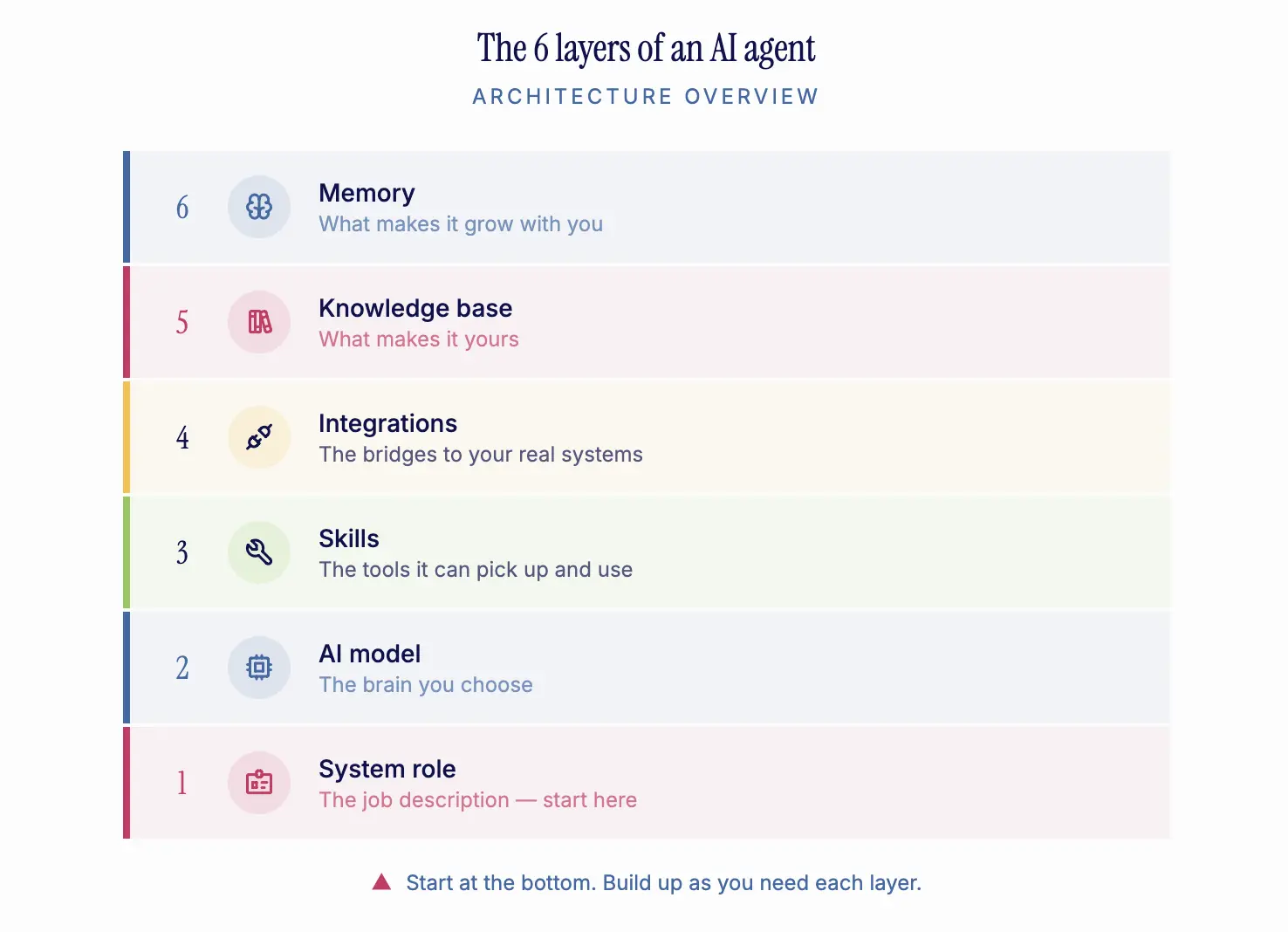
Every AI agent, no matter what platform you build it on, is a stack of six layers:
System Role, Model
Skills
Integrations
Knowledge Base
Memory
I didn't learn this from a course... I learned it by digging through documentation.
I came across a tool called LobeHub last week. Open-source AI agent platform with tens of thousands of stars on GitHub positions itself as a "Chief Agent Operator." The pitch is that instead of one-off AI conversations, you build persistent agent teammates that run tasks around the clock and report back even when you're offline.
Now, my first instinct with any new tool these days is to have Claude scan it before I sign up. Because Claude has context on what I've already built and what I actually need. It either confirms my instinct or redirects me before I waste three hours setting up something that duplicates what I already have. (This habit alone has saved me more time than any productivity app I've ever tried.)
But the interesting thing wasn't whether LobeHub was right for me. It was what I learned digging through their documentation. Because they laid out something clearly that I'd been doing instinctively without ever naming it: every agent is actually a stack of six distinct layers.
And once you see the layers, you can't unsee them. It explains why some agents work beautifully, and others give you word salad on Tuesdays and brilliance on Thursdays.
The 6 Layers of an AI Agent (In Plain English)
I'm going to walk through each one in plain English. Not because you need to memorize a framework, but because understanding these layers lets you actually diagnose what's going wrong when an agent isn't performing... and know what to add to make it better.
The six layers of every AI agent... start at the bottom, build up as you need each one.
Layer 1: The System Role (a.k.a. The Job Description)
This is where you tell the agent who it is and what it does.
Think about it like onboarding a new hire. You wouldn't just say "help me with stuff" and walk away. (Well, you might. I've definitely done that. It doesn't go well.) You'd tell them their responsibilities, the tone you expect, the boundaries of what they should and shouldn't touch, and what "done" looks like.
A system role does the same thing. "You are a research assistant who reads articles and produces 3-bullet summaries in a conversational tone" is a system role. "Help me with research" is... not.
Here's the thing, though. If you've never had to hire anybody, you don't know that you need a job description. You don't know that you need clear expectations, defined boundaries, and an explicit description of what the output should look like. That's not a failure of intelligence. That's a gap in experience.
And I think this is where the humanities matter more than the technology. The people who build great agents aren't necessarily the most technical. They're the ones who can think clearly about what a human would need to do this job well... and then translate that into instructions an AI can follow. What context would a new hire need on their first day? What mistakes would they make without guardrails? What does "good work" actually look like for this specific task?
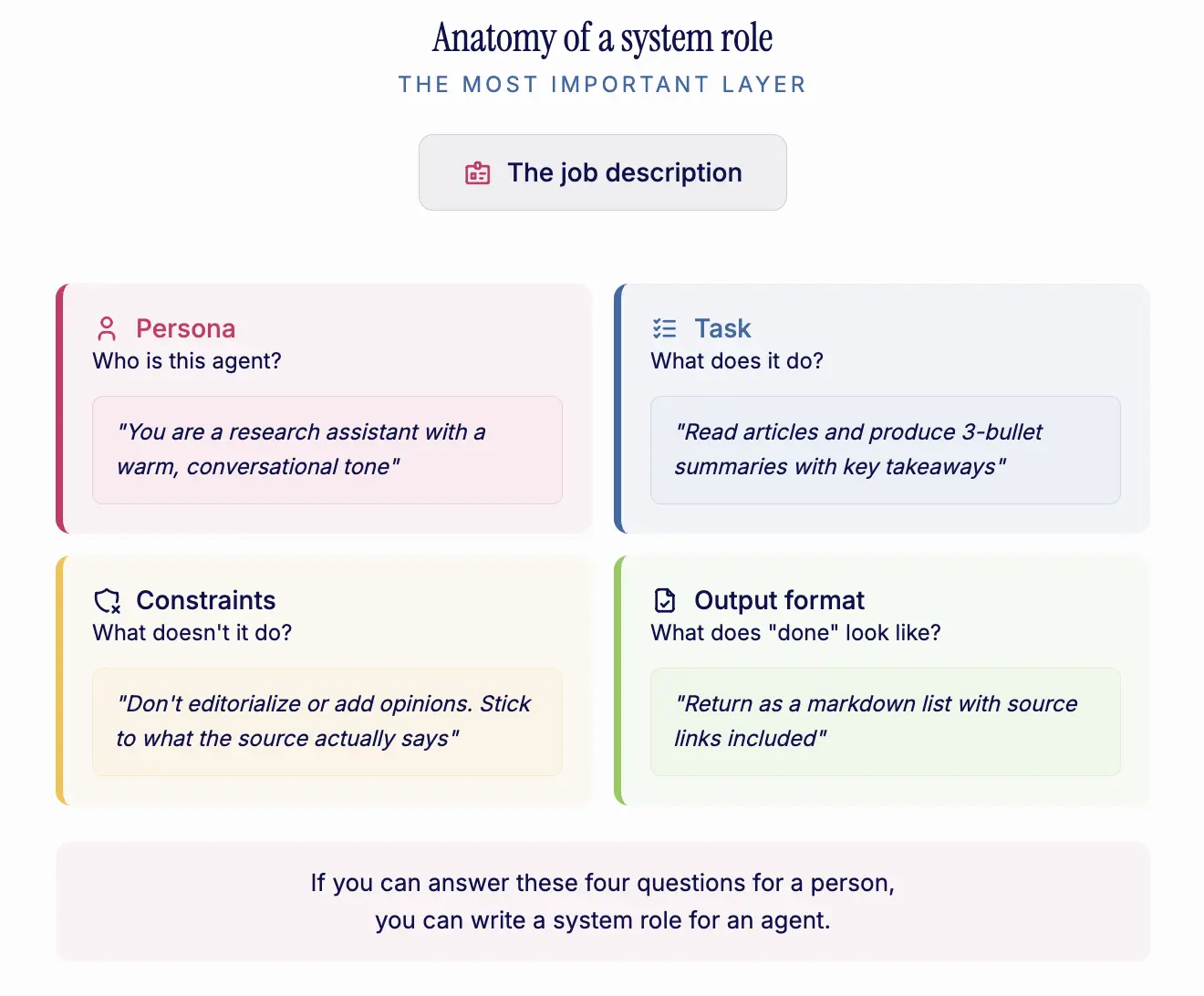
If you can answer those questions for a person, you can write a system role for an agent.
If you can answer these four questions for a person, you can write a system role for an agent.
Layer 2: The AI Model (The Brain You Choose)
Not all AI models are the same, and I didn't appreciate that early on.
Claude, GPT-4, Gemini, DeepSeek, Mistral... they all have different strengths. Some are better at reasoning through complex problems, some are faster and cheaper for straightforward tasks, some handle long documents better, and some write with noticeably more nuance.
I use Opus for final content writing because the voice quality is noticeably better. Sonnet handles research and analysis because it's fast, capable, and I don't need Opus-level depth for that kind of work. Choosing a model isn't about picking "the best one." It's about matching the brain to the job.
If you're just starting? Don't overthink this. Pick one model and learn it well. You can get sophisticated about model selection later when you actually feel the difference.
Layer 3: Skills (The Tools It Can Pick Up)
A base AI model can think and write. But it can't search the web, generate images, run code, or read a PDF unless you give it the tools to do so.
Skills are those tools. And the analogy I keep coming back to is this: you hire a smart, capable marketing coordinator. But if you don't give them access to your design software, your analytics dashboard, or your email platform... they're just sitting there being smart with no way to actually do the work.
Adding skills to an agent is giving it the equivalent of software logins and access to tools. Web search, code execution, image generation, file reading... each skill expands what the agent can actually do versus just what it can think about.
Layer 4: Integrations (The Bridges to Your Real Systems)
Skills are what the agent can use... integrations are where it connects to the systems where your work actually lives.
Your email platform, your CMS, your Slack workspace, your project management tool, your Shopify store... these connections are what turn an agent from a clever conversation partner into something that can actually take action in your business.
If you've heard of MCP servers (Model Context Protocol)... this is what they do. They're the connectors that let an AI agent reach into real systems to either pull data or push actions. LobeHub's marketplace has tens of thousands of them. And the number is growing across every platform, every week.
This is the layer where the difference shows up between an agent that tells you what to post on social media and one that actually posts it for you.
Layer 5: Knowledge Base (What Makes It Yours)
A base AI model knows a lot about the world in general. But it doesn't know your business, your brand voice, your customer data, your content archive, your pricing, or your competitors. Until you give it those things.
A knowledge base is your documents, your data, your context... uploaded and indexed so the agent can reference them when it works. This is the difference between an agent that writes "generic industry content" and one that writes content that sounds like your brand, references your actual offers, and understands your audience.
You don't need a massive database to start. One document that describes your business, your voice, and your audience will transform what even a basic agent can do for you. Seriously. One document.
Layer 6: Memory (What Makes It Grow With You)
Without memory, every conversation starts from scratch. The agent doesn't remember that you prefer short emails, that your CEO's name is Janet, or that you already tried that approach last month and it didn't work.
With memory, the agent accumulates context over time... it learns your preferences, remembers past decisions, and builds on previous work rather than starting over every session.
This is the layer that most free tools don't give you. And it's the layer that, when it's working well, makes an agent feel less like a tool and more like a colleague who's been on your team for months.
Why Does Building Agents Feel So Much Harder Than It Should?
Building agents is hard because it requires a skill most solopreneurs have never practiced: extracting implicit knowledge from your head and turning it into explicit instructions someone else can follow. That's a management skill, not a tech skill.
Let's be real for a second. The reason building agents feel overwhelmed isn't because the technology is complicated. It's because we're being asked to do something most of us have never had to do: clearly define a job, break it into steps, and write instructions precise enough that someone (or something) with zero context can execute it reliably.
That's a management skill, a communication skill, a thinking skill.
And if you've been a solopreneur... You probably haven't had to hire or manage many people. You just do the work yourself. You know how to do it, but you've never had to explain how you do it. The knowledge is in your hands and your head, not in a document.
So when someone says "just build an agent to handle that," what they're really saying is, "Extract all your implicit knowledge about this task, organize it into explicit instructions, define what good output looks like, set boundaries for what the agent should and shouldn't do, and choose the right tools and context to support it."
No wonder people stare at a blank prompt and freeze.
But here's the good news. This is learnable. And if you approach it from the human side... how would I explain this job to a real person?... you're already 80% of the way there.
I learned this the way I learn everything... I jumped in and did it. The first agents I worked with were other people's, and that's honestly how I'd recommend starting. Use someone else's well-built agent and watch what it does... notice how the system role shapes the output, notice what happens when you give it context versus when you don't. Then start building your own, one layer at a time.
Where to Actually Start
Two layers. That's it. A clear system role and a model.
Write a system role that covers four things: who the agent is (persona), what it does (task), what it doesn't do (constraints), and what the output looks like (format). Pick a model, run it, and see what happens.
Then add layers as needed. If the outputs are good but you need the agent to pull information from the web, add a search skill. If the outputs are generic and don't sound like you, add a knowledge base document. If you want it to remember your preferences across sessions, look for a platform that supports memory.
Don't over-engineer upfront... build lean, test, and iterate. You don't need to plan the entire architecture before you write the first prompt. You just need to know that the layers exist so you can add them intentionally, rather than wondering why things aren't working.
Your starter prompt
If you're reading this and thinking "okay, but what would I actually build?"... here's a prompt you can take into Claude, ChatGPT, or whatever AI tool you use. Paste it in, answer the questions, and it'll help you identify where an agent would actually make a difference in your business and draft your first system role.
I want to figure out where an AI agent would be most useful in my business, but I don't know where to start. Interview me about my business and daily work. Ask me questions one at a time about:
What I spend most of my time on each week
Which tasks do I repeatedly perform that follow a similar pattern every time
What work I procrastinate on or dread doing (and why)
Where I feel like I'm the bottleneck in my own business
After the interview, recommend my top 3 candidates for a first AI agent. For each one, explain why it's a good fit and rate it on a scale of 1-5 for how easy it would be to set up.
Then, for my #1 pick, draft a starter system role that covers four things: the agent's persona (who it is), its task (what it does), its constraints (what it doesn't do), and its output format (what "done" looks like).
That's it. One prompt, one conversation, and you'll walk away with a clear picture of where to start and a system role you can actually use.
And if you're wondering where you fall on the AI spectrum right now... whether you're still in the "using AI for chat" phase or already building... my AI Advantage Profile Quiz can help you figure that out in about two minutes.
Do I need to know how to code to build an agent?
No. Most agent-building platforms today are no-code or low-code. What you actually need is clarity about what you want the agent to do and the ability to communicate that clearly. That's a thinking skill, not a coding skill.
What's the difference between an AI agent and an automation?
An automation follows a fixed sequence: if this happens, do that. An agent can make decisions, adapt to context, and handle tasks that don't follow a predictable script. Automations are rigid and reliable, while agents are flexible and contextual... and most businesses benefit from both.
Should I build my own agent or use a pre-built one first?
Start with someone else's. Seriously. Using a well-built agent teaches you more about agent design in a week than reading documentation for a month. Once you understand how a good agent works, building your own gets dramatically easier.
What's the minimum I need to create a useful agent?
Two layers: a clear system role and a model. That's genuinely it to start. A system role that defines the persona, task, constraints, and output format... plus a model to run it... will get you surprisingly far. Add the other layers as you need them.
Why This Matters Now
Agents are moving from novelty to infrastructure. Every major platform is building agent capabilities. The tools that used to require a developer are becoming accessible to anyone willing to learn.
But understanding the architecture now means you're building a durable skill, not just learning a tool. When the platforms inevitably change (and they will), the six layers don't change. System role, model, skills, integrations, knowledge base, memory... that's the stack, and that's what every agent is made of, no matter where you build it.
And the thing that's going to differentiate the people who actually get value from agents versus the people who bounce off them? It's not a technical skill. It's the ability to think clearly about what you need, communicate it precisely, and approach the whole thing from a deeply human perspective.
How would you onboard a real person for this job?
Start there. The technology will meet you where you are.
Kim Doyal
Kim Doyal is a digital marketing strategist and AI builder with 18 years of online business experience. She is the founder of AI Spark Studios and SPARK Lab, and the creator of The Hub — a custom 33-agent AI operating system that runs her entire business. She has also built kimdoyal.com, StackRewards, and multiple AI tools and agents using vibe coding, a natural language approach to building software without a traditional development background.