HOME/BLOG/WHAT YOU BUILT WORKS... YOU JUST DON'T WANT TO OPEN IT
AI Building
What You Built Works... You Just Don't Want to Open It
Here's the filter I ran on my own product, plus the four prompts so you can run it on yours
July 27, 2026|5 min read
QUICK ANSWER
If something you built works fine and you have no appetite for it, that's a signal worth reading rather than something to push past. The usual cause is that it's organized around your logic rather than your customer's, which means the fix is to resequence rather than rebuild. Four prompts will tell you which one you're looking at before you touch anything.
I've been saying this since my early WordPress days, and it stands the test of time. When software is ugly, I bounce. 😂
I don't care what it does or how good the features are underneath. If the interface makes me not want to be in there, I'm not logging in, and anyone who's known me for any length of time has heard some version of that come out of my mouth more than once. Notion is a perfect example of this. I wanted so much to love it because I get the power behind it, but my brain just said, "Nope. Looks like a spreadsheet!"
So there is a certain justice in what happened next.
I launched SPARK Lab minimum viable, which for me meant twelve tools wired up and working, billing connected, login solid, go. Everything did exactly what I said it would, and I still didn't want to log in to it (not that there haven't been issues with some of the tools, and thanks to the members who let me know, but they get fixed) - and not just because I don't need to (I have a lot of the tools in the Lab built into my own workflows).
I couldn't put my finger on the issue, but I was frustrated. I also know enough about myself and how I work that it wasn't something I could force. I needed to sit with it, have some patience, do a little research, and then basically brain-dump everything into Claude. It wasn't broken or wrong; it was flat. Flat is a harder problem than broken, because at least broken tells you where to go.
What I kept circling was this: if it doesn't excite me, it is not going to excite somebody paying me fifteen dollars a month for it. I love what those tools do; I built every one of them, but loving what something does and wanting to spend time inside it are two different feelings. I want people to want to log in and use the tools.
I want to be clear that launching it that way was right and I'd do it again. You can't think your way to the answer from outside the thing. Shipping is what turns the question from theoretical into actual, and every useful piece of information I got came from the version that was already live.
What I got wrong (or learned) wasn't about how I launched it or shipped it (after years in the internet marketing space, I prefer a quiet launch to a noisy one. The noisy one can come later when I have more data on what's working and what people want). The other thing that hit me as I was working through all this is that there really isn't a final destination when it comes to building, selling, etc. Hardly a new concept, but this made that crystal clear.
There's no start and stop to any of this. You ship, you sit with it, you notice what's flat, you watch what people actually do, and you go again. That is not the messy part before the real version. That is the job, and it's the only part of this work that never ends.
A lot of the anxiety I'm watching people carry with AI right now comes from believing the opposite, that there's a correct version out there and everyone else has already found it, so launching yours wrong is a permanent condition. It isn't. Nothing you build is permanent anymore, which is either terrifying or the best news of your career depending on the day you're having.
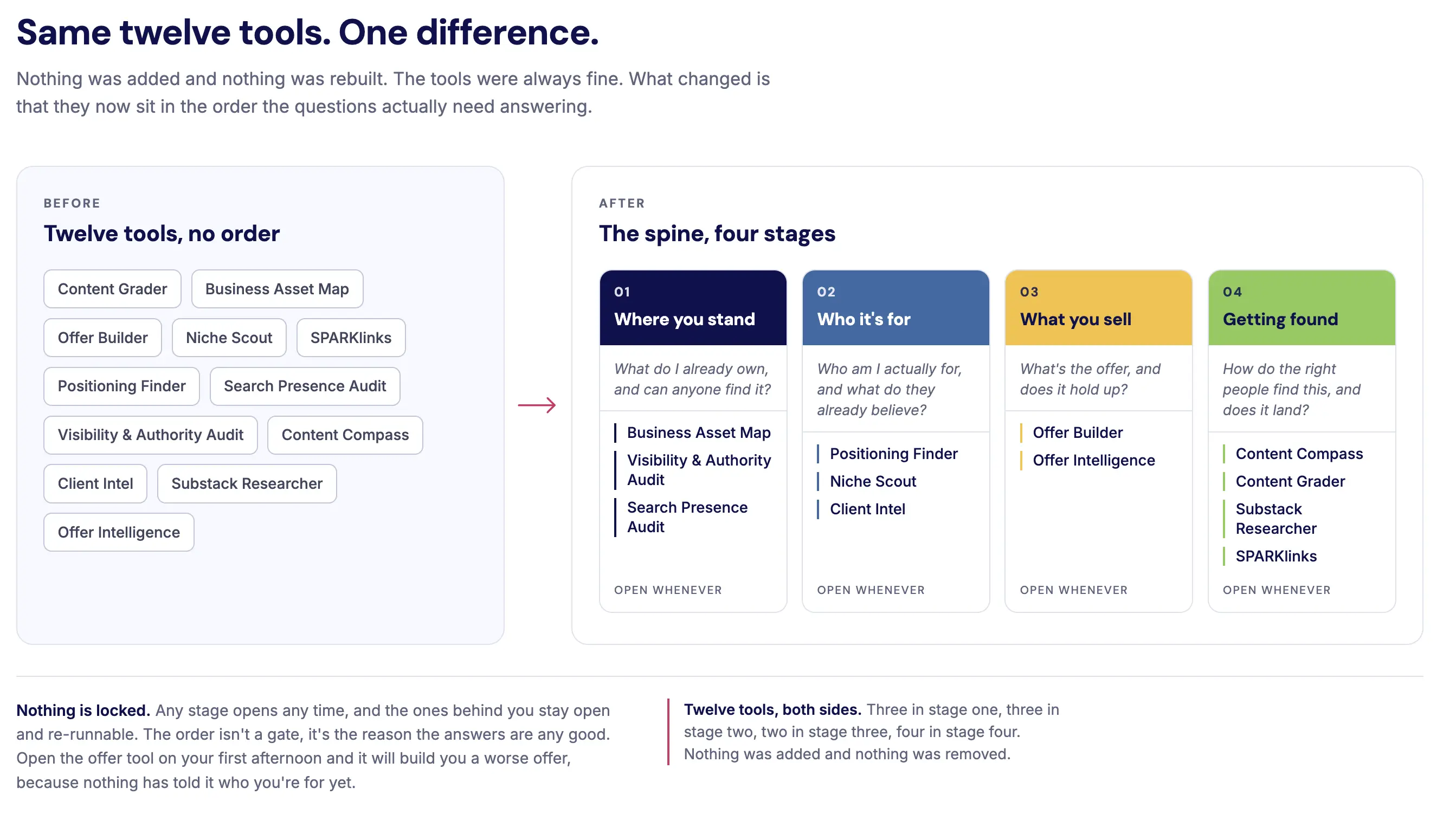
Same twelve tools. This is the only thing that changed.
So I went and looked
I've logged into a lot of other people's paid tiers. Memberships, portals, tool libraries, the whole spread. That's research, and I'd recommend it to anybody building something, because you learn more in twenty minutes inside a product than in a week of reading about one.
I also have older data on this.
Years ago, I was in a $3,000-a-month mastermind that started life as a Facebook advertising group. It had real content at the beginning, and then it slowly turned into a standing call where you showed up, asked for help, and somebody looked at your stuff, which is a very different product than the one that got sold. Guru end of the pool. A friend of mine ran it; I traded my way in by helping organize the retreats, and I stayed for over a year.
What actually fixed my ads was hiring one Facebook ad specialist for $15,000. More expensive, and I made every dollar back from the ads themselves because what I got was a dialed-in strategy instead of ambiguous big-picture thinking. Tangible and tactical beat motivational, and it wasn't close.
I've never stopped applying that, and it's the standard I hold this post to. If you don't leave here with something you can actually go use, I wasted your time.
Which brings me to Skool, since it sits at one end of everything I looked at and I have opinions.
I can't stand it.
The gamification, the points, the leaderboards, the part where you post in a chat to unlock content you already paid for. And that's before we get to how it looks, which is dated in a way I don't think is a matter of taste. I've been using software for a very long time, and I know exactly what it feels like to open something and immediately want to close it again. I seriously hate logging in to every school community I'm in.
The one thing I'll give it is that I can access every Skool membership I'm part of with a single login. That's definitely a convenience, but that's about all I like.
But here's where it gets interesting, and this is the part that took me longer to admit. The opposite end isn't very helpful either. A login page with twelve tools behind it is a filing cabinet you pay for monthly. It doesn't overwhelm you with fake achievement; it just doesn't do anything for you at all, and that was mine.
Yawn.
Both of those are somebody else's container. Neither one starts from who I'm serving or how I want to live, and that's why sitting with the flatness mattered. The question underneath it wasn't what should this look like. It was where is this going, what do I want it to do, and is it part of something bigger or is it a collection point for resources?
I didn't want to build a collection point for resources. I appreciate the communities I'm part of that have a great collection of resources, but that doesn't align with how I want this to evolve. Nor does it align with how I want to live my life. 😉
I asked to be told what was wrong before I asked for help
Before I talked strategy with Claude at all, I had it audit my own offers file. That's the document holding everything about my offers, pricing, positioning, and how the pieces connect, and it gets read whenever we work on a business decision together, which means every answer I get is downstream of it.
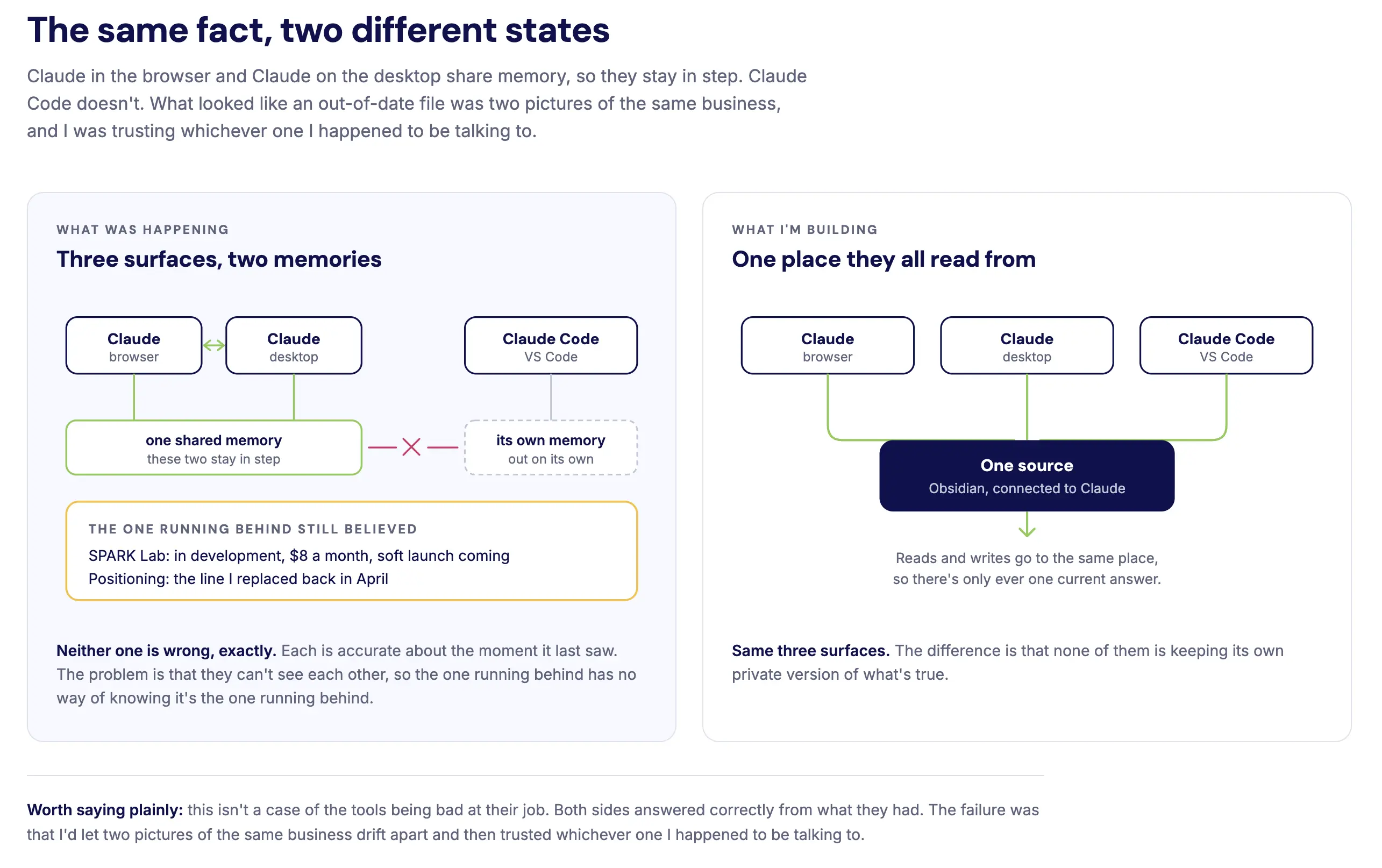
It had been flagged as out of date a couple of weeks earlier, and I hadn't dealt with it. This is more of a memory problem than a 'stale inputs' problem. I'm finally building one place (second brain/master memory, whatever you want to call it) that connects Obsidian with Claude, so I can work with it in the browser/desktop, or in VS Code via Claude Code. Once that's finished, I won't end up with two different instances of Claude thinking things are in different states.
What came back:
SPARK Lab listed as in development, soft launch still coming, roughly $8 a month, described with a word I'd permanently banned from tier naming. Wrong on price, wrong on status, wrong on structure.
The positioning line from before my April repositioning, still sitting there as though it were current.
A funnel map that ended at SPARK Lab, as if the Lab were a destination.
A product marked "launching Friday" that nobody could tell me had shipped or quietly died.
Two other files contradicting each other about a tier I retired months ago.
The funnel one would have done the real damage. If SPARK Lab is the end of the funnel, every downstream structural decision is about pushing people toward it. If SPARK Lab is the layer everything else sits on top of, which is what it actually is, those decisions invert completely. I'd have spent the whole night confidently solving the wrong problem if I didn't know one version of Claude was behind the other (and this, my friends, is why every now and then we stop, assess, and restructure things. I'm not bothered by any of it. This stuff moves so fast it's bound to happen).
You have a version of this whether or not you've ever written it down. It's whatever you'd say if somebody stopped you right now and asked what you sell and who it's for, and the odds are decent that a piece of that answer quit being true a while ago and nothing ever forced you to notice.
Both sides were right about the moment they last saw. Only one of them was current.
Four passes, and the useful part was being told no
Then we actually started, and I was told "no" roughly four times... but I didn't even care (I was doing this in the evening with the TV on in the background, so I made it very clear that I was in the middle of processing things and wanted help pulling out and defining what wasn't working. Nothing annoys me more than Claude trying to school me when I'm already frustrated, lol.)
If the AI you're working with only ever agrees with you, you don't have a thinking partner; you have a very expensive mirror... but I also want it to watch its tone, lol. For this kind of work, a mirror is worthless. I didn't need something to make my idea sound better than it was; I needed something to notice that my idea contradicted a thing I'd said forty minutes earlier.
Which is exactly what happened.
I'd drifted toward something with a social shape to it and got stopped with a version of "but I thought you said you didn't want chat stuff."
Which, yes, I did say that, repeatedly and for years. Presence and obligation are the two things I've deliberately designed out of this business, and I'd wandered right back toward them because the alternative felt too plain and I wanted the page to feel like more.
There were others. When I said one of the things sitting finished in my codebase was ready to turn on, I got asked what would have to be true before I flipped that switch, and I didn't have a good answer, which told me it wasn't ready. When I was working out pricing on a standalone bundle, I got told the overlap I was carefully pricing around wasn't a pricing problem at all. It was a positioning problem, and no price was going to fix it.
That's the part I'd want you to take from this more than the structure I landed on. Four rounds of being contradicted produced something I would never have reached by being quickly agreed with.
What SPARK Lab actually became
It became a single-authored sequence with four stages, and every member sits somewhere on it rather than in a category I assigned them to.
The unlock came from a reframe I didn't see coming.
The category I'm in is drowning in information. Hundreds of prompts, tool lists, downloads, templates, swipe files, much of it sitting in no particular order, everybody competing on how much they can hand you.
Which means the scarce thing is not content. It's sequence.
Or, put more directly, "How [this tool] helps you with 'X'.
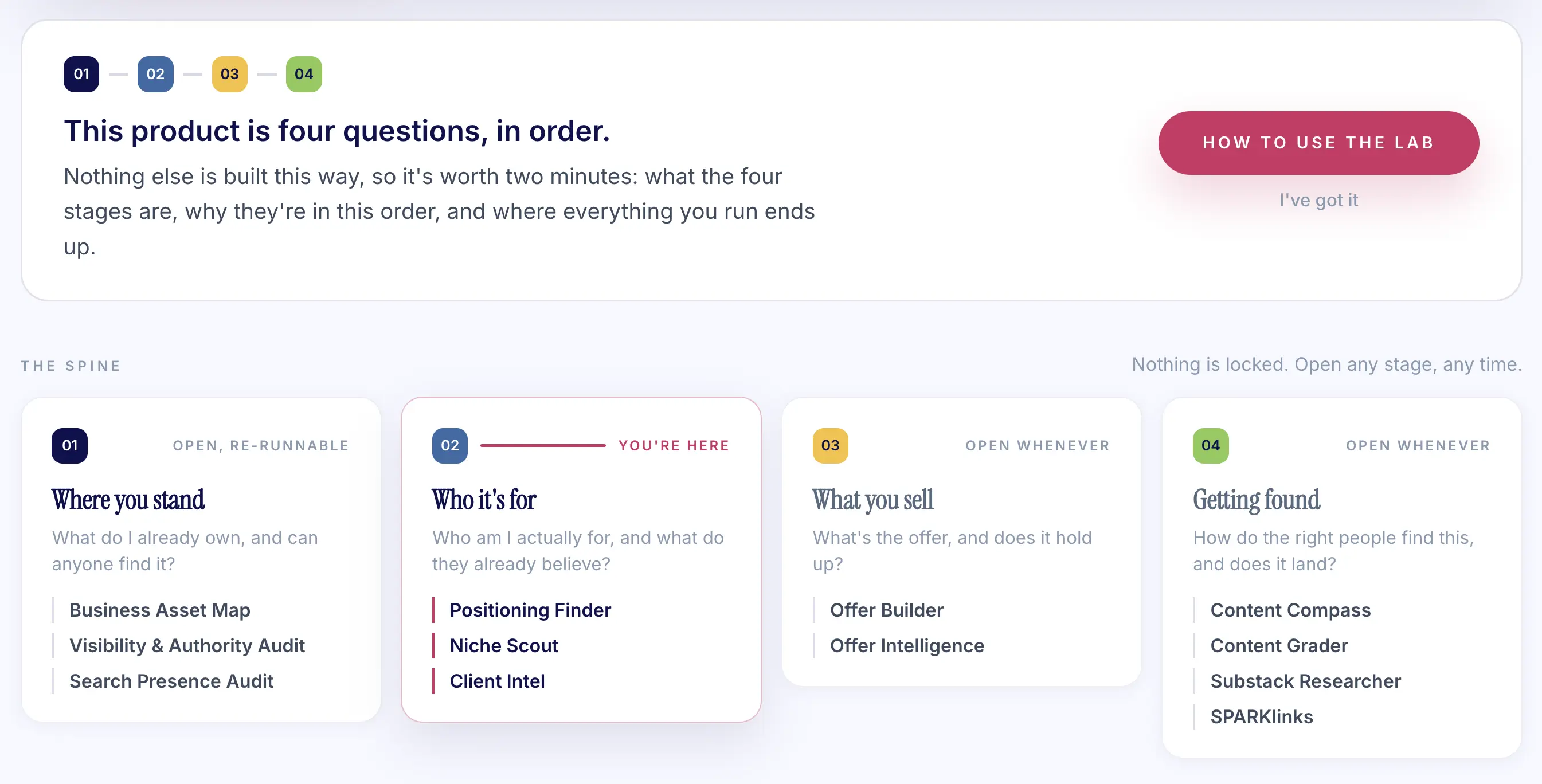
So everything now hangs off a single authored sequence, and I've been calling it the spine. Every member is on the same spine. What differs is where they are on it.
Where You Stand. What do I already own, and can anyone find it?
Who It's For. Who am I actually for, and what do they already believe?
What You Sell. What is the offer, and does it hold up?
Getting Found. How do the right people find this, and does it land?
Same twelve tools. This is the only thing that changed.
Two things about it matter more than the four stages: they're the design principles rather than the decoration.
Nothing is gated by stage. The order is guidance, not a lock. If you're sitting at stage two and you want to open a stage four tool, open it. Sequence without a permission structure stacked on top of it is the entire trick, and it's what keeps this from quietly becoming the container I said I didn't want.
The Build Tools and Intel Tools split has been removed from the member view.
That was my taxonomy. It sorted by how the tools work, which is how I think about them because I made them. My customer doesn't care whether a tool builds or analyzes; she cares about what she's trying to get done this month, and the spine sorts by her question rather than my architecture. I should have caught that a long time ago (you know the old saying, "Can't see the forest for the trees").
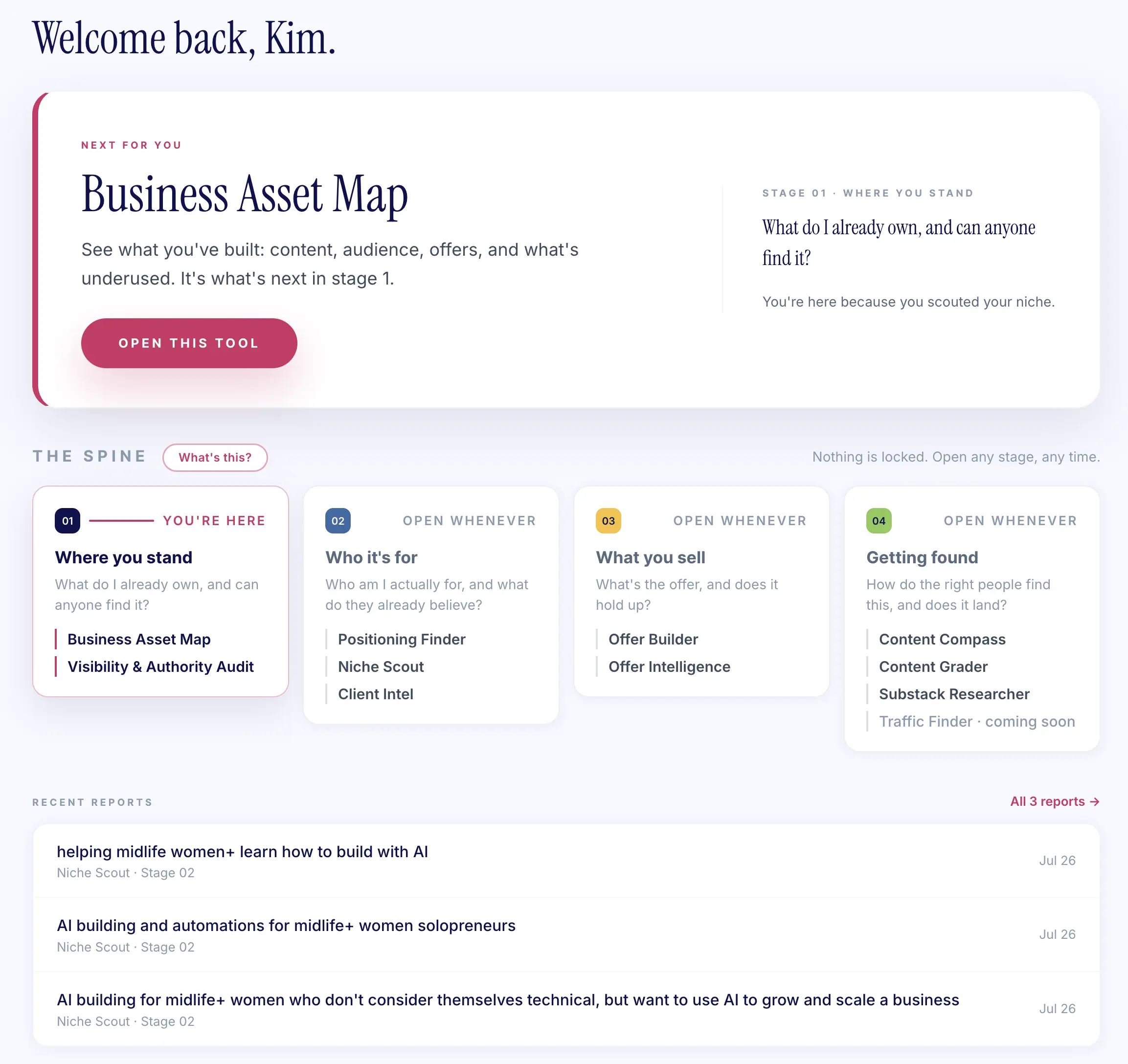
The piece I'm quietly most pleased with is the report library. I had added this last week, but now it's got a better structure.
Every tool run produces something, and those outputs now accumulate in one place. Accumulation is exactly what I've been designing against everywhere else in this product, except here it's right because it's her work rather than my catalog. Six months in, she has a body of work living in the Lab that she made, and I didn't have to manufacture a reason to stay.
Growth without overwhelm is the design principle, and it's also what I'm promising you. Those turned out to be the same sentence, which is how I knew the structure was finally right. And I want to log into it now, which is the other way I knew.
Where you are, what's next, and what you've already made. That's the whole dashboard.
All of that took two sessions
Which is the part I keep coming back to. The reframe, the four stages, the taxonomy I retired, the report library, all of it landed across two sittings, and I worked both of them until I needed a break.
Speaking of breaks...one of my goals with AI is to 'buy back my time.'
Let me be clear... AI has not given me my time back.😉
I'm working more than I was two years ago, deliberately, and I'd do it again tomorrow. Eighteen years of building sites and running marketing and watching what actually moves revenue turned out to be the exact preparation for this particular moment, and I can feel the leverage now in a way I couldn't before, so I work until I can't, and then I take a real break, and then I go again.
There's a window open right now, and I'm grabbing it with both hands.
I want to be careful with that, because it reads like it's about me and it isn't. Whatever you've been doing for the last ten or twenty years is the same kind of preparation, and none of it had to be technical.
Knowing what a bad client looks like before they sign, knowing which promise your market actually believes, knowing why the thing you sold in 2019 landed and the one in 2021 didn't. That's the part nobody can prompt their way to, and you already have it.
The time comes later, and it comes from assets rather than hours. A directory that's built and optimized and running without me, apps, automations that don't need me to babysit them.
That's where the time actually lives, and none of it exists unless I go deep enough now to build the right thing instead of a fast thing.
Which is why speed is both a challenge and a gift. Iteration is faster than it has ever been.
That's precisely why depth matters more now, not less. When execution was slow, the slowness did some of your thinking for you. You couldn't afford to create the wrong thing because it took much longer to make, so you had to be sure before you started. That friction is gone, and nothing arrived to replace it.
Speed will carry you to the wrong place just as efficiently as the right one, and it'll do it before you've noticed you're moving.
The only thing standing between fast and wrong is knowing what you actually want, and AI will not hand you that. It'll help you find it if you let it argue with you, but it won't hand it over.
One note on platforms
Substack ran out the Pangram integration last week, where readers can scan a post over 100 words to see how much of it a machine wrote, and writers get a space to say how they actually work.
I'm not going to relitigate it here (we've all read plenty about it, I'm sure). What it reminded me of is that platforms don't get to dictate how we do this, which is the same thing I was working out with SPARK Lab from a different direction, and I wrote about the underlying principle a few days ago in "Build Assets With AI, Not an Audience You Rent."
The Flat Filter
Everything up to here is me running a filter on my own product. So here it is as something you can run on yours.
Four prompts, in order, for whatever you've got that works fine and doesn't excite you. A page, an offer, a membership, a service, a whole business. Paste them into Claude or ChatGPT one at a time and answer honestly, because the output is never better than what you're willing to admit in the first one.
The order matters more than the wording. Each one is only answerable because the one before it cleared something out of the way.
1. Stale Inputs
I'm about to make decisions about [PROJECT / OFFER / PAGE]. Before we do any of that, I want you to audit my assumptions rather than help me.
Here is everything I currently believe about it: [paste your description, positioning, pricing, who it's for, and how it fits with everything else you sell]
Ask me up to seven questions designed to find where this description is out of date, internally contradictory, or describing a version of my business that stopped existing a while ago. Look specifically for prices, names, or statuses that may have changed; places where two things I've said can't both be true; anything I've described as coming soon that has been coming soon for a while; and positioning language that predates my most recent thinking.
Do not offer solutions and do not reassure me. Just find the stale parts.
2. Broken or Flat
Here is [PROJECT / OFFER / PAGE]: [describe it, or paste the content]
I want to work out whether this is broken or flat. Broken means something doesn't work. Flat means everything works and nobody, including me, especially wants to be there.
Ask me these one at a time and wait for my answer before moving to the next:
When did I last open this for a reason other than maintaining it?
If I showed it to someone whose opinion I care about, what would I explain or apologize for first?
What did I imagine it would feel like to use, and where does the real thing diverge from that?
If it vanished tomorrow, what would the people using it actually miss?
After my answers, tell me which question revealed the most and why. Be direct. If my answers suggest the thing is genuinely fine and I'm just bored with it, tell me that instead of inventing a problem for me to solve.
3. Whose Logic Is This
Here is how [PROJECT / OFFER / PAGE] is currently organized: [paste your navigation, tiers, page structure, product lineup, however it's sorted or grouped]
For every way this is grouped, sorted, named, or sequenced, tell me whether the organizing logic comes from:
(a) how I built it, or how I think about it internally (b) what the person using it is actually trying to get done (c) a convention I inherited from a platform, a template, or a competitor
Be specific about which category each element falls into and why you put it there. Then show me what this would look like if every element were reorganized around (b), and tell me what I'd lose in the process.
I expect most of it to land in (a) or (c). Don't soften that.
4. Argue With Me
I've decided [state the change you're planning to make].
Your job now is not to help me execute it. Your job is to find where I'm wrong.
Go back through everything I've told you in this conversation and find any place where this decision contradicts something I said earlier, any place where I'm solving a positioning problem with a pricing change or a strategy problem with a design change, anything I said I didn't want that this quietly reintroduces, and what would have to be true for this to be the right call, including whether I've actually established it.
Push back at least three times before you agree with anything. If you find yourself agreeing quickly, you aren't looking hard enough.
The fourth one is the one you'll want to skip, and it's the one that does the work. An AI that agrees with you is the most expensive way to stay wrong.
Frequently Asked Questions
Should I wait until it's right before I launch it?
No, and I'd argue you can't. You cannot think your way to the answer from outside the thing, so launch it minimum viable and let the live version tell you what's wrong. The mistake was never shipping early. It was quietly assuming there'd be a finish line after which the iterating stops.
How do I tell whether my product is broken or just flat?
Broken means something doesn't work, and the fix is usually obvious once you find it. Flat means everything works and nobody, including you, especially wants to be there. Flat is the harder one because it doesn't tell you where to go, and the fastest test is whether you've opened it recently for any reason other than maintaining it.
Won't AI just agree with whatever I tell it?
It will if you let it, which is why you have to instruct it not to. Tell it explicitly to find where you're wrong, then push back when it caves and agrees with you anyway. An AI that agrees quickly is the most expensive way to stay wrong, and that's the entire reason the fourth prompt above exists.
Do I have to redesign everything I've built?
Usually not. Most of what feels flat is organized around your logic rather than your customer's, and reorganizing costs far less than rebuilding. Run the third prompt before you touch anything, because the answer is more often a resequencing than a redesign.
What I'd ask you instead
When software is ugly, I bounce. And then I built something I didn't want to log in to, and it took me longer than I'd like to admit to treat it as information rather than a mood.
I'm not going to tell you the spine is your answer, because it's mine, and borrowed structures are how this goes sideways in the first place.
So what have you got running right now that isn't broken, exactly? It works, nobody's complaining, you just don't especially want to open it.
That's not a mood... That's the most useful data you have, and it's been sitting there the whole time.
Kim Doyal is a digital marketing strategist and AI builder with 18 years of online business experience. She is the founder of AI Spark Studios and SPARK Lab, and the creator of The Hub — a custom 33-agent AI operating system that runs her entire business. She has also built kimdoyal.com, StackRewards, and multiple AI tools and agents using vibe coding, a natural language approach to building software without a traditional development background.