HOME/BLOG/I BUILT MY BRAND STRATEGY FROM DATA, NOT VIBES... HERE'S THE EXACT PROCESS
AI Building
I Built My Brand Strategy from Data, Not Vibes... Here's the Exact Process
Here's What "Building from Data" Actually Means
April 9, 2026|5 min read
It started with a phone call that accidentally ended abruptly.
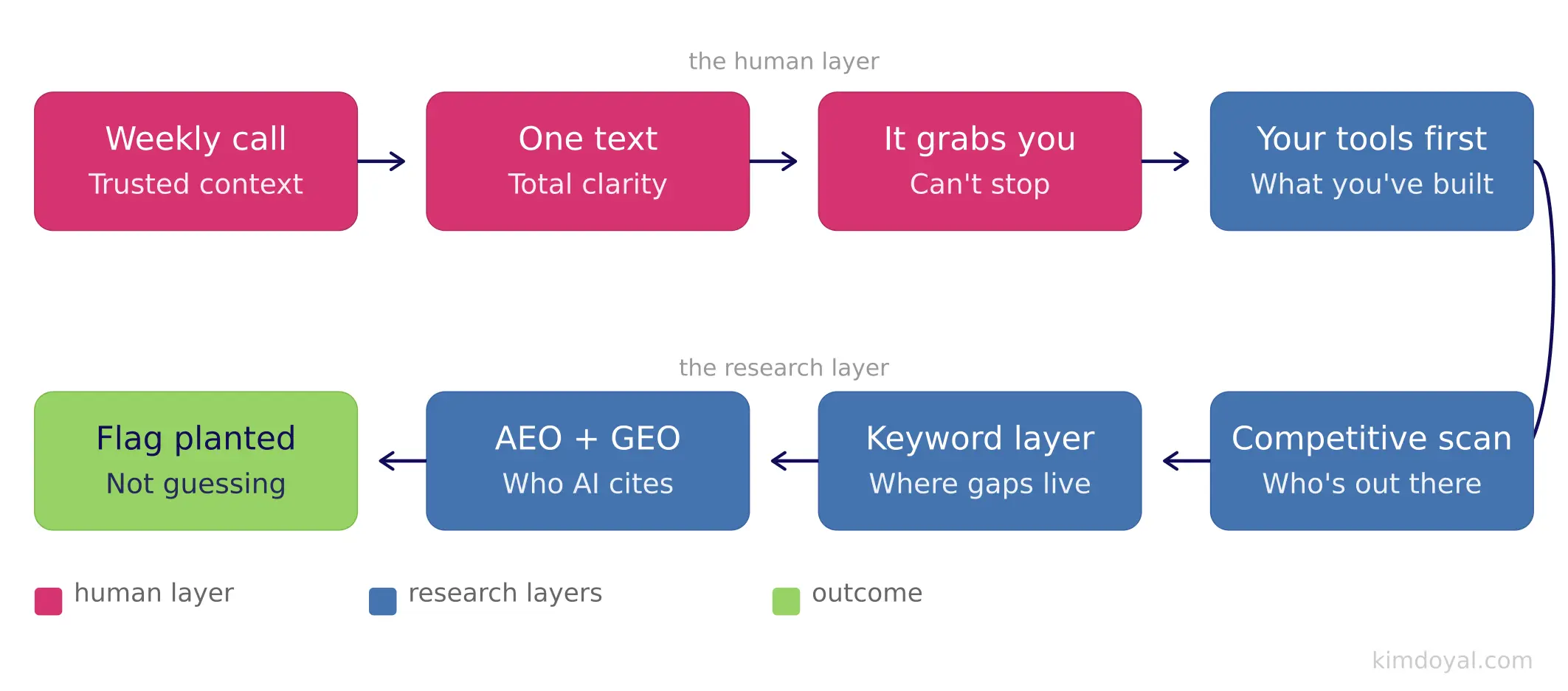
Jason and I have a standing weekly call. He's known me since my WordPress Chick days, through the Content Planner, through every pivot and reinvention, and through every "wait, what am I actually doing?" moment in between. He's one of those rare people who holds the full arc of your story in their head and talks to you from inside that context rather than just reacting to whatever you said five minutes ago.
We were talking about positioning that day... I'd been feeling not stuck, exactly, but blurry. Like I knew what I was doing but couldn't quite land the words for it in a way that felt both true and complete. And then his internet cut out. Just gone (because, of course, it did. Right when he was sharing some gold nuggets 😉).
A few minutes later, a text came through.
"I think for you it's a matter of going deep into why you build something and becoming that voice in the market that people get inspired by, but also reach out to learn from and build stuff for."
The second I read it, I knew...
That's it.
Not because it was some genius insight I'd never encountered before, but because it named the thing I'd been circling around without letting myself fully claim it. I'd been softening the builder angle, hedging it, framing myself as someone who teaches AI strategy because I'd convinced myself my audience wouldn't see themselves as builders and wouldn't want to be led by one.
The thing is, they're all becoming builders, whether they know it yet or not, and softening my own identity to seem more approachable had been quietly diluting exactly what made me interesting to them.
Here's the thing about what happened next, though, and why I'm telling you this story the way I'm telling it: no amount of research was going to surface that clarity for me. The agents, the data, the audits we'll talk about in a minute... all of that is genuinely powerful, and I mean that. But Jason's text landed the way it did because he's watched me evolve through enough iterations that he has pattern recognition on me that no tool does. He could see what I couldn't see clearly from the inside. The research can confirm a position, but it can't choose one for you. That part required someone who's been paying attention long enough to see the pattern.
That text landed on a Wednesday afternoon. By Wednesday night, I had repositioned my entire website.
Here's what actually happened.
What the Rest of That Day Looked Like
The sequence I ran — from the conversation that sparked it to the flag planted at the end. Click any node to go deeper.
The rest of that day was one of those sessions where you look up, and it's been four hours, and you haven't stopped once. The idea had grabbed me, and I was not putting it down.
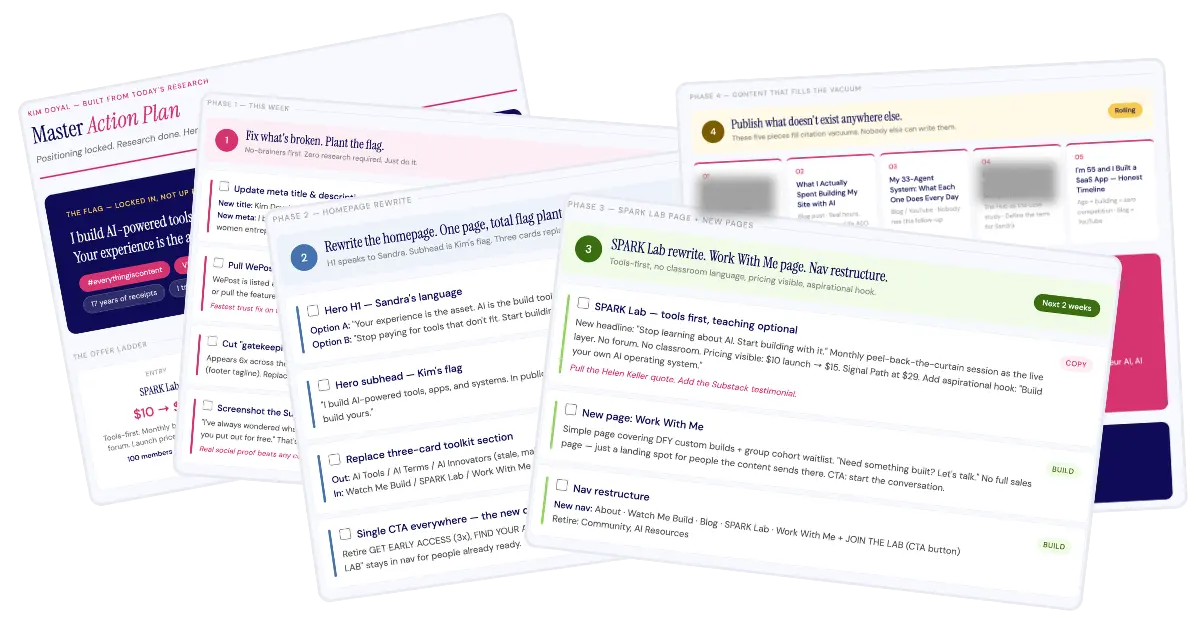
Before I ran a single agent, I mapped out the whole project visually, talking it through with Claude and building a master action plan, structured step by step, with dependencies flagged so I knew what had to happen before what else. Some of it went in order. Some of it had that "oh wait, I can't do this until I do that" realization mid-process. But the map held, and having it meant I was working from a plan I'd committed to rather than making decisions on the fly.
This is what 'I mapped it out first' actually looks like. Four phases, tasks with dependencies, copy options, all of it — built in one conversation before I touched a single page of the site.
That's the part I want you to see, because it's the part that doesn't make it into most "I used AI" stories. I didn't open Claude and ask it to write my homepage. I opened Claude and thought out loud about my business for a while first, and what it handed back was a roadmap I could actually work from. The research agents came after that. The rewriting came after that. The whole thing had a structure before it had a single new sentence.
This is what I mean when I say "building with AI rather than just writing with it" (building doesn't always mean building apps or big projects).
Then I started the research, and the first thing I did was scrape my own website. You'd think that after building and rebuilding it for years, you'd have a clear picture of what you're actually saying on it, but running it through a research agent gives you something different. You see the gap between what you think you're communicating and what you're actually putting out there, and that gap, for most of us, is more interesting than we expect.
From there, the process had its own momentum. 🚀
I have research agents built into my own business operating system. Some I've purchased and added to, some I've built from scratch. Thanks to Dheeraj Sharma of GenAI Unplugged and his Content Gap Analyzer, I'm a little obsessed with agents (these are all triggered by me, none of them need to run on a consistent basis).
I ran the competitive research first, and I won't share the specifics because, well, that would be silly to publish here before I've had a chance to implement it all. It showed me things I genuinely didn't expect. Then the keyword and phrase layer, mapping where people in my niche actually search and where the coverage is thin. Then the AEO/GEO audit (stick with me, even if you're not familiar with those terms, I explain them below).
What I want you to understand about this sequence is that each layer informed the next:
✔️ The competitive scan told me who was out there and what they were claiming
✔️ The keyword layer told me where demand existed without a dominant answer
✔️ The AEO audit told me who was being cited and, more importantly, who wasn't.
By the time I was done, I had a map of the territory rather than a feeling about it, and those are very different things to make decisions from.
Three Things the Research Revealed
I'm going to be intentional about what I share here, because some of what I found is active competitive territory. But the types of things that came back from this research are absolutely worth teaching, because they're almost certainly sitting in your data, too, if you go looking.
There's almost certainly a gap in your market you don't know about.
It wasn't a small gap; it was an intersection where a specific combination of experience, perspective, and audience met a real demand that nobody was explicitly claiming. The people who could own that intersection were either unaware it existed or weren't communicating it clearly enough for the market to recognize them as the answer.
Let me make this concrete with a different niche, since I'm not giving mine away. 😉
Imagine you're a nutritionist who specializes in perimenopause and athletic performance. You know the space. There are general nutritionists, perimenopause specialists, and sports nutrition experts. But is anyone explicitly positioning at the intersection of all three, for women over 45 who are still training hard?
Maybe. Maybe not. You would have to look.
Most people don't think to look, not because they don't want to, but because they assume it's already taken, and they assume that because they know the individual pieces of their niche are crowded, so they project that crowding onto the intersections without actually checking.
I did this too, for longer than I want to admit.
Here's what I can tell you from the other side of it: the research is more interesting than the assumption (and it's incredibly exciting!). Running the data and seeing what's actually out there, what's claimed and what isn't, what's crowded and what's wide open — that's a fundamentally different experience than sitting with a hunch. It's the difference between standing outside a room and guessing what's inside and just opening the door.
Platform ownership is becoming a moat, not just a nice-to-have.
One thing doesn't move. Everything else floats. Seventeen years of building on owned ground — that's the moat.
Something came up in my research that wasn't about keywords at all: there are creators in my adjacent space with enormous audiences, thousands of paying members, YouTube channels with real influence, and some of them have built entirely on rented land. No owned website, no domain authority that's theirs, regardless of what an algorithm decides tomorrow, just platform-dependent presence.
I've been building on my own domain for 18 years. That's not nostalgia — it's a strategic position that compounds over time in ways that social metrics simply don't, and it looks very different in a research scan than it does for a creator with three times my subscriber count but no owned infrastructure (no judgment).
AI answer engines aren't citing anyone in certain categories right now. That's a crisis or an opportunity, depending on what you do next.
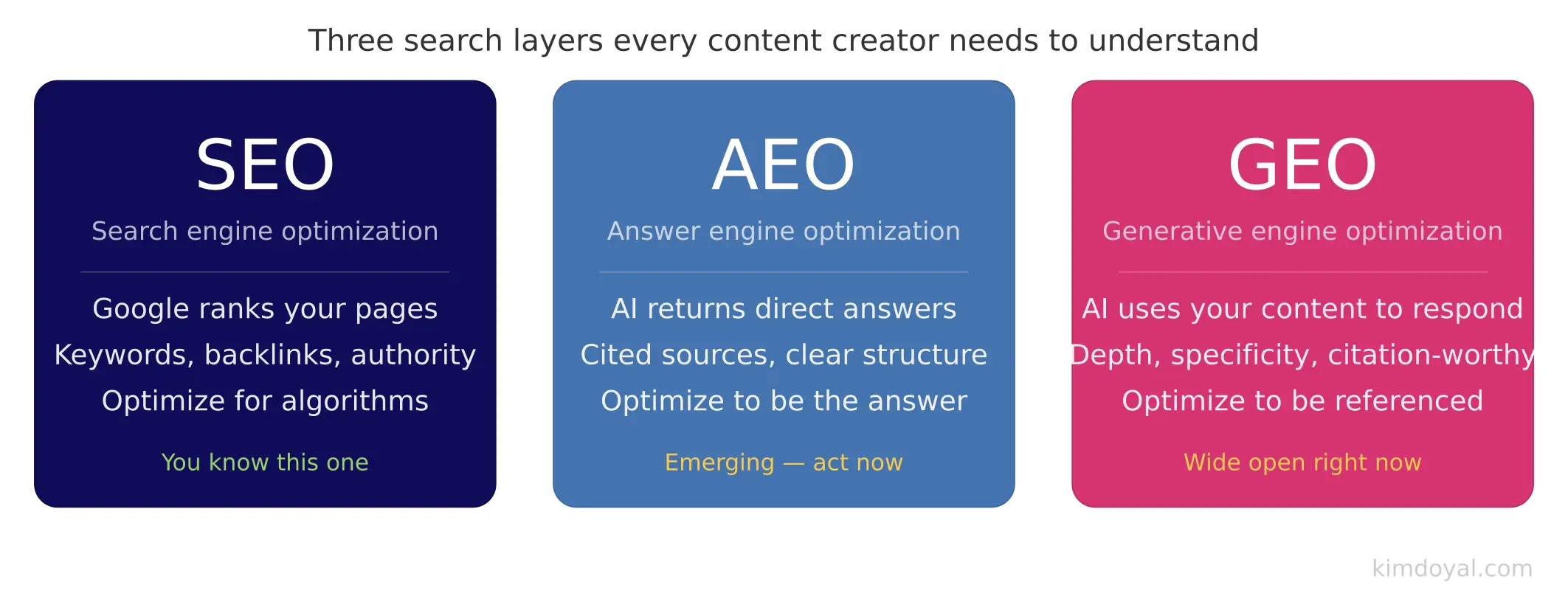
SEO you already know. AEO and GEO are the layers most people are still skipping — and right now, that gap is an opportunity.
AEO is Answer Engine Optimization, and GEO is Generative Engine Optimization, and they both refer to the same fundamental question: when someone asks an AI assistant something in your niche, whose content does it reference? Whose expertise does it surface consistently? Right now, for many specific, niche categories, the answer is: nobody in particular. There's no dominant voice the AI consistently calls on. The content exists but hasn't established citation authority in the AI search layer.
That gap is a timed window.
How to Find Your Own Lane
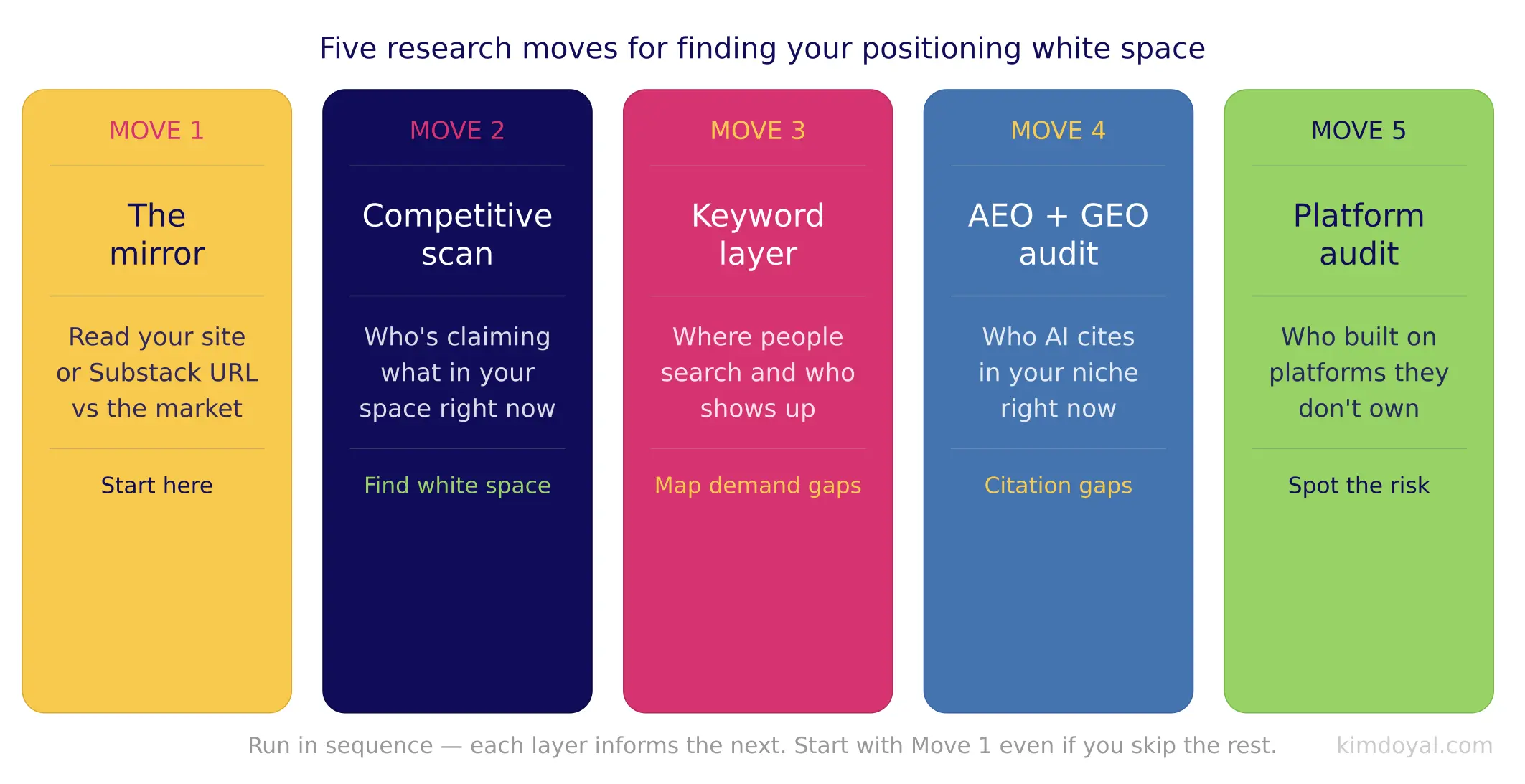
You don't need my agents to run this research. You can start right now with Claude, ChatGPT, or Perplexity... whichever you already have open. The prompts below are rough frameworks, not copy-paste magic. You'll adapt them to your context, your audience, your niche. But the five moves are real, and they work.
One important note before you start: if you don't have a website yet, your Substack publication page works just as well for Move 1. The goal is to audit the content you're actually putting out there — whatever that looks like right now.
Run Move 1 first, even if you stop there. Knowing what you're actually saying is the whole foundation.
Move 1 — The mirror: read your own content before you look anywhere else
This is the step most people skip, and it's the one that makes everything else land harder. You need to know what you're actually saying before you can see how it maps to what the market needs.
Paste your URL directly into Claude, Perplexity, or ChatGPT. Both the free and paid versions of Perplexity can fetch and read a URL, and Claude on the web can do the same. You don't need to copy and paste your content — just give it the link and let it read the page.
Rough prompt:"Go to [your website URL or Substack publication URL]. Read all the content on the page. Then do four things: (1) List every positioning claim I'm making — every statement about who I serve, what I do, and why I'm different from others in this space. (2) Flag any word or phrase that appears more than twice — repetition can signal emphasis or dilution, and I want to know which. (3) Identify what questions a visitor would have after reading that the page doesn't answer. (4) Call out anything that sounds generic — copy that could appear on any competitor's site without changing a word."
That last instruction is the one that stings. When I ran this on my own site before repositioning, I found out I'd used the word "gatekeeping" six times across different pages. Strong word — once. Six times it becomes wallpaper. You want to know this before you go looking at anyone else's positioning.
Move 2 — Competitive scan: who's claiming what in your space right now
Before any brand or positioning decision, you need to see the actual territory — not to react to it or copy it, but to know what you're positioning against and where the white space is.
Rough prompt: "I'm a [your role or expertise]. Analyze the competitive landscape in [your niche]. Identify the 8 to 10 most prominent voices or brands. For each, describe how they position themselves, who they say they serve, what they claim to be known for, and what language they use repeatedly. Then identify positioning territory that appears unclaimed or underdeveloped — intersections where real demand exists, but nobody is explicitly planting a flag. My specific audience is [describe them in real detail, not a generic label]."
What you're looking for: not quality gaps (everyone thinks they're better than the competition), but positioning gaps. Is anyone explicitly speaking to the exact intersection you occupy? If the answer is no, that's your data.
Move 3 — Keyword layer: where your people actually search
This is about how your audience searches, not just what's popular in your industry. Those are meaningfully different questions, and the gap between them is often where opportunity lives.
Rough prompt:"My ideal client is [very specific description — go beyond demographics into worldview, what they've already tried, what they're frustrated by, what they actually want]. What terms and phrases would this specific person use when searching for [your type of help, content, or product]? Include the search intent behind each term. Then flag any terms that have significant search behavior but thin or low-quality content coverage — places where people are clearly looking, but nobody's giving them a real answer."
The more specific you are about who you're describing, the more useful the output. A generic audience description gets you generic keywords.
Move 4 — AEO/GEO audit: who AI cites when someone asks about your niche
This is the one most people are skipping right now, and the timing of that skip matters more than most people realize.
Rough prompt:"Act as an AI search analyst. When someone asks an AI assistant a question about [your niche] related to [your specific audience], what sources and voices would most likely be cited? What content formats and types are being referenced in AI-generated answers about [your key topic area]? And where are the citation gaps — topics or audience segments where AI answers exist but no specific voice is being consistently referenced?"
Then go test it yourself. Ask Claude, ask ChatGPT, ask Perplexity the questions your ideal client would actually ask. See who shows up. Notice who doesn't. That map of who's absent is your opportunity.
Move 5 — Platform ownership audit: who built on ground they don't own
Not a keyword exercise. A strategic risk assessment of your competitive landscape, and a way of seeing where your moat actually lives.
Rough prompt:"Research prominent creators and brands in [your niche]. For each, identify: Do they have an owned website with real domain authority, or are they primarily platform-dependent? Do they control their email infrastructure? Where does their audience primarily live, and what happens to that audience if the platform changes its algorithm, its pricing, or its terms? Summarize the overall platform dependency risk across the space."
You're looking for who in your space has built on rented land. That's their vulnerability — and it's part of your moat if you've been building on owned infrastructure.
A note on how I actually run this
The prompts above work with any AI tool you already have open. For a single page audit or a Substack publication, free versions of Claude, ChatGPT, or Perplexity will get you most of what you need.
Here's my actual setup, in the spirit of full transparency: I have Firecrawl (a web scraping API) and Perplexity connected via API, running inside Claude Code in VS Code. That's what powers my research agents — the ones that ran the full competitive analysis, scraped my site systematically across every page, and surfaced things like "gatekeeping appears six times" in about 30 seconds flat.
If you're at that stage, that's the setup to build toward. If you're not there yet, the prompts above get you 80% of the same intelligence using tools you already have — and that is a completely legitimate place to start. Don't let the existence of a more powerful version stop you from running the version you can run today.
That's kind of the whole point.
Why the Window Is Open Right Now
We are in a genuinely early window for establishing citation authority in AI-generated search results — early enough that the positions aren't locked, early enough that consistent, substantive, specific content in your niche can actually move the needle on whether AI assistants surface you as a source.
In 12 to 18 months, that window starts closing. Not because AI gets harder to influence, but because the content ecosystem catches up. More people figure this out, more people start publishing with this intent, early movers get established as sources, and late movers have to fight harder for the same ground.
This is how it's always worked. The people who built domain authority in early blogging still benefit from it. The people who understood YouTube SEO in 2015 built channels that still dominate. The people who grew their email lists before social media became the default are in an infinitely better position than those who gave those years to Instagram instead. AI search is the current version of that window, and you don't need to understand every nuance of AEO and GEO to start. You need to understand that it exists, it matters, and that showing up consistently with real depth in your specific niche is the foundation.
That's it.
But you have to start.
What Actually Changed
I've been thinking about why Jason's text landed the way it did, and I keep coming back to the same thing: he didn't tell me anything I didn't already know, not exactly. He just said it cleanly, from outside my head, where I'd been running circles on it for longer than I want to admit. Sometimes you need someone who has watched you evolve to reflect back the version of you that's already there, waiting for you to claim it.
The research did the same thing, in a different way. The data didn't tell me who to be — it told me where the ground was open, and it confirmed that the thing I'd been circling around was real, available, and worth planting a flag in.
What changed wasn't just a headline on a website. I went from "AI strategy for creators" to "I build AI-powered tools, apps, and systems. Watch me." That's not just a different line — it's a different claim, a different promise, and a different kind of authority. One I can actually back up, and one the research confirmed had space in the market for someone willing to own it fully.
You have this same research available to you. The moves, the prompts, the audits. You can run this for your business, in your niche, with your specific audience, and what you find will be yours.
So here's my question: what would change about how you show up if you actually knew what territory was open?
Kim Doyal is a digital marketing strategist and AI builder with 18 years of online business experience. She is the founder of AI Spark Studios and SPARK Lab, and the creator of The Hub — a custom 33-agent AI operating system that runs her entire business. She has also built kimdoyal.com, StackRewards, and multiple AI tools and agents using vibe coding, a natural language approach to building software without a traditional development background.