HOME/BLOG/I BUILT A YOUTUBE RESEARCH AGENT (AND IT CHANGED HOW I PLAN VIDEOS)
AI Building
I Built a YouTube Research Agent (And It Changed How I Plan Videos)
What happens when you stop planning videos from your own head and start using real data
March 2, 2026|7 min read
I've been staring at my YouTube pipeline for weeks.
Not because I don't have ideas. I have plenty of ideas. The problem is that every one of them came from the same place — my own head. And my own head, while full of opinions and experience, doesn't actually know what people are searching for on YouTube right now. It doesn't know which competitors own which keywords. It doesn't know the engagement rates on videos in my space or whether the topic I'm excited about has a view ceiling of 300K or 3K.
I was making content decisions based on vibes. And I don't mean "vibe coding" vibes. I mean the bad kind — the "I feel like this would be a good video" kind.
So I built a YouTube research agent.
The Backstory (Or: How I Ended Up Building AI Agents For Fun On a Sunday)
A few weeks ago, I wrote about building a content research system — SEO agents, competitive analyzers, and content gap tools. The whole system. I followed Dheeraj Sharma's framework at GenAI Unplugged, then made each agent highly specific to my business, audience, and positioning.
(If you missed that post, the short version: these agents read three context files about my business before they do anything. They know who Sandra is - my ideal customer avatar. They know my four content pillars. They know my seven competitors. Every insight they surface gets filtered through that lens. You can read that full post here.)
But here's the thing... those agents were all built for written content. Blog posts. Newsletters. SEO for my website.
YouTube is a completely different animal.
YouTube has its own search algorithm, its own engagement metrics, its own competitive landscape. The people dominating my space on Google are not the same people dominating it on YouTube. The keywords that work for a blog post don't necessarily work for a video title. And the data you need — view counts, engagement rates, channel subscriber growth, trending topics — comes from a completely different API.
I kept looking at my YouTube pipeline, thinking, "I should make a video about vibe coding for beginners," without knowing whether anyone was actually searching for it on YouTube. Whether the space was already crowded. Whether there was room for my angle.
So instead of guessing, I built the thing. 😉
What I Actually Built
The YouTube Research Agent uses the YouTube Data API v3 — real data, not AI guesses. It has three modes:
Discovery Mode — This is the one that blew my mind. You give it a broad topic like "building with AI," and it maps the entire YouTube landscape. Who's making videos? How many views are they getting? What's the engagement? Where are the gaps?
Topic Research — Before you commit to a specific video, you run this. It searches YouTube for the exact topic, analyzes the top-performing videos, checks the competition, looks at keyword data, and gives you a verdict: should you make this video? And if so, what angle should you take?
Channel Audit — A competitive check. It pulls your competitors' channels, looks at their recent uploads, analyzes their engagement rates, and tells you what's working for them and where they're leaving gaps.
All three modes load the same business context files as my other research agents. So when the YouTube agent analyzes competitors, it's not just looking at raw numbers — it's looking at them through the lens of my positioning, my audience, and my content strategy.
The Moment I Knew This Was Different
I ran discovery mode on "building with AI"—my primary content pillar—and waited about 45 seconds.
The report that came back stopped me cold.
Here's what it found: the "building with AI" space on YouTube is dominated by one creator who owns 6-9 of the top 10 results for every relevant search. He gets 50K-90K views per video. But his engagement rate? 0.08%.
Let that sink in for a second. He's getting tens of thousands of views, and almost nobody is engaging with his content. He wins on SEO optimization — keyword-stuffed titles, daily uploads, formulaic thumbnails. But his audience watches once and leaves.
Meanwhile, another female creator, whom the agent flagged as my top competitor, gets 8-12% engagement on her videos about Claude Code and AI tools for non-technical beginners. Smaller numbers, but actual audience connection.
And then the kicker: the agent's key insight.
"This space is dominated by generic male tech educators creating tutorial content for faceless viewers. NOBODY is telling personal build stories. NOBODY is speaking to entrepreneurs (vs. aspiring developers). NOBODY represents women over 40. The category has massive search volume but zero personality."
Nobody.
I've been sitting on a wide-open positioning advantage on YouTube, and I didn't know it because I was planning videos from my own head instead of looking at the actual landscape.
From Data to Decisions (Where the Hub Comes In)
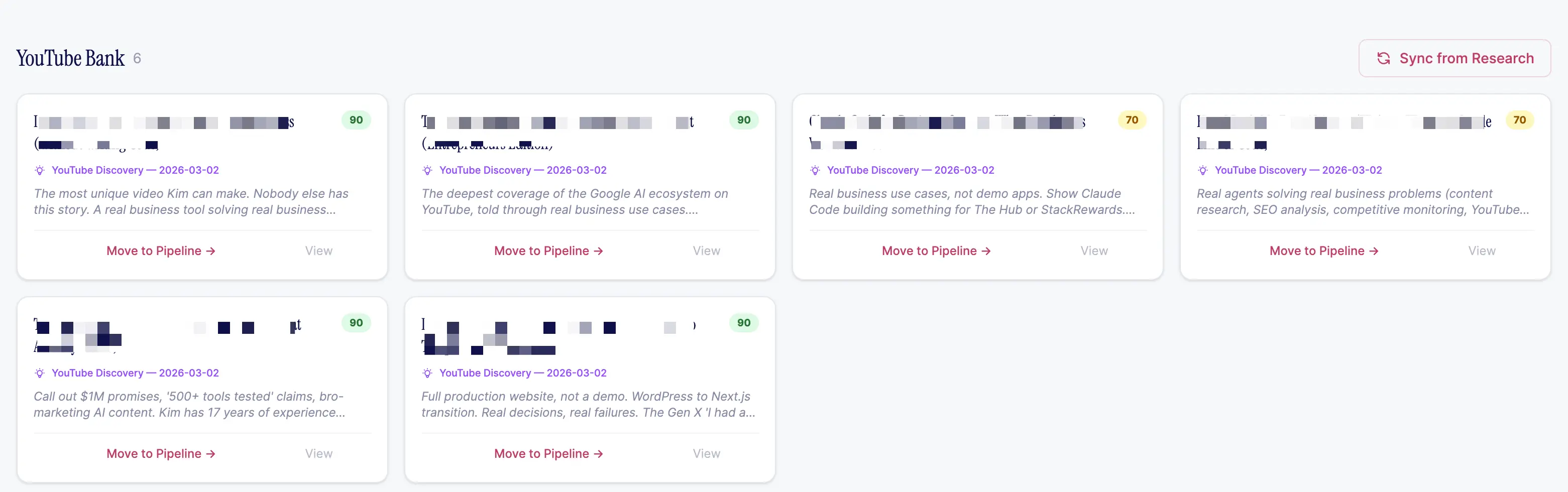
YouTube Bank interface showing six video opportunity cards with scores, descriptions, and Move to Pipeline buttons.
Here's where it gets really interesting — and where this stops being about research and starts being about workflow.
I built the research agent to output JSON files. Those files get read by my Hub — the Next.js app I've been building through vibe coding to manage my whole operation. And on the YouTube Pipeline page, I added something new: a YouTube Bank.
The YouTube Bank works like this:
I run a discovery or topic research from the command line
The agent generates a report with ranked video opportunities
I open my Hub, click "Sync from Research," and the high-opportunity ideas automatically populate the bank
Each card shows the title, opportunity score, differentiation angle, and where it came from
When I'm ready to commit to a video, I click "Move to Pipeline," and it drops into my Ideation column with all the research context pre-loaded
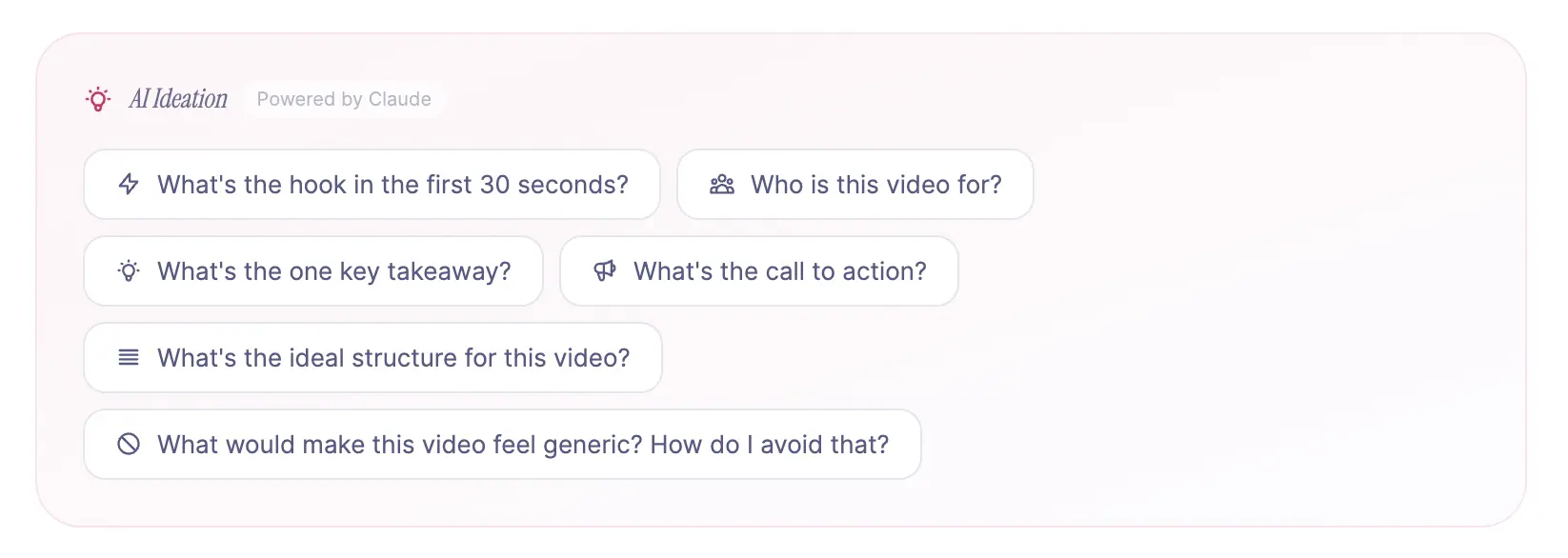
And then... this is the part that made me actually laugh out loud (because I was so excited) when I open the video detail modal, there's now an AI Ideation section. Six prompts powered by Claude that know my video context:
"What's the hook in the first 30 seconds?" "Who is this video for?" "What's the one key takeaway?"
AI Ideation interface powered by Claude with six context-aware prompt buttons for video planning and differentiation.
Click one. Claude reads the video title, the research data, the differentiation angle, and my existing planning notes — and generates a specific, actionable answer. Not generic advice. Specific to this video, this angle, this audience.
After I've worked through a few prompts, I hit "Generate Script Brief," and the whole thing compiles into a formatted prompt I can paste into Claude Desktop for full script generation.
I went from "staring at an empty YouTube pipeline" to "here are 9 ranked video opportunities with competitive data, engagement ceilings, and AI-generated ideation notes" in about two hours.
What This Is Really About (It's Not The Tech)
I want to be honest about something because I think it matters more than the tools.
I didn't build this because I love coding. I mean, I do... the vibe coding thing has genuinely become fun in a way I never expected. But that's not the point.
I built this because I was stuck. I had a YouTube channel with 30 videos and no strategy beyond "record what feels interesting." I've started working with a YouTube team (they're great)- but still wanted to go deeper and do some longer-form tutorials.
Every time I sat down to plan content, I was working from the same limited perspective — my own experience, my own assumptions, my own gut feelings about what would work.
The research agent didn't give me creativity. What it gave me was context. Real data about what the landscape actually looks like, where the gaps actually are, and what my actual competitive advantages are.
And you know what? The data confirmed what I suspected but couldn't prove: my positioning is genuinely unique on YouTube. There's nobody doing what I'm doing, the way I'm doing it, for the audience I serve. That's not ego talking... that's the data.
But I wouldn't have known that with confidence unless I'd looked.
And I wouldn't have looked unless I'd built the tool to do it. 😉
The Part Where I Tell You What Happened Next
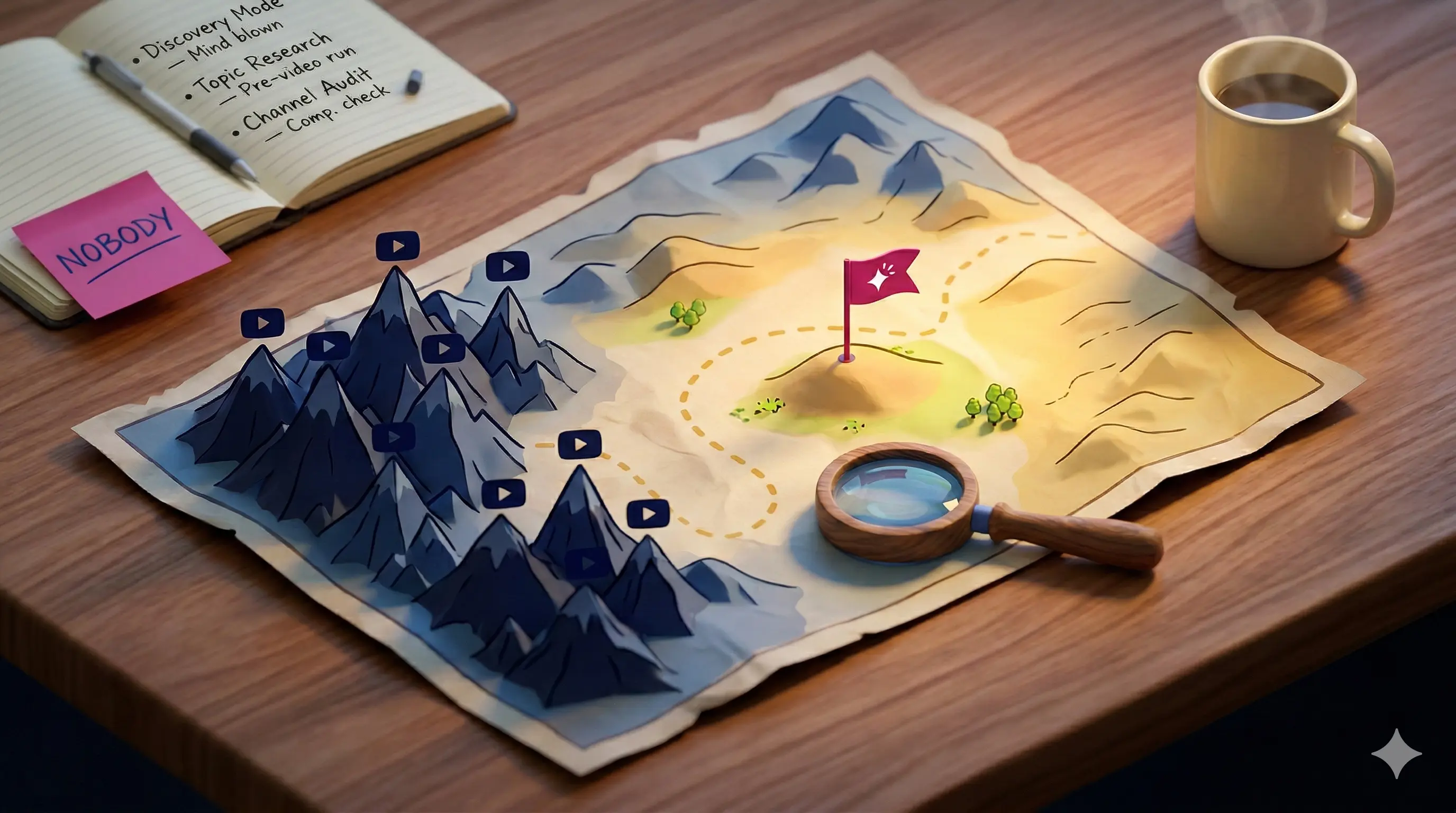
D isometric map of YouTube landscape — crowded mountains with play buttons and a sunlit open valley with a fuchsia flag planted.
The Discovery Report ranked 9 video opportunities. The top one — with HIGH readiness and a "THIS WEEK" timing flag — was something I'd already been thinking about. But now I had data behind it: 1M+ YouTube results in the category, a view ceiling of 353K, and wide-open whitespace for my angle.
The second and third picks were just as on-point. The agent even generated a content calendar for the next three months.
I moved two ideas to my pipeline, ran the AI ideation prompts, and I now have more structured planning notes for those two videos than I've ever had for any video I've made. And I did it in an evening.
Here's the thing — in the first post I wrote about building research agents, I said the agents are only as good as the context you give them. That's still true. But tonight I learned something else: the context you give yourself about your own competitive position changes how you show up.
I'm not guessing anymore.
Stay curious, Kim
Kim Doyal
Kim Doyal is a digital marketing strategist and AI builder with 18 years of online business experience. She is the founder of AI Spark Studios and SPARK Lab, and the creator of The Hub — a custom 33-agent AI operating system that runs her entire business. She has also built kimdoyal.com, StackRewards, and multiple AI tools and agents using vibe coding, a natural language approach to building software without a traditional development background.