HOME/BLOG/CONTENT WITH BLINDERS ON... BUILT FOR FREEDOM: PART 02
Content Creation
Content with Blinders On... Built for Freedom: Part 02
How AI lets me ignore everything else and create better content because of it
April 28, 2026|5 min read
QUICK ANSWER
An AI content strategy with blinders on means using AI to handle the noise; research synthesis, trend tracking, content distribution, AEO scoring... so your creative energy stays protected for the work that actually requires your voice. Instead of reacting to every model drop, platform change, and content trend, you build a focused system: publish deep on fewer platforms, automate everything else, and let AI protect your attention, not just save your time.
I'm no stranger to name brands. Growing up in the 80s, GenX happily walked around in our Guess jeans and Gap sweatshirts, serving as free billboards for brands that were already making a fortune off us. We didn't just tolerate it... We thought it was cool. We paid more to advertise for them. 🙄
Unfortunately, nothing has changed.
I recently saw that Target is doing another influencer collab drop, and I have absolutely no idea who the influencer is, which honestly tells you everything you need to know about where I'm at in my life. We literally pay a premium for the same products just because a celebrity's name is on them. I don't know about you, but I'm ready for collabs to be a thing of the past. And newsflash, Target: it's not a collab... you're just paying someone to use their name and sell more stuff. You're a retailer... that's what you do. Now you can just charge more because [INSERT Celebrity, athlete, influencer, musician, etc.] signed off on the packaging.
And that exact dynamic, the one where we pay extra for a name we recognize instead of evaluating the thing on its own merits, has seeped into everything. Content creation jumped on the bandwagon years ago, and AI seems to be the latest and not-so-greatest version of this. Every week, there's a new model, a new tool, a new framework with someone's name attached to it, and you're supposed to drop everything and pay attention.
(I've been creating online since 2008; I've watched more than enough cycles of this.)
And if you're a solopreneur trying to build an AI content strategy that doesn't eat your life, this post is the filter I wish I'd had years ago.
The Noise Problem
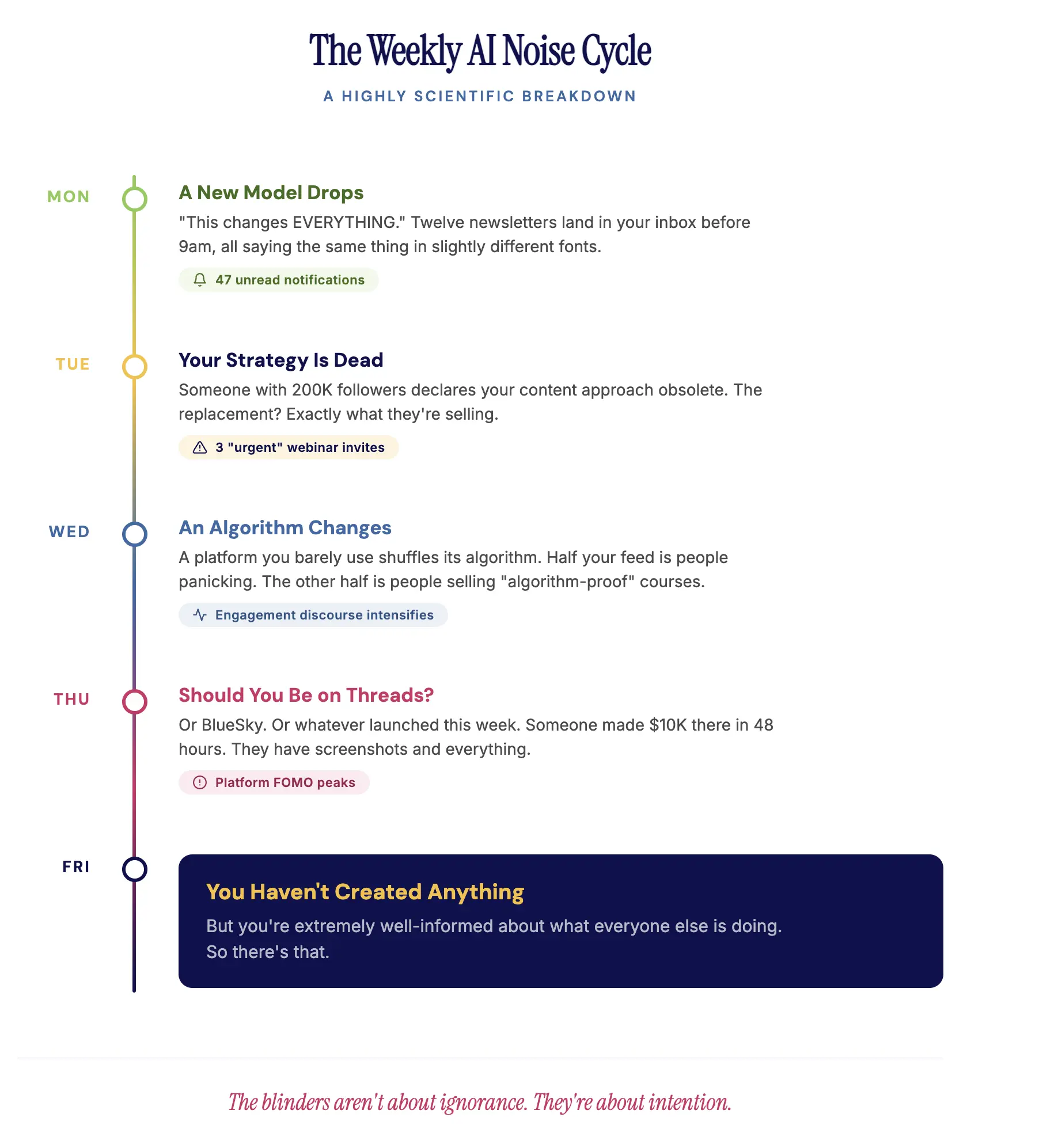
Here's what a typical week looks like if you're paying attention to everything.
Monday morning: A new AI model drops. Twelve newsletters hit your inbox before 9 am, all delivering the same breathless take in slightly different fonts. "This changes EVERYTHING." Does it? Does it really? Maybe. But you won't know for at least three months, and by then there will have been four more model drops that also "changed everything."
(Meanwhile, you spent half of last week going down the same rabbit hole with the previous model drop and quietly abandoned the AI system you were building because, if we're being honest, you weren't even using it yet.)
Tuesday: Someone with 200K followers declares your content strategy obsolete. The replacement happens to be exactly what they're selling, which is a coincidence I'm sure we're all meant to overlook.
(Also, remember that $2,000 course you bought three months ago? The one you and your friend swore you'd finish before buying anything else? How's that pact going?)
Wednesday: A platform you barely use shuffles its algorithm, and half your feed is people panicking while the other half is people selling "algorithm-proof" courses. Both groups are performing for each other, not actually teaching anything.
(You've lived through every single one of Google's algorithm updates, and you're still standing. Patience, young Jedi. You've literally survived all of them.)
Thursday: You're wondering if you should be on Threads. Or BlueSky. Or whatever launched this week. Someone claims they made $10K there in 48 hours, and they have the screenshots to prove it (because screenshots have never been misleading, obviously).
(You've been doing this long enough to know that the screenshots never tell the whole story. You knew that before AI, and you know it now.)
Friday: You haven't created a single thing. But you're extremely well-informed about what everyone else is doing. So there's that.
(Here's what I want you to hear right now: trust yourself. You've made it this far in life and in business without someone handing you a blueprint for every single decision. You have a clear path and know what you're doing. The noise is loud, but it's not smarter than you.)
The Weekly AI Noise Cycle... a highly scientific breakdown of how the noise eats your week.
I want to be clear about something: I'm not uninformed. I'm aware of the overhyped tools, the breathless announcements, and the new platforms. I just don't let any of it run my calendar anymore. There's a massive difference between being informed and being reactive, and removing the reactivity has been one of the most helpful decisions I've made in the last year.
Racehorses wear blinders not because they can't handle seeing other horses. They wear them because the race ahead requires their full attention. That's not weakness or ignorance....that's strategy.
What Did I Actually Stop Doing?
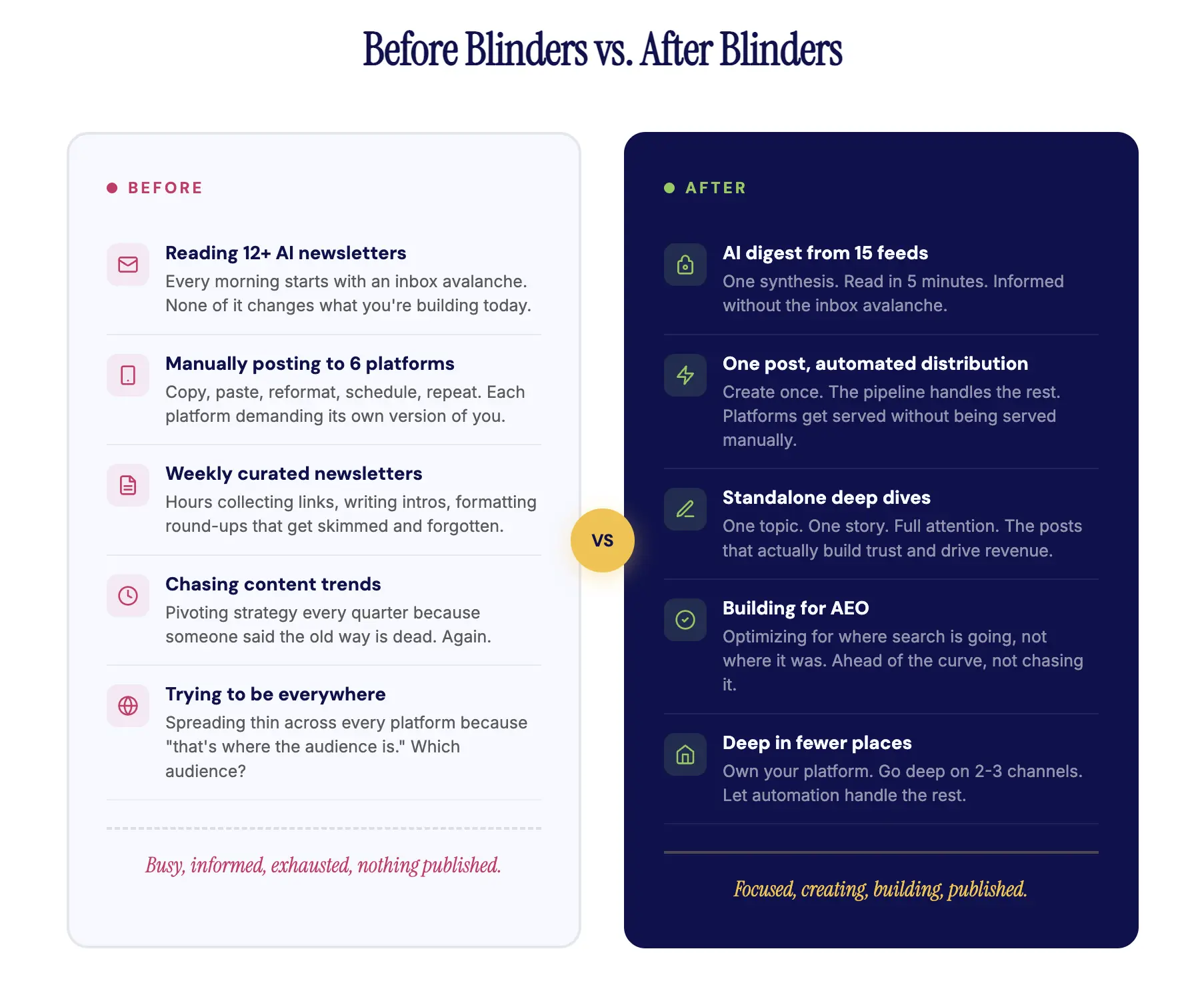
I stopped reading every AI newsletter, stopped creating manually for platforms I don't enjoy, retired my weekly curated newsletter after 250+ issues, stopped chasing content trends, and stopped trying to be everywhere. Here's what each of those decisions actually looked like.
I want to get specific here, because vague advice about "focusing more" is the kind of thing that sounds good in a caption and changes absolutely nothing in your actual workday. So here's what I actually cut.
I stopped reading every AI newsletter. I kept three or four that I genuinely trust and look forward to opening, and I'm building an automated AI Intelligence Digest using n8n that pulls from 15+ RSS feeds and delivers a single synthesized summary instead of the 47 individual articles cluttering my mornings. I read a synthesis now, not an avalanche.
I stopped creating manually for platforms I don't enjoy. I didn't abandon those platforms (well, at least not permanently)... I automated them. The content still goes out to LinkedIn, Instagram, and everywhere else through the automation pipeline I wrote about in "I Don't Need a Second Brain, I Need a Second Pair of Hands." The platforms get served without me serving them manually, and I'm testing whether automation plus occasional engagement is enough. It's too early to tell either way, but I'll do an update in a few months.
I stopped the weekly SPARK newsletter. This one was hard because I'd been doing it for 250+ issues, and it had become part of my identity in a way that made it difficult to see clearly. But the data was undeniable, and I'll dig into that more in the next section. The curated weekly format simply wasn't doing what standalone posts were doing, so I let it go entirely. No weekly, no monthly recap (which I thought I would do, and I might, but not until I know the right format), no version of it at all. It's done.
I stopped chasing content trends. I've never been much of a content or SEO trend chaser... I've always done the SEO fundamentals, and that's served me well. But I was definitely susceptible to the "you should be doing X this quarter" pressure that shows up every few months in every entrepreneurial circle. I stopped following that pressure and started building for AEO instead (while continuing SEO best practices), which is AI engine optimization, the practice of making your content visible to AI engines, not just Google. Most people haven't even heard of this yet, and that's exactly why it matters.
I stopped trying to be everywhere. Although honestly, I stopped trying to be everywhere years ago. What changed recently is that automation gave me a third option between "be present on a platform" and "ignore it entirely." I chose automation over absence, which is its own kind of blinders decision... you're technically there, but you're not letting it consume your attention or your creative energy.
Before Blinders vs. After Blinders... same person, different filter
What I Doubled Down On
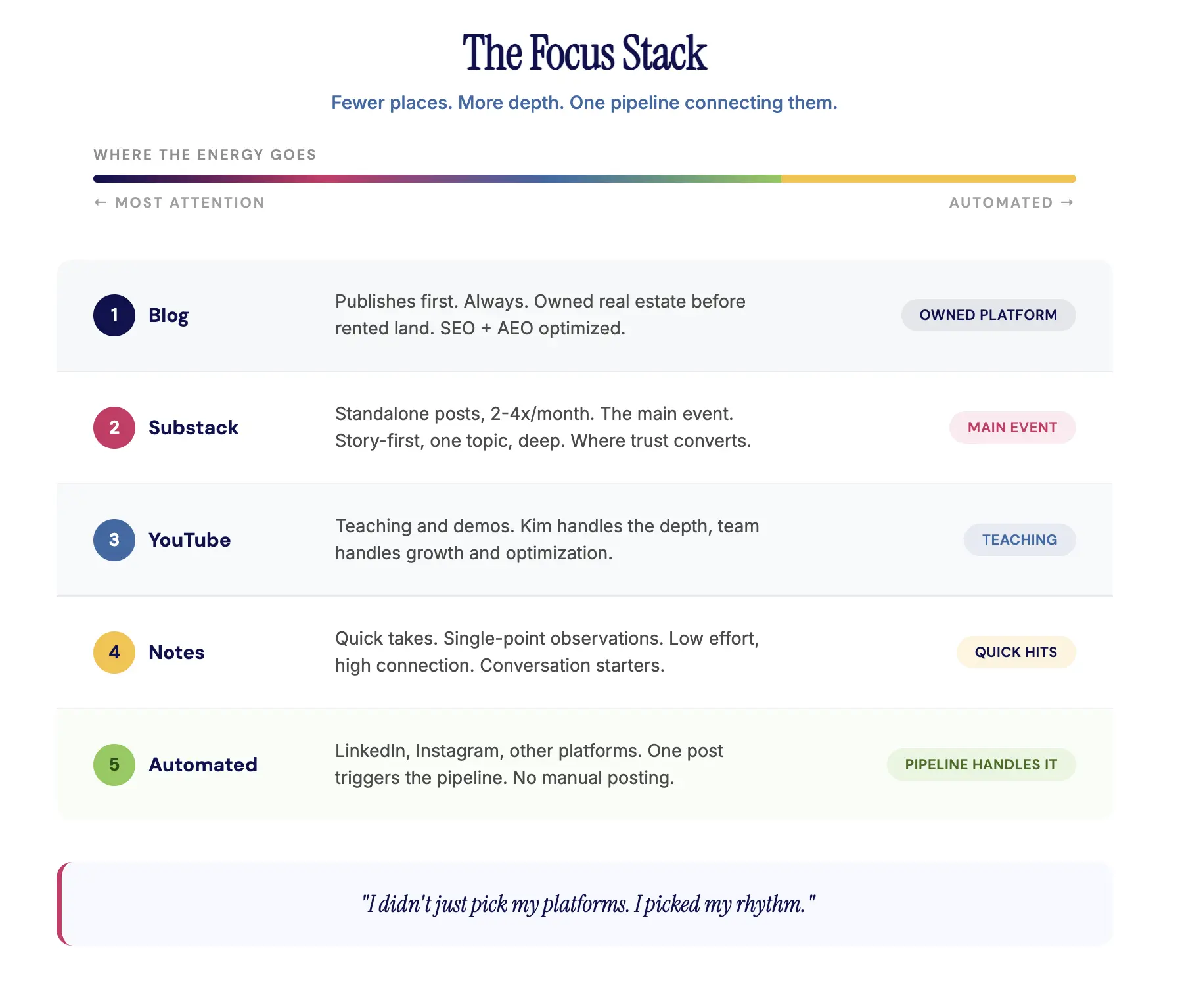
I focused my creative energy on five channels with clear roles: my blog (publishes first, always), standalone Substack posts twice a week, YouTube for reaching my ideal customer, Substack Notes for quick takes, and automated distribution for everything else.
Blinders aren't just about subtraction...they're about addition with intention. Here's the focus stack I'm running right now.
My blog on kimdoyal.com publishes first, always. Owned real estate before rented land, and every post gets SEO and AEO optimized before it goes anywhere else. This is the home base, the foundation from which everything else extends.
Standalone Substack posts are the main event. I'm publishing twice a week right now, and each post is either a deep dive on a single topic or part of a strategic series (like this one). The content isn't random... It's directly based on the actual work I'm doing in my business. When I build something, I write about the build. When I make a strategic decision, I write about the decision. The writing and the work feed each other.
YouTube is where I get in front of my ideal customer. Some of that is teaching and demos, because those perform well and they're genuinely useful for the people I want to reach. But it's also conversations about my journey and the decisions behind what I'm building, so that my ideal customer avatar can see herself in the process and figure out how to apply it in her own business. I'm not trying to become a YouTuber... if the channel monetizes, great, but that's a bonus, not the objective. The objective is to reach the right people. Side note: I had a YouTube team for a bit, but they weren't getting any better results than I was, so for now, it's back to me. I paused for a minute to regroup and create a better strategy.
Substack Notes for quick takes. Low-effort, high-connection, single observations and reactions that start conversations without requiring a full post.
And then everything else runs through the automation pipeline. One post triggers the distribution system, and LinkedIn, Instagram, and whatever other platforms are in the rotation get content without me opening a single app.
I didn't just pick my platforms. I picked my rhythm.
And I think that's one of the most underappreciated decisions in an AI content strategy right now, because it's not just about where you show up. It's about how often, in what format, and with what level of your actual creative energy you're willing to commit. Sandra (my customer avatar... and I know there's a Sandra reading this right now) has been told her entire online business career to "be everywhere," to "meet your audience where they are." And the result is that you're stretched across six platforms, doing a mediocre job on all of them, wondering why none of it feels like it's working.
It's not working because you're not going deep anywhere. You're going wide everywhere... And wide is exhausting.
The Focus Stack: fewer places, more depth, one pipeline connecting them.
What Format Shift Changed Everything?
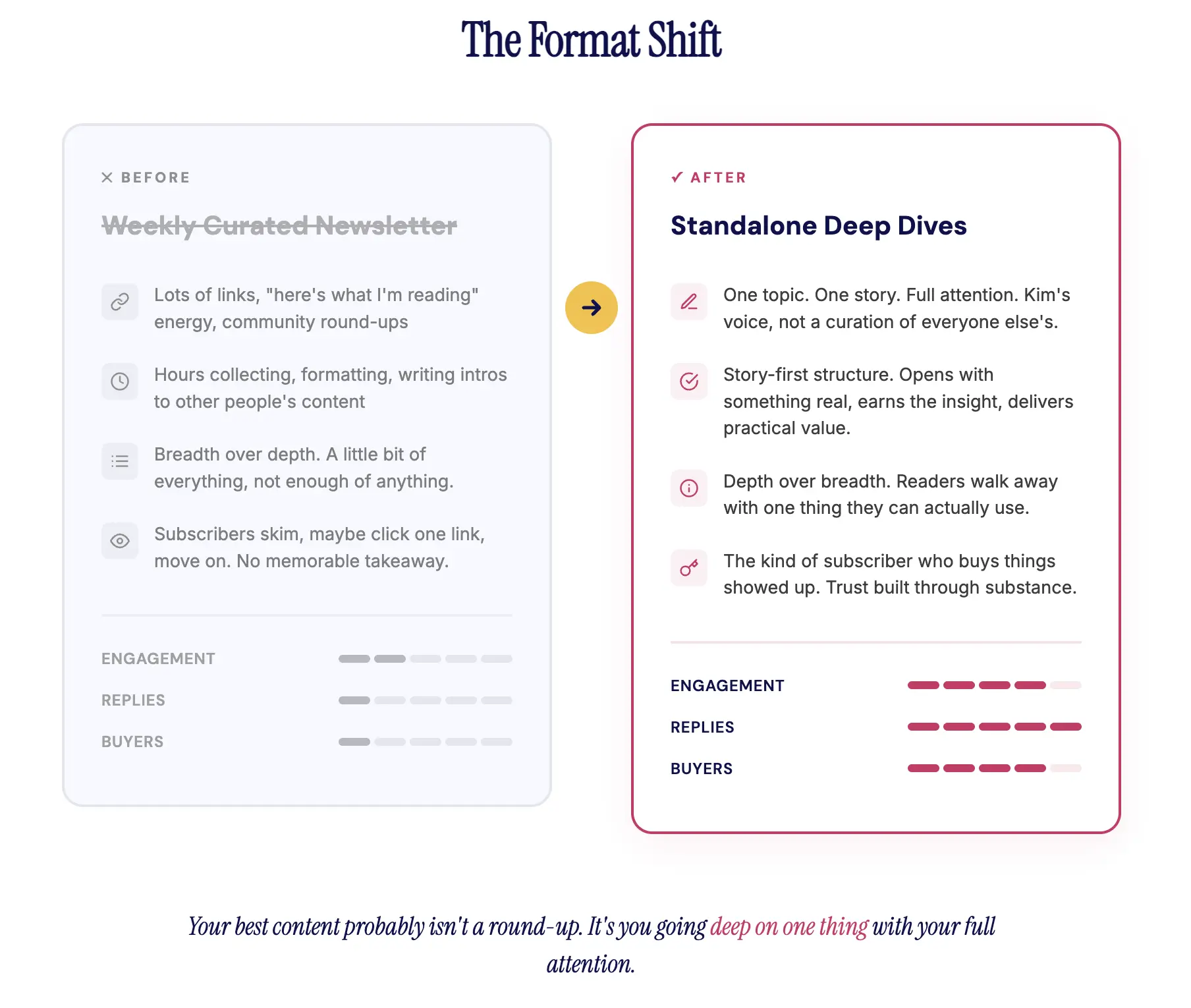
Retiring my weekly curated SPARK newsletter after 250+ issues and switching to standalone deep dives. The standalone posts got more engagement, more meaningful replies, and attracted subscribers who actually buy.
This deserves its own section because it was a specific, data-backed decision that changed the entire trajectory of my content, and I think there's a lesson in it for anyone who's still clinging to a format that used to work (it also turned me into a bit of a data fiend... AI makes it so much easier for my visual-thinking brain to digest data instead of looking at spreadsheets!).
For 250+ issues, I published a weekly curated SPARK newsletter. It was full of links and resources, had that "here's what I'm reading and thinking about" energy, and included community round-ups and recommendations. It was genuinely good content, and people seemed to really enjoy it... It worked for a long time (originally known as #FtheHUSTLE). But it worked until it didn't, and when I started publishing standalone opinion pieces alongside the newsletter, the difference became impossible to ignore.
The standalone posts got significantly more engagement and, more importantly, they got more meaningful replies. The kind of responses where someone tells you how a particular idea changed the way they're thinking about their business, or asks a follow-up question that turns into a real conversation. And the part that really got my attention was that the subscribers who showed up through standalone posts were buyers. People who connected with the depth of one idea and wanted more of it, not people who skimmed a list of links and moved on (no judgment, we all have things we skim and move on from).
So I made the call and retired the weekly curated format. Standalone deep dives and strategic series are the format now, and I'm publishing at a pace that would have seemed unsustainable a year ago but feels completely natural because every post comes directly from work I'm already doing (and is a far smoother workflow for me than curating).
The Format Shift: from curated round-ups to standalone deep dives, and what happened to engagement.
I want to be honest about something here, though.
I'm still refining this... constantly.
The format isn't "done" in some final, polished sense. I'm still tightening the structure of every post, still improving the SEO elements, still figuring out what makes a standalone piece land versus fall flat. I've been intentionally slow about launching SPARK Lab and updating my Substack navigation because I wanted to do it correctly this time. I've spent too much of my online career leaping before I look, and I love what I'm building right now so much that I want to be incredibly intentional about how it all comes together.
The lesson for you: your best content probably isn't a round-up. It's you going deep on one thing with your full attention, and then doing it again two days later.
How Does AI Protect Your Attention (Not Just Your Time)?
AI protects attention by handling the noise... research synthesis, trend tracking, distribution, scoring... so your creative energy stays available for the work that requires your actual voice. Saving time gives you more hours. Protecting attention gives you better hours, and those are not the same thing.
Here's the claim I want to make, and it's different from the one most people in the AI space are making right now.
AI doesn't just save time. It protects attention. (And let's be honest... most of us actively using AI daily are probably working more than we were before. Which I don't mind... It's a ton of fun).
Saving time gives you more hours... protecting attention gives you better hours. Those are fundamentally different, and I think the difference matters more than most people realize.
The AI Intelligence Digest I'm building with n8n is a perfect example of this distinction. Instead of reading 47 articles from 15 sources every week, I'll read one AI-generated synthesis that distills the signal and leaves the noise behind. That's not a time hack... that's an attention hack. My morning starts with signal instead of noise, and the creative energy I would have burned scanning headlines is available for the work that actually matters.
The same principle runs through everything I'm building right now. My research agents will run twice a month, so I don't have to manually track trends and developments. My AEO scoring system (named Astraea, the goddess of justice) analyzes every post before it goes live, so I can make decisions based on actual data rather than guesswork. The distribution automation sends content to every platform without me having to open a single app or remember which hashtags are trending in each one.
None of this is about speed, and that's the part I want you to really sit with. All of it is about protecting the creative energy I need for the work that can't be delegated... the standalone posts, the YouTube conversations, the builds themselves. The things that require my full attention and my actual voice can't be sent through a pipeline (and oddly enough, because of this system, I am "speedier" with my output, even though the intention wasn't speed).
If you take one thing from this entire post, let it be this: the question isn't "how can AI save me time?"
The question is, "What work is AI protecting my attention for?"
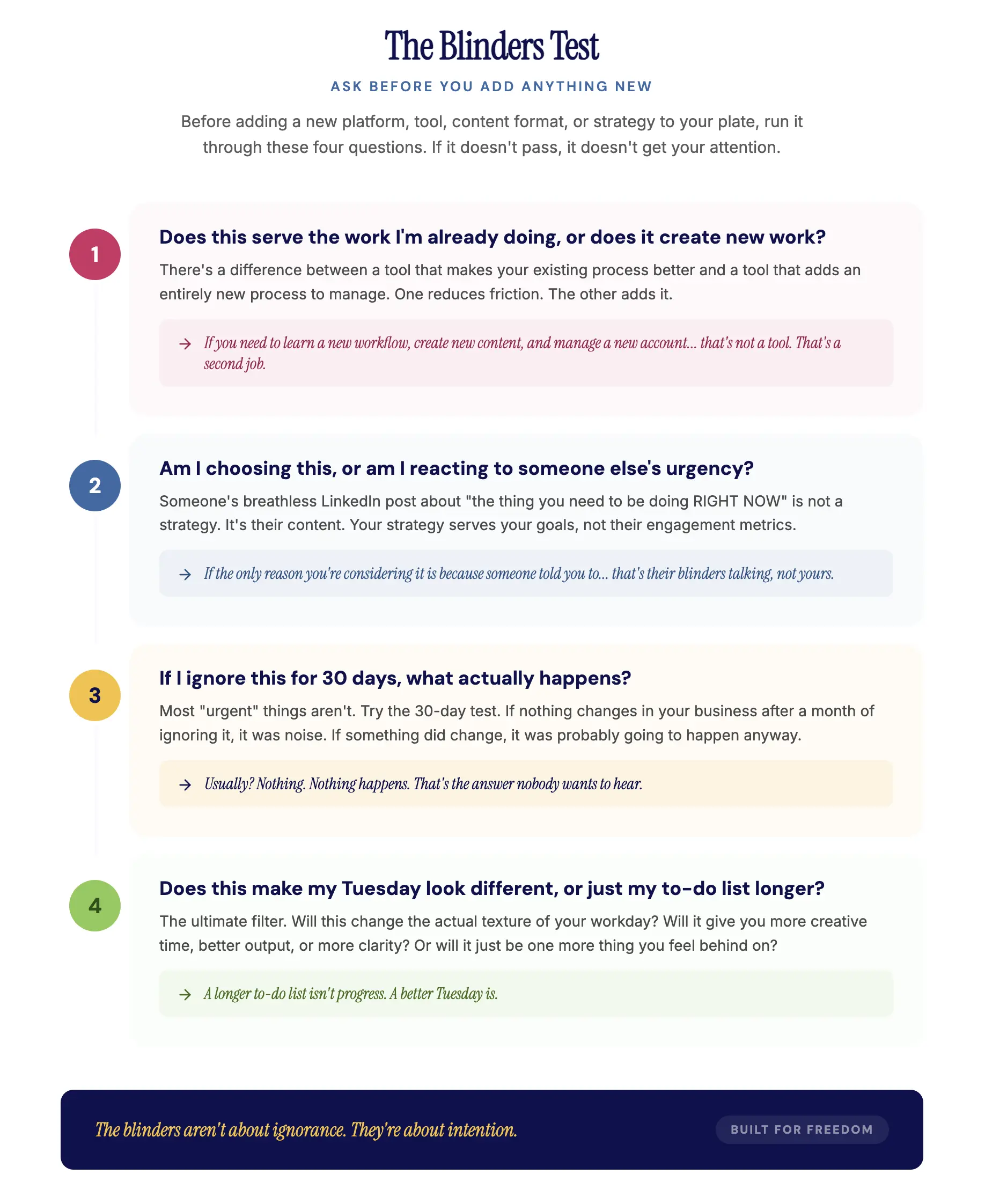
The Blinders Test
Before you add anything new to your content strategy, run it through four questions. If it doesn't pass all four, it doesn't get your attention.
One: Does this serve the work I'm already doing, or does it create new work? There's a real and important difference between a tool that reduces friction in your existing process and a tool that adds an entirely new process to manage. If you need to learn a new workflow, create new content, and manage a new account, that's not a tool. That's a second job.
Two: Am I choosing this, or am I reacting to someone else's urgency? Someone's breathless post about "the thing you NEED to be doing right now" is not your strategy. It's their content, designed to perform for their audience, and it has nothing to do with what you're building. Your strategy serves your goals, not their engagement metrics.
Three: If I ignore this for 30 days, what actually happens? Try the 30-day test on anything that feels urgent. Most "urgent" things aren't... they're just loud. If nothing changes in your business after a month of ignoring something, it was noise. (The answer is almost always "nothing happens," and that's the answer nobody wants to hear because it means the urgency was manufactured.)
Four: Does this make my Tuesday look different, or just my to-do list longer? This is the ultimate filter. Will this actually change the texture of your workday, give you more creative time, and produce better output? Or will it just be one more thing you feel behind on? A longer to-do list isn't progress. A better Tuesday is.
The Blinders Test: four questions to ask before you add anything new to your plate.
The Content Blinders Audit
A copy-paste prompt to audit your content ecosystem and figure out what deserves your attention... and what doesn't.
I want you to run a Content Blinders Audit on my current content ecosystem. The goal is to help me figure out what I should stop doing, where I should double down, whether there's a format shift opportunity I'm missing, and where AI could be protecting my attention rather than just saving my time.
Before you give me any recommendations, I need you to interview me first. Ask me the following questions ONE AT A TIME (wait for my answer before moving to the next question). Don't rush through them, and don't start analyzing until you have all my answers.
INTERVIEW QUESTIONS:
1. What platforms are you currently active on? List every platform where you're creating or posting content, even if it's inconsistent. Include your website/blog, email list, social platforms, YouTube, podcast, community platforms... everything.
2. For each platform you listed, how are you showing up? Are you creating original content for it, repurposing content from elsewhere, automating it, or just occasionally checking in? Be honest about the difference between "I post there" and "I actively create for that platform."
3. What's your primary content format right now? (Examples: weekly newsletter, blog posts, short-form video, long-form video, social posts, podcast episodes, courses, etc.) How often are you publishing in that format?
4. What content activities take the most time in your week? Walk me through what a typical content creation week looks like, from idea to published.
5. Which of your content activities actually generates results? Results can mean engagement, email signups, sales, meaningful conversations, inbound leads, or whatever metric matters to your business. Be specific about what's working and what you're doing out of habit or obligation.
6. What content activities do you dread or procrastinate on? These are the things that feel like a chore every time, even if you think you "should" be doing them.
7. Are you currently using any AI tools in your content workflow? If so, what for? If not, what's holding you back?
8. What does your ideal workday look like when it comes to content? Not what you think it should look like. What would actually make you excited to sit down and create?
---
After you have all my answers, deliver the following four outputs. Be direct and specific. Don't hedge with "it depends" or "you might consider." Tell me what you see.
OUTPUT 1: THE STOP LIST
Based on my answers, identify the content activities I should stop doing, automate, or dramatically reduce. For each one, explain why it's not earning its place in my week and what would happen if I dropped it for 30 days. Be honest, even if it's something I seem attached to.
OUTPUT 2: THE DOUBLE DOWN RECOMMENDATION
Identify the 1-2 content activities in which I should invest more of my creative energy. These should be the activities where I'm already seeing results, where I show genuine enthusiasm, or where there's clear untapped potential. Explain what "doubling down" would actually look like in practice, not just "do more of it."
OUTPUT 3: THE FORMAT SHIFT OPPORTUNITY
Look at my current primary format and tell me honestly: is it the best format for what I'm trying to accomplish? Is there a format shift that could get me better results with the same or less effort? Consider whether I'm doing round-ups when I should be doing deep dives, or whether I'm creating long-form content when short-form would serve me better, or whether I'm spread across too many formats when I should be mastering one. Give me a specific recommendation, not a menu of options.
OUTPUT 4: THE AI ATTENTION AUDIT
Based on my current workflow, identify where AI could protect my attention (not just save me time). There's an important distinction here: saving time gives you more hours, but protecting attention gives you better hours. Look for places where I'm burning creative energy on tasks that could be synthesized, automated, or delegated to AI, so that energy is available for the work that actually requires my voice and my full focus. Be specific about what tools or approaches would help, and be honest about what's not worth automating.
---
IMPORTANT GUIDELINES:
- Be direct. I don't need you to validate everything I'm doing. I need you to tell me what's working and what isn't.
- Be specific. "Focus more on what works" is not helpful. "Stop posting original content to Instagram and redirect that energy to your weekly newsletter, which is generating 3x the engagement" is helpful.
- Consider the whole picture. Sometimes the thing I should stop doing is the thing that's technically working but costing me so much energy that it's undermining everything else.
- Don't recommend adding new platforms or tools unless I'm clearly missing an obvious opportunity. The default recommendation should be subtraction, not addition.
- Frame AI recommendations around attention protection, not productivity optimization. The goal is better creative hours, not more output.
How to Use This
Copy the entire prompt below and paste it into Claude or ChatGPT. It will walk you through a structured audit of your current content strategy and deliver four actionable outputs. Answer the questions honestly (not aspirationally), and you'll get recommendations based on what you're actually doing, not what you think you should be doing.
What if I'm just starting out and don't have a content strategy yet?
Even better, honestly. You get to build with blinders from the start instead of having to subtract later. Pick one primary platform where you'll go deep, automate everything else from day one, and resist the pressure to "be everywhere" before you've figured out what you actually want to say.
Does this content strategy work if I'm not using AI tools?
The blinders test works regardless of your tech stack. The AI pieces, like automated distribution, research synthesis, and AEO scoring, amplify the strategy and make it easier to maintain, but the core principle is the same whether you're using AI or not: fewer platforms, more depth, protect your creative energy for the work that matters.
What if I've already built an audience on a platform I want to stop using?
You don't have to abandon it. I automated the platforms I don't enjoy instead of deleting them entirely, and the content still goes out without me burning creative energy to create for them manually. Automation is the middle ground between presence and absence, and it's a perfectly valid blinders decision.
How do I know if my content format needs to change?
Look at what's generating meaningful responses versus what's getting skimmed. If your most engaging content is the stuff where you go deep on one idea with your full voice, and your least engaging content is curated round-ups or multi-topic newsletters, you might be sitting on the same format shift I made. The data will tell you if you're willing to look at it honestly.
The blinders aren't about ignorance. They're about intention.
In Part 1 of this series, I built the engine... the Substack growth system, the automation, the infrastructure that runs without me performing for platforms. This post is about what goes into that engine, because you can automate chaos, and it's still chaos. The filter matters as much as the machine.
Freedom doesn't come from doing more things faster. It comes from doing fewer things with your full attention, getting better results, and letting the rest go without guilt or second-guessing.
If Kim in 2015 could hear me say that, she would not believe it. She was hustling on seven platforms, reading every blog post, attending every webinar, and wondering why she always felt behind even though she was doing everything "right." The blinders would have terrified her back then. But the blinders are just the operational version of something it took me years to learn: trust yourself.
You already know what matters... You already know what's noise. The blinders are the AI content strategy... AI is the infrastructure, and freedom is the result.
Kim Doyal is a digital marketing strategist and AI builder with 18 years of online business experience. She is the founder of AI Spark Studios and SPARK Lab, and the creator of The Hub — a custom 33-agent AI operating system that runs her entire business. She has also built kimdoyal.com, StackRewards, and multiple AI tools and agents using vibe coding, a natural language approach to building software without a traditional development background.